
Can run flat tyres be repaired
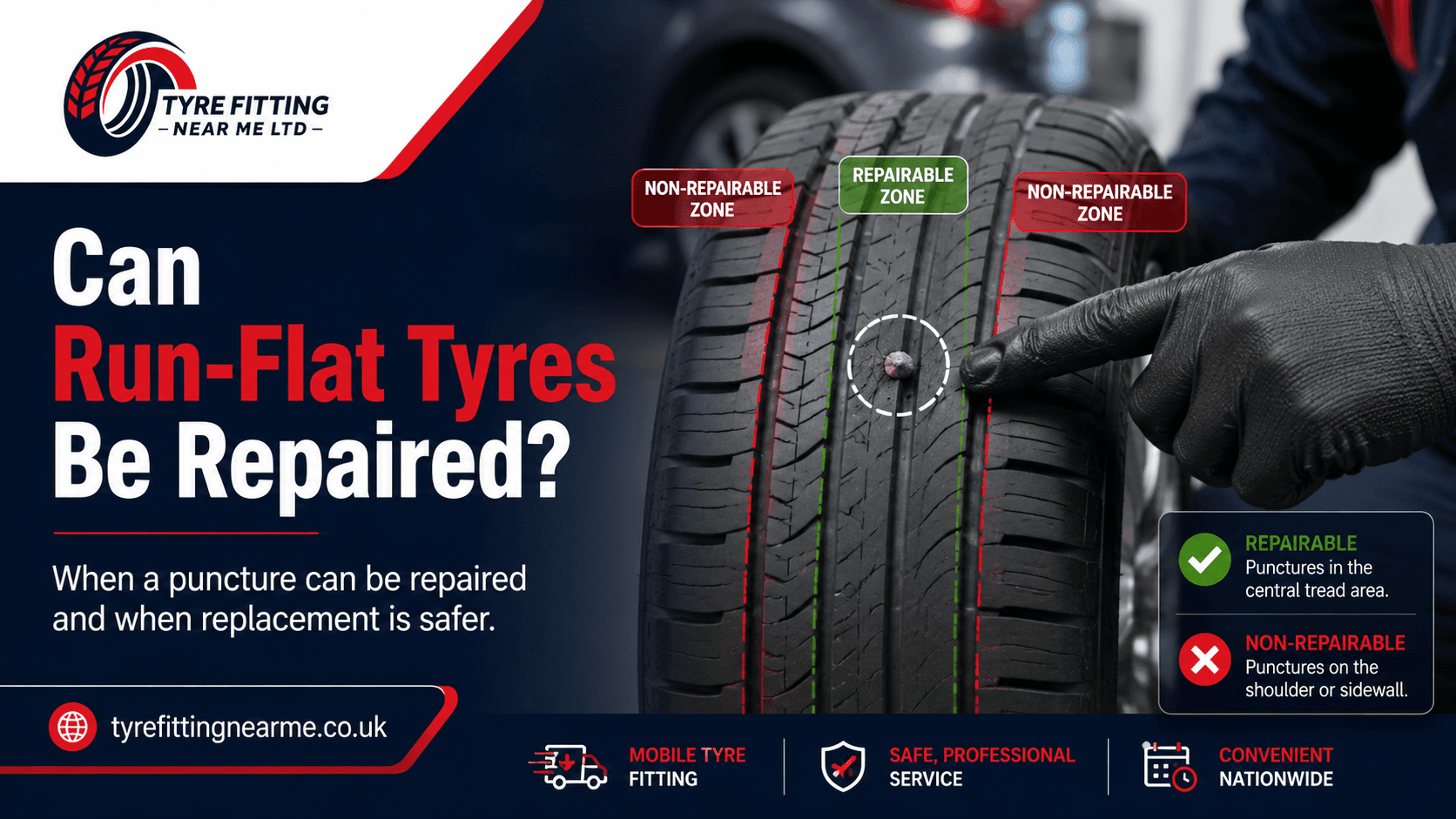
Run-flat tyres can sometimes be repaired after a puncture, but only when the damage sits within the central tread area, the tyre has not been driven for a damaging distance at low pressure, the manufacturer permits repair, and an internal inspection finds no structural damage. Punctures affecting the shoulder, reinforced sidewall, bead, cords, or inner liner normally require tyre replacement.
This guide explains how tyre technicians decide whether a punctured run-flat tyre can be repaired safely. The assessment covers puncture location, damage size, pressure-loss history, manufacturer restrictions, internal tyre condition, and previous repairs. Drivers who notice a puncture can arrange a professional mobile tyre repair assessment instead of continuing to drive and risking additional structural damage.
Can run-flat tyres be repaired after a puncture?
Run-flat tyres can be repaired in limited circumstances when the puncture remains inside the approved tread repair zone and the casing passes a complete internal inspection. The technician must also confirm that low-pressure driving has not damaged the reinforced sidewall or inner liner. Shoulder punctures, sidewall damage, bead damage, exposed cords, heat marks, and uncertain pressure history usually make replacement necessary.
What conditions make a run-flat tyre repairable?
A potentially repairable run-flat tyre normally has one small puncture within the central tread area. The tyre must retain a sound internal structure, adequate tread depth, an acceptable repair history, and manufacturer approval for the proposed repair method.
The puncture sits inside the approved central tread repair zone.
The puncture remains within the applicable diameter limit.
The tyre has not covered a substantial distance at low or zero pressure.
The reinforced sidewall shows no crushing, cracking, abrasion, or heat damage.
The inner liner remains smooth, intact, and free from rubber debris.
The cords, bead area, and casing retain their original structure.
The tyre manufacturer permits repair for that model.
The tyre has sufficient tread depth and usable service life remaining.
A visible nail or screw cannot prove that these conditions have been met. A technician must remove the tyre from the wheel before approving any permanent repair.
What conditions mean the tyre must be replaced?
A run-flat tyre needs replacement when damage affects an area that carries significant load or flex. Replacement also becomes necessary when the tyre contains evidence of overheating, internal abrasion, cord damage, previous structural failure, or prolonged underinflated driving.
Tyre condition Likely outcome Reason Small central tread puncture Inspection required The puncture may remain inside the approved repair zone. Shoulder puncture Replacement normally required The shoulder experiences high levels of movement, load, and heat. Sidewall puncture Replacement required The reinforced sidewall supports the vehicle after pressure loss. Inner-liner damage Replacement required The tyre may no longer retain pressure or structural strength safely. Exposed or damaged cords Replacement required The load-bearing casing has been compromised. Unknown low-pressure distance Replacement often recommended The technician cannot confirm how much heat or flex damage occurred.
Drivers can compare these outcomes with the broader examples in the repairable versus non-repairable punctures guide.
What makes run-flat tyres different from standard tyres?
Run-flat tyres use reinforced sidewalls or another load-support system to keep the vehicle moving temporarily after pressure loss. A standard tyre normally collapses as pressure falls, while a run-flat tyre can retain enough shape to support limited emergency travel. The stronger construction improves short-term mobility, but it can also conceal internal damage that cannot be identified through an external visual check.
How does a reinforced sidewall support the vehicle?
A reinforced sidewall contains additional structural material that carries part of the vehicle's weight after tyre pressure falls. The construction reduces immediate sidewall collapse and helps the driver reach a safer stopping point or tyre service location.
The support system experiences additional flex and heat while the tyre runs underinflated. Excessive distance, speed, vehicle load, or low pressure can weaken the sidewall even when the tyre still looks normal from outside.
Why does TPMS matter on run-flat tyres?
A Tyre Pressure Monitoring System matters because drivers may not immediately feel pressure loss in a run-flat tyre. The reinforced sidewall can keep the vehicle relatively stable, which makes the dashboard warning an important indication that the tyre needs attention.
A driver should record the warning time, displayed pressure, distance travelled, approximate speed, vehicle load, and whether the tyre reached zero pressure. A technician can also inspect warning lights, sensors, and valve components through a professional TPMS diagnostic and sensor service.
When can a run-flat tyre puncture be repaired?
A run-flat puncture may qualify for repair when the injury remains within the central tread, the puncture size stays within professional repair limits, and the internal casing remains undamaged. The pressure-loss history must also show that the tyre was not driven far enough to create excessive heat or sidewall deformation. Manufacturer policy and technician judgement control the final decision.
Can a central tread puncture be repaired?
A central tread puncture represents the most likely repairable scenario. The central tread experiences less flex than the shoulder and sidewall, which allows an approved internal repair to restore the air-retention layer when the surrounding structure remains sound.
The technician must still remove the tyre and inspect the complete puncture path. A screw that appears centred externally may have entered at an angle and damaged an area outside the approved repair zone.
Repair criterion Required condition Inspection requirement Puncture position Central tread area The injury must remain away from the shoulder and sidewall. Puncture size Within the permitted repair limit The technician measures the completed injury after removing the object. Pressure history No damaging low-pressure journey The driver provides warning, distance, speed, and load information. Internal condition No structural deterioration The technician checks the liner, cords, bead, and sidewall. Manufacturer policy Repair permitted The tyre brand and model guidance must allow the repair.
Why should the tyre receive a health check before repair?
A complete tyre assessment identifies issues beyond the visible puncture. The technician should inspect tread depth, tyre age, wear pattern, valve condition, pressure retention, sidewall condition, previous repairs, and wheel damage before recommending repair.
A driver who remains uncertain about the tyre's general condition can request a free mobile tyre health check before committing to repair or replacement.
How does previous repair history affect eligibility?
Previous repairs affect eligibility because repeated punctures can weaken a limited area of the casing. Some manufacturers restrict run-flat tyres to one lifetime repair, while individual repairers may apply stricter policies when the previous repair location or method cannot be verified.
A previous repair near the new injury can make the area unsuitable.
Multiple punctures can reduce the available safe repair zone.
An external plug may conceal the true condition of the puncture channel.
An undocumented repair can prevent the technician from confirming compliance.
Low remaining tread depth can make replacement more economical.
When must a run-flat tyre be replaced instead of repaired?
A run-flat tyre must be replaced when the puncture reaches the shoulder, sidewall, bead, cords, or another structural area. Replacement also becomes the appropriate outcome when internal inspection shows heat rings, rubber debris, liner abrasion, cracking, or sidewall fatigue. Significant low-pressure driving creates additional uncertainty because the reinforced structure may have carried the vehicle's load while overheating.
Why are shoulder punctures normally unsuitable for repair?
The shoulder forms the transition between the tread and sidewall. That area changes shape continuously as the tyre rotates, corners, brakes, and supports the vehicle. A repair placed within the shoulder can experience movement that prevents it from maintaining a reliable seal and stable casing structure.
A puncture near the shoulder should not be judged by the position of the visible object alone. The internal puncture channel may extend beyond the central tread repair zone.
Why are sidewall punctures unsafe to repair?
The sidewall carries repeated flexing forces during every wheel rotation. Run-flat sidewalls also contain the reinforced structure that supports the vehicle after pressure loss. A puncture, cut, bulge, exposed cord, or abrasion in that area can weaken the component responsible for carrying the vehicle's load.
A patch cannot restore damaged sidewall cords or recreate the original reinforced construction. Replacement therefore becomes the appropriate safety outcome.
What internal damage signs require replacement?
Internal damage shows that the tyre has experienced forces beyond a normal tread puncture. A technician should reject repair when any evidence suggests that the liner, cords, bead, or reinforced sidewall has deteriorated.
Internal sign Possible cause Recommended decision Rough or wrinkled inner liner Extended underinflated driving Replace the tyre Loose rubber debris Internal sidewall breakdown Replace the tyre Heat ring or dark heat marking Excessive flex and temperature Replace the tyre Cracked internal rubber Structural fatigue or ageing Replace the tyre Visible or damaged cords Casing penetration or severe abrasion Replace the tyre Damaged bead Impact, poor removal, or wheel contact damage Replace the tyre
The complete puncture repair guide explains how location, tyre structure, and damage type affect standard and run-flat tyres.
How does driving after pressure loss affect repairability?
Driving after pressure loss affects repairability because the tyre generates additional heat and flex while operating without normal air support. Run-flat construction may allow temporary movement, but that capability does not guarantee that the tyre will remain repairable. Distance, pressure, speed, road conditions, vehicle weight, and tyre temperature all influence the amount of internal damage.
Does the advertised run-flat distance guarantee repairability?
An advertised emergency range does not guarantee repairability. The range describes limited mobility that may help the driver reach a safe location. The figure does not certify that the tyre will remain structurally suitable for permanent repair after completing that distance.
A tyre driven only a few miles can still become unrepairable when it reaches zero pressure, carries a heavy load, travels at excessive speed, or contains pre-existing damage. A tyre driven within an advertised distance must still undergo complete internal inspection.
What details should the driver record?
The driver should record as much information as possible after the TPMS warning. Accurate information helps the technician evaluate the amount of heat, load, and sidewall flex the tyre may have experienced.
Record when the TPMS warning first appeared.
Record the pressure shown by the vehicle or pressure gauge.
Record the distance travelled after the warning.
Record the highest speed reached after pressure loss.
Record the number of passengers and amount of luggage.
Record whether the vehicle was towing.
Record whether the tyre reached zero pressure.
Record whether the nail or screw remained inside the tread.
Record any vibration, pulling, noise, or handling change.
Should you continue driving on a punctured run-flat tyre?
A driver should avoid unnecessary travel after detecting pressure loss. Continued driving can convert a repairable tread puncture into an unrepairable tyre by increasing sidewall temperature and internal abrasion.
The driver should slow down, avoid abrupt steering or braking, follow the vehicle handbook, and stop in a safe location. The guide covering whether you can drive on a flat tyre explains the wider safety risks for conventional and run-flat tyres.
Can a run-flat tyre with a nail, screw, or slow puncture be repaired?
A run-flat tyre containing a nail, screw, or slow leak may be repairable when the injury remains inside the central tread and internal inspection finds no structural deterioration. The object type does not determine repairability by itself. Puncture location, channel angle, pressure history, damage size, previous repairs, and manufacturer policy provide the decisive evidence.
Can a nail in a run-flat tyre be repaired?
A nail puncture may qualify for repair when the nail enters the central tread and creates a small, clean injury. The technician must remove the tyre from the wheel, remove the nail, inspect the puncture channel, and confirm that no cords or internal components have been damaged.
A nail near the shoulder normally requires replacement because the injury may extend into an area that experiences significant flex.
Can a screw in a run-flat tyre be repaired?
A screw puncture may qualify under the same conditions as a nail puncture. Screws can produce wider or angled damage, so the technician must measure the actual injury rather than relying on the screw head's visible position.
The driver should leave the screw in place until inspection because removing it can increase the rate of pressure loss.
Can a slow puncture damage a run-flat tyre?
A slow puncture can damage a run-flat tyre when the driver continues using the vehicle at reduced pressure. Repeated journeys may generate sidewall heat and internal wear even when the tyre never appears completely flat.
Scenario Possible repair outcome Replacement becomes likely when Nail in central tread May be repairable after inspection Internal damage or prohibited repair history is found Screw in central tread May be repairable after inspection The puncture channel is too large or angled toward the shoulder Slow tread puncture May be repairable The tyre has been used repeatedly while underinflated Nail near the shoulder Normally not repairable The injury falls outside the approved repair zone Screw in the sidewall Not repairable The load-bearing sidewall structure has been penetrated
Drivers experiencing recurring pressure loss can review the slow puncture causes and warning signs guide.
Does the tyre manufacturer allow run-flat repairs?
The tyre manufacturer determines whether a particular run-flat model may receive a permanent puncture repair. Construction methods, reinforced components, repair limits, warranty conditions, and approved procedures vary between brands and product ranges. A repair permitted on one run-flat model may remain prohibited on another tyre with the same size and similar appearance.
What do manufacturer policies normally control?
Manufacturer policies can control the permitted repair area, maximum injury size, number of lifetime repairs, accepted repair method, low-pressure distance limits, and disqualifying internal conditions.
Whether the tyre model can receive any permanent repair.
Whether only central tread injuries may qualify.
How many repairs the tyre can receive during its service life.
Whether previous low-pressure driving automatically prohibits repair.
Which internal damage signs require replacement.
Whether an approved repair affects the tyre warranty.
Why should the exact tyre model be checked?
The exact tyre model matters because a brand may sell several run-flat technologies with different construction and repair restrictions. The sidewall markings identify the manufacturer, model, size, speed rating, load index, production date, and run-flat designation.
A technician should compare those details with the vehicle handbook and current manufacturer guidance before approving repair.
Why should the tyre size and specification match?
A replacement tyre must meet the vehicle's approved size, load index, speed rating, and construction requirements. Matching the tyre specification helps preserve braking performance, handling balance, stability-control operation, and axle consistency.
Drivers who cannot identify their sidewall markings can use the guide to finding the correct tyre size before requesting a replacement quote.
Can BMW run-flat tyres be repaired?
BMW run-flat tyres can sometimes be repaired, but the BMW badge does not provide automatic repair approval. The exact tyre manufacturer, tyre model, puncture location, internal condition, pressure history, previous repairs, and workshop policy determine the outcome. Many BMW vehicles use run-flat tyres as original equipment, which makes vehicle-specific replacement and axle-matching requirements particularly important.
Does BMW or the tyre manufacturer decide?
The tyre manufacturer normally defines whether the tyre construction permits repair. BMW provides vehicle-specific guidance covering tyre specifications, pressure monitoring, emergency driving, axle requirements, and replacement compatibility.
Decision source Main responsibility Practical limitation BMW handbook Vehicle operation and tyre specification The handbook may not cover every tyre manufacturer's repair policy. Tyre manufacturer Construction-specific repair restrictions Rules can vary between models and regional markets. BMW dealership Dealer, warranty, and replacement policy The dealer may apply a replacement-first approach. Independent tyre technician Physical inspection and repair-zone assessment The technician must still follow manufacturer restrictions.
Why might a BMW dealer recommend replacement?
A BMW dealer may recommend replacement when the pressure history cannot be confirmed, internal inspection equipment is unavailable, tyre warranty risk exists, or dealership policy does not support run-flat repairs.
The recommendation may also consider tread-depth differences across the axle, tyre availability, xDrive requirements, or the need to maintain matching tyre models.
Why might an independent tyre shop offer an inspection?
An independent tyre specialist may offer an inspection when the puncture appears to sit within the central tread. The technician can remove the tyre, inspect the internal structure, check the brand policy, and determine whether an approved repair remains possible.
A reliable answer should explain the specific condition behind the decision rather than relying on a general statement that every run-flat tyre can or cannot be repaired.
How does a technician inspect a run-flat tyre before repair?
A technician inspects a run-flat tyre by removing it from the wheel, locating the complete puncture channel, examining the inner liner, checking the reinforced sidewall, and confirming the manufacturer's repair policy. External observation alone cannot reveal heat damage, internal abrasion, cord deterioration, bead damage, or rubber breakdown caused by underinflated driving.
Why must the tyre be removed from the wheel?
Wheel removal gives the technician access to the complete internal surface. A visible nail, screw, or tread mark cannot show whether the inner liner contains rough areas, heat rings, cracks, debris, exposed cords, or sidewall damage.
The tyre must also be removed before a permanent internal repair can be prepared and installed correctly.
What inspection sequence should the technician follow?
Confirm the tyre brand, model, size, age, and run-flat marking.
Ask the driver about the TPMS warning and pressure-loss history.
Inspect the tread, shoulder, sidewall, valve, and wheel externally.
Remove the wheel from the vehicle.
Deflate and remove the tyre from the wheel rim.
Locate the puncture from both the external and internal surfaces.
Confirm whether the puncture sits within the approved tread zone.
Inspect the liner for roughness, cracks, heat marks, and debris.
Inspect the sidewall support structure, cords, bead, and casing.
Check for previous repairs and nearby damage.
Review manufacturer and workshop repair restrictions.
Approve an internal repair or recommend replacement.
What happens when the locking wheel nut key is missing?
A missing locking wheel nut key can prevent the technician from removing the wheel for inspection. Damaged locking nuts, rounded key patterns, and lost adapters may require specialist removal before the tyre can be assessed or replaced.
Drivers facing this problem can arrange an on-site locking wheel nut removal service.
What should the driver prepare before the appointment?
The driver should provide the vehicle registration, tyre size, current location, locking wheel nut key, puncture details, TPMS information, and any known repair history. Clear access around the affected wheel also helps the technician complete the inspection efficiently.
The mobile tyre fitting preparation checklist explains what to have ready before the technician arrives.
How much does run-flat tyre repair cost compared with replacement?
Run-flat tyre repair normally costs less than replacement when the tyre passes every safety check. The repair price may include callout, tyre removal, internal inspection, approved repair material, refitting, pressure testing, and balancing. Replacement includes the cost of a new run-flat tyre and may also include fitting, valve service, TPMS work, balancing, disposal, and emergency attendance.
What costs can be included in a run-flat repair?
Cost item Repair route Replacement route Mobile callout May apply May apply Internal inspection Required before approval Used to confirm replacement need Tyre removal Required Required Repair material Required after approval Not applicable New run-flat tyre Not required Main replacement cost Valve or TPMS work May be required May be required Wheel balancing Often completed after refitting Completed after replacement Old tyre disposal Not normally applicable Normally included or charged separately
Why does wheel balancing matter after tyre work?
Removing and refitting a tyre can change the wheel and tyre assembly's balance. An imbalanced wheel can create steering vibration, uneven tyre wear, reduced ride comfort, and additional suspension stress.
A professional mobile wheel balancing service can restore smoother rotation after tyre replacement or qualifying repair work.
When does replacement provide better value?
Replacement provides better value when the tyre has low tread depth, advanced age, uneven wear, previous repairs, internal damage, sidewall damage, or an uncertain pressure-loss history. Paying for an inspection and repair offers limited value when the tyre will require replacement soon for another reason.
The mobile tyre fitting price guide explains the common factors affecting callout, fitting, balancing, and replacement costs.
Should price determine whether the tyre is repaired?
Price should not override a failed safety inspection. A cheaper repair provides poor value when the casing cannot safely withstand motorway speeds, braking forces, vehicle load, or repeated heat cycles.
The technician should make the repair-versus-replacement decision before discussing the cheapest available option.
Should you plug, patch, or seal a run-flat tyre yourself?
A driver should not treat a DIY plug, external patch, or sealant as a permanent run-flat repair. These methods may reduce air loss temporarily, but they cannot confirm whether the inner liner, cords, bead, reinforced sidewall, or casing remains safe. A run-flat tyre requires professional removal and internal inspection before any permanent repair can be approved.
Why is an external plug not enough?
An external plug fills the visible puncture channel without examining the internal tyre structure. The method cannot reveal heat damage, liner abrasion, sidewall breakdown, exposed cords, or damage caused by driving at low pressure.
An external plug can also make later inspection more difficult when the puncture channel becomes distorted or contaminated.
Can an internal patch permanently repair the tyre?
An approved internal repair may provide a permanent solution when the puncture sits within the permitted tread zone and the tyre passes every inspection criterion. The technician must prepare the injury correctly, install the approved repair unit, seal the liner, test for leaks, and refit the tyre.
An internal patch cannot make shoulder, sidewall, cord, bead, or heat-damaged tyres repairable.
Can tyre sealant affect future inspection?
Tyre sealant can cover the puncture path and contaminate the inner liner. The technician may need to remove the residue before assessing the casing or applying an approved repair.
Sealant can also enter the valve or wheel area, so the driver should tell the technician when a temporary repair product has been used.
Method Typical status Main limitation External plug Temporary or unsuitable for final approval The method does not confirm internal condition. Internal approved repair Potential permanent repair The tyre must first pass every safety and policy check. Tyre sealant Emergency measure Residue can complicate inspection and repair preparation. Tyre replacement Permanent service outcome The driver must purchase and fit a replacement tyre.
What should you do after a TPMS warning on a run-flat tyre?
After a TPMS warning, the driver should reduce speed, avoid unnecessary distance, follow the vehicle handbook, and stop in a safe location. The driver should not assume that the run-flat construction makes continued travel harmless. Every additional mile at reduced pressure can increase heat, sidewall flex, internal wear, and the likelihood that replacement will become necessary.
What should you do before driving further?
Reduce speed gradually without harsh braking.
Avoid rapid steering movements and hard acceleration.
Move away from live traffic when a safe stopping area is available.
Check the dashboard pressure reading where available.
Follow the speed and distance limits in the vehicle handbook.
Do not remove a nail or screw from the tyre.
Record the pressure, distance, speed, and vehicle load.
Arrange professional inspection as soon as possible.
When should you request mobile tyre fitting?
Mobile fitting becomes appropriate when the vehicle cannot safely reach a tyre centre, the pressure continues falling, the tyre shows visible damage, or the driver has already travelled at reduced pressure.
A technician can attend the home, workplace, roadside location, or another safe place through a mobile tyre fitting service.
How long can a mobile fitting appointment take?
The appointment duration depends on the tyre size, wheel condition, locking wheel nuts, TPMS components, balancing needs, technician access, and whether more than one tyre requires attention.
The mobile tyre fitting time guide explains the typical fitting stages and common causes of delay.
How does the mobile fitting process work?
The process normally begins with vehicle and tyre identification. The technician then travels to the agreed location, confirms the tyre condition, removes the affected wheel, completes the approved service, balances the assembly where required, and performs final pressure and safety checks.
Drivers can review the full appointment sequence in the guide explaining how mobile tyre fitting works.
Need urgent help with a damaged run-flat tyre?
A punctured run-flat tyre needs professional assessment before repair or replacement. Book 24/7 emergency tyre fitting when the vehicle cannot be driven safely, or arrange mobile run-flat tyre replacement when the shoulder, sidewall, internal structure, or pressure history makes repair unsuitable.
What questions do drivers ask about run-flat tyre repair?
Drivers often ask about legality, motorway safety, repeated repairs, BMW policies, mobile fitting, axle replacement, tyre sealant, and changing to standard tyres. Every answer depends on the same core evidence: puncture location, pressure history, internal casing condition, tyre specification, manufacturer policy, and the technician's physical inspection.
Are run-flat tyres illegal to repair in the UK?
Run-flat tyres are not automatically illegal to repair in the UK. A repair may be possible when the injury falls within the permitted tread area, the tyre passes internal inspection, and the manufacturer allows the procedure. Shoulder, sidewall, structural, and internally damaged tyres should not be repaired. The technician should follow recognised UK puncture-repair standards and the tyre manufacturer's restrictions.
Can a run-flat tyre be repaired after being driven flat?
A run-flat tyre normally becomes less likely to qualify for repair after meaningful low-pressure or zero-pressure driving. The reinforced sidewall may develop heat damage, internal abrasion, or structural fatigue while supporting the vehicle. The technician must remove the tyre and inspect the liner, sidewall, cords, and bead. Unknown distance or pressure history often leads to replacement.
Can a run-flat tyre be repaired more than once?
Some manufacturers restrict a run-flat tyre to one repair during its service life. Other manufacturers or repairers may apply different limits. A second puncture may also become unsuitable when it sits near a previous repair, affects another structural area, or appears after significant underinflated driving. The technician should identify every previous repair before approving additional work.
Is a repaired run-flat tyre safe at motorway speeds?
A professionally repaired run-flat tyre can return to normal service only when the tyre manufacturer permits repair and the casing passes every inspection requirement. The puncture must remain within the approved tread zone, and the tyre must contain no sidewall, liner, bead, heat, or cord damage. A temporary plug or sealant does not provide the same approval.
Why do some tyre shops refuse all run-flat repairs?
Some tyre shops apply a replacement-only policy because pressure history and hidden internal damage can be difficult to verify. The business may also lack the equipment, repair materials, manufacturer data, or liability policy required for run-flat repairs. A professional refusal should explain the failed condition rather than relying on a general statement that every run-flat tyre is unrepairable.
Do mobile tyre fitters repair run-flat tyres?
Some mobile fitters can inspect and repair eligible run-flat punctures, while others focus on replacement. A permanent repair requires tyre removal, internal inspection, suitable equipment, approved materials, and manufacturer permission. Mobile replacement often provides the more practical option when the vehicle cannot safely reach a workshop.
Can you have run-flat tyres fitted at home?
A mobile technician can fit run-flat tyres at a home, workplace, or another safe private location when sufficient space and safe access are available. The vehicle should stand on stable ground with enough clearance around the affected wheel. The home tyre fitting guide explains access, parking, and preparation requirements.
Is mobile fitting better than visiting a garage?
Mobile fitting offers convenience when the vehicle is unsafe to drive, the driver cannot leave work or home, or a roadside puncture requires assistance. A garage may offer broader workshop equipment and immediate access to larger tyre stock. The mobile versus garage tyre fitting comparison covers the practical differences.
Should run-flat tyres be replaced in pairs?
Run-flat tyres may need replacement in pairs when tread-depth differences, handling balance, vehicle guidance, or drivetrain requirements make a single replacement unsuitable. The technician should compare the tyre model, construction, size, load index, speed rating, tread depth, and axle position. Four-wheel-drive systems may require closer matching between tyres.
Can you replace a damaged run-flat tyre with a part-worn tyre?
A suitable part-worn tyre must match the required specification and meet all applicable condition and marking requirements. Different tread depth, age, wear history, and previous damage can affect value and performance. The part-worn versus new tyres guide compares safety, cost, remaining life, and purchasing considerations.
Can you buy a run-flat tyre online and arrange fitting?
Drivers can purchase tyres online when they correctly identify the size, load index, speed rating, run-flat designation, and vehicle compatibility. The fitting arrangement should include delivery, installation, balancing, valve or TPMS checks, and disposal where needed. The online tyre ordering and fitting guide explains the complete process.
Can you switch from run-flat tyres to standard tyres?
Some vehicles can use standard tyres instead of run-flat tyres, but the replacement must meet the approved size, speed rating, load index, axle, and vehicle requirements. Drivers should also consider spare-wheel availability, recovery arrangements, TPMS operation, ride characteristics, and insurance implications. Run-flat and standard tyres should not be mixed casually across the vehicle.
Should you remove a nail or screw from a run-flat tyre?
A driver should leave the nail or screw in place until the tyre is inspected. The object may slow pressure loss and help the technician identify the puncture path. Removing it can cause rapid deflation and make the vehicle unsafe to move. The driver should record the pressure warning and arrange assessment without unnecessary driving.
Can tyre sealant permanently repair a run-flat tyre?
Tyre sealant cannot provide a confirmed permanent run-flat repair because it does not restore damaged cords, sidewall structure, bead material, or casing strength. Sealant may help the driver reach a safer location where the product and vehicle manufacturer permit its use. The tyre still requires removal, cleaning, and professional internal inspection.
Can an old run-flat tyre be repaired?
Tyre age affects whether repair provides a sensible service outcome. Rubber hardens and loses flexibility over time, while cracking, weathering, uneven wear, and previous impacts can reduce structural reliability. The technician should check the production date, tread depth, internal condition, sidewall condition, and remaining service life before approving repair.
Can a tyre be repaired when the puncture object has fallen out?
A tyre can still be assessed after the object falls out, but the puncture may lose pressure more quickly. The technician must locate the leak, inspect the puncture path, confirm the damage zone, and examine the internal casing. The absence of the object does not automatically make the tyre repairable or unrepairable.
What should you do when the replacement tyre is unavailable?
The driver should avoid fitting an incorrect size, rating, or construction simply because the exact tyre is temporarily unavailable. The fitter can check compatible manufacturer-approved alternatives, tyre availability, axle requirements, and expected delivery times. The vehicle should remain parked when the damaged tyre cannot support safe travel.