Is it illegal to drive on a flat tyre
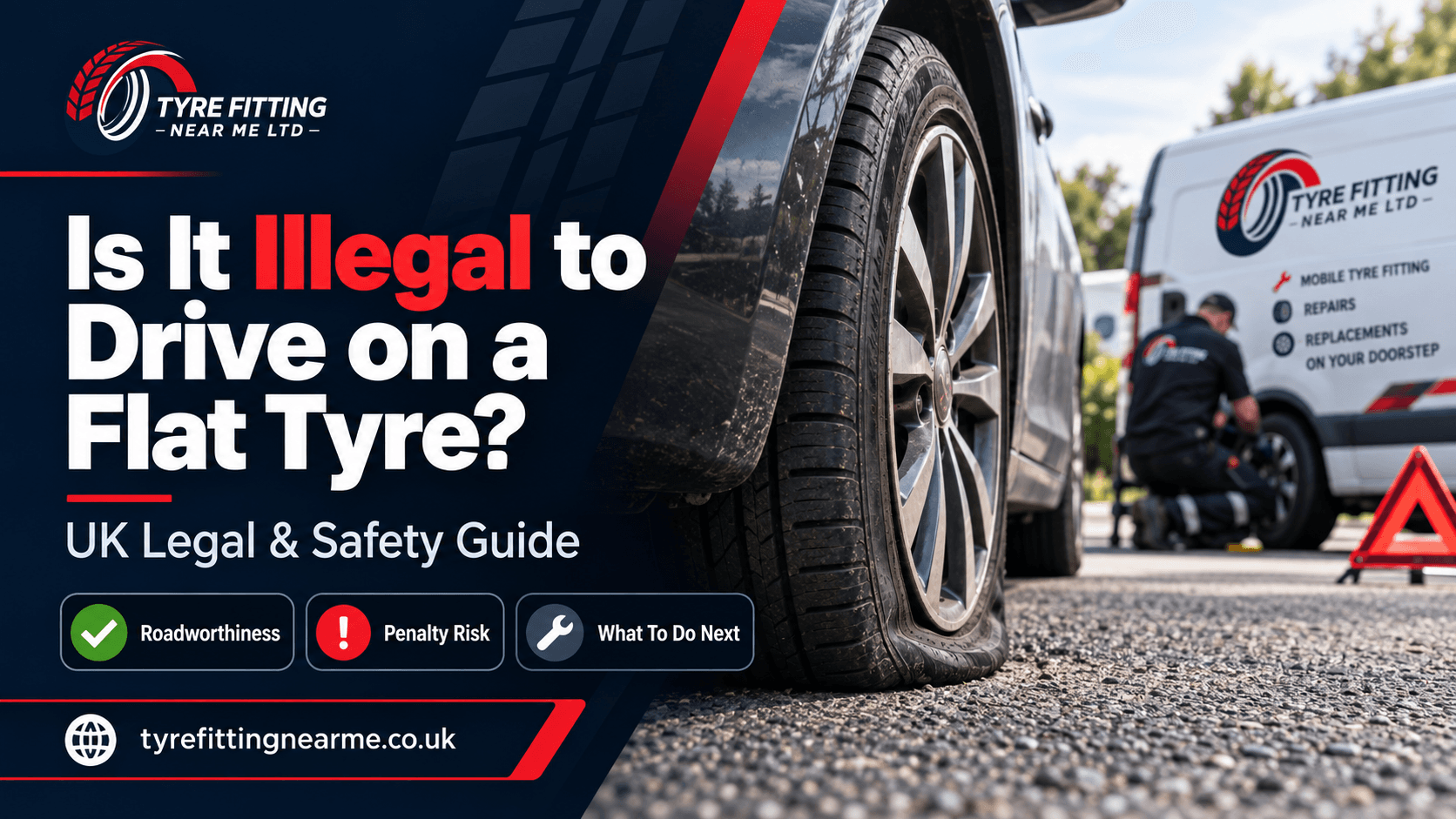
In the UK, you should not drive on a completely flat tyre. A flat or defective tyre can make your vehicle unsafe, unroadworthy, and difficult to control. If your tyre is fully deflated, stop in a safe place, avoid continuing your journey, and arrange mobile tyre fitting, tyre repair, or recovery.
A flat tyre is not only a tyre problem. A flat tyre can affect steering, braking, wheel condition, road safety, tyre repairability, and legal responsibility. This guide explains when driving becomes unsafe, when limited movement may be necessary, what damage can happen, and which safer tyre service can get you moving again.
Can you legally drive on a flat tyre in the UK?
You should not treat a flat tyre as legal or safe for normal driving in the UK. A driver is responsible for keeping the vehicle roadworthy before and during a journey. A fully flat, damaged, or defective tyre can make the vehicle unsafe and may expose the driver to enforcement action if the vehicle is considered dangerous.
What makes a tyre unsafe or unroadworthy?
A tyre becomes unsafe when it cannot support the vehicle correctly. A flat tyre has lost the air pressure needed to keep the tread, sidewall, bead, and wheel rim working safely together.
UK tyre safety depends on tread depth, tyre pressure, visible damage, sidewall condition, valve condition, and structural strength. If the tyre is fully deflated, the safest action is to stop and arrange help instead of driving to a garage.
What penalties can apply for driving with a dangerous tyre?
Driving a vehicle in a dangerous condition can lead to a fine, penalty points, or further action depending on the situation. A flat tyre may become part of that risk when the tyre condition affects safety, control, or roadworthiness.
The legal issue is not only the phrase “flat tyre.” The real issue is whether the tyre condition makes the vehicle unsafe to use on the road.
Is it safe to drive on a flat tyre?
Driving on a flat tyre is unsafe because the tyre cannot support the vehicle correctly. The tyre sidewall can collapse, the wheel rim can take direct load, and the vehicle can lose predictable handling. A short journey can still damage the tyre, wheel, steering, or suspension.
How does a flat tyre affect steering and braking?
A flat tyre affects steering because the wheel no longer rolls on a stable inflated tyre. The vehicle can pull towards the damaged side, especially while braking, turning, or driving on uneven roads.
A flat tyre affects braking because the tyre contact patch becomes distorted. The tyre may drag, fold, or bounce, which reduces control and increases the risk of skidding.
Why can a flat tyre damage the wheel?
A flat tyre cannot cushion the wheel rim from the road surface. The rim can bend, scrape, crack, or lose its proper seal with the tyre bead. That damage can turn a simple puncture into a more expensive wheel and tyre replacement.
If your tyre is flat and you need help at home, work, or roadside, use mobile tyre fitting at home, work, or roadside instead of risking extra damage by driving.
What should you do if your tyre goes flat while driving?
You should slow down smoothly, avoid harsh braking, and stop in the safest available place. The safest action depends on road type, traffic speed, visibility, and the position of the vehicle. After stopping, use hazard lights and arrange tyre help from a safe location.
How should you stop safely on a normal road?
Hold the steering wheel firmly. A flat tyre can pull the vehicle towards the damaged side.
Ease off the accelerator. Sudden braking can make the vehicle less stable.
Signal carefully. Move towards a safe stopping place when traffic allows.
Stop away from moving traffic. Use a car park, side road, lay-by, petrol station, or wide safe area where possible.
Switch on hazard warning lights. Make the vehicle visible to other road users.
Keep passengers away from traffic. Passenger safety matters more than tyre inspection.
Arrange professional help. Do not continue a normal journey on a fully flat tyre.
What should you do if you cannot safely continue?
If the tyre is fully flat, the safest next step is usually repair, replacement, or recovery at the vehicle location. If the vehicle is blocking traffic or sitting in a dangerous position, move only as far as needed to reach safety.
For urgent roadside help, book 24/7 emergency tyre fitting for a flat tyre and avoid continuing on a damaged tyre.
Can you drive to a garage on a flat tyre?
You should not drive to a garage on a completely flat standard tyre as a planned journey. A flat tyre can suffer internal damage within a short distance. Moving the vehicle may be acceptable only when the current location creates immediate danger and the vehicle must reach a safer position.
When is limited movement acceptable?
Limited movement means moving the car the shortest practical distance to leave immediate danger. A driver may need to clear a live lane, junction, bend, or unsafe road position. That action is different from driving 5 or 10 minutes to avoid a call-out.
Car stopped in a live lane: Move only if the vehicle remains controllable, then stop safely.
Car parked safely at work: Do not drive; arrange mobile tyre help.
Garage is 10 minutes away: Avoid driving because tyre and rim damage risk is high.
Tyre only looks slightly low: Check pressure and visible damage before making any journey.
When should you call a mobile tyre repair service?
You should call a mobile tyre repair service when the tyre is flat, punctured, losing pressure quickly, or unsafe to drive on. A trained technician can check whether the tyre can be repaired or whether replacement is safer.
If the tyre has a repairable puncture, mobile tyre repair for punctured tyres can help you avoid a risky journey to a garage.
How far can you drive on a flat tyre?
A standard flat tyre has no universal safe driving distance. Even a short distance can damage the tyre sidewall, bead, wheel rim, steering, or suspension. The safest distance is only the distance needed to leave immediate danger and stop somewhere safe.
Can you drive 100 metres, 1 mile, or 2 miles on a flat tyre?
100 metres: This may be acceptable only when the vehicle must leave immediate danger.
1 mile: This can damage the tyre, sidewall, bead, and rim.
2 miles: This creates a high risk of tyre and wheel damage.
5 miles or more: This is unsafe for a normal flat tyre and should not be planned.
Can you drive 5 or 10 minutes on a flat tyre?
A time-based journey still creates risk because tyre damage depends on distance, speed, road surface, vehicle load, tyre condition, and remaining air pressure. A 10-minute drive can destroy a tyre that may otherwise have been repairable.
If you are unsure whether the tyre is flat or only low on pressure, read can you drive on a flat tyre safely before making the journey.
Can you drive slowly on a flat tyre?
Driving slowly does not make a flat tyre safe. Lower speed may reduce impact force, but it does not restore air pressure, sidewall support, or rim protection. The tyre can still fold under vehicle weight and damage the wheel.
Does slow speed reduce any risk?
Slow speed can reduce harsh impact over potholes or kerbs. Slow speed cannot stop the sidewall from collapsing or the rim from taking load. That means slow driving remains risky on a fully flat tyre.
Why can slow driving still cause expensive damage?
The tyre sidewall can become crushed between the road and the rim. The tyre bead can lose its seal, the rim can scrape the road, and the tyre structure can break internally. A slow journey can still turn a puncture repair into a full tyre replacement.
How far can you drive on run-flat tyres?
Run-flat tyres can allow limited driving after pressure loss, but only within manufacturer limits. A run-flat tyre has reinforced construction that supports limited movement after a puncture. A normal flat tyre does not have the same structure and should not be treated the same way.
What makes a run-flat tyre different?
A run-flat tyre has stronger sidewall support than a standard tyre. That support can allow the driver to reach a safer location after pressure loss. The driver still needs to follow the vehicle handbook, tyre markings, speed limit, distance limit, and TPMS warning.
When should a run-flat tyre be replaced?
A run-flat tyre may need replacement if it has been driven after pressure loss, has sidewall damage, or fails inspection. Some run-flat tyres can be repaired only under specific conditions, and many require professional inspection before reuse.
If your car uses run-flats, choose run-flat tyre replacement at your location so the correct manufacturer-approved tyre can be fitted safely.
What is the difference between a flat tyre, puncture, and low tyre pressure?
A flat tyre has lost most or all usable air pressure, while a puncture is damage that may cause fast or slow air loss. Low tyre pressure means the tyre is underinflated but may still hold air. Each condition needs a different action.
How can you tell if the tyre is fully flat?
A fully flat tyre may show visible sagging, rim contact, heavy pulling, flapping rubber noise, vibration, or poor steering response. Low-profile tyres can hide pressure loss, so a visual check alone is not always reliable.
How can you tell if it is a slow puncture?
A slow puncture usually causes repeated pressure loss after inflation. A nail, screw, valve leak, bead leak, or small tread puncture can release air gradually. If pressure keeps dropping, the tyre needs inspection.
Fully flat tyre: Visible collapse, pulling, vibration, and rim risk usually mean the car should not be driven.
Slow puncture: Repeated pressure loss, an embedded object, or TPMS warning means the tyre needs inspection.
Low tyre pressure: Soft handling or a pressure warning means the tyre should be inflated and monitored.
Run-flat pressure loss: A TPMS warning may allow limited movement only within manufacturer limits.
If your tyre has a nail or screw, read nail or screw in tyre driving advice before removing the object or continuing the journey.
What damage can driving on a flat tyre cause?
Driving on a flat tyre can damage the tyre, rim, steering, suspension, and alignment. Some damage may be hidden inside the tyre, which means the tyre can look usable while remaining unsafe. A professional inspection should follow any meaningful distance driven while flat.
What tyre damage can happen?
The tyre sidewall can crack, fold, or tear when the tyre runs without air pressure. The inner liner, bead, casing, and structural cords can also become damaged. That internal damage may make the tyre unsafe even if the puncture looks small.
What wheel or suspension damage can happen?
The wheel rim can bend or scrape when the tyre no longer cushions the road. Steering alignment can change when the vehicle pulls to one side. Suspension components can receive extra vibration and impact.
Tyre sidewall: Cracking, folding, cord damage, bulges, or visible collapse can make replacement necessary.
Wheel rim: Bending, scraping, air leaks, wobble, or rim marks can happen after flat driving.
Steering alignment: The vehicle may pull even after tyre replacement.
Suspension: Knocking, bouncing, or uneven tyre wear can appear after impact or vibration.
If you feel vibration after a flat tyre, check on-site wheel balancing for tyre vibration because imbalance or wheel damage can affect handling after repair.
Can a flat or punctured tyre be repaired?
A punctured tyre can sometimes be repaired, but a flat tyre that has been driven on may need replacement. Repair depends on puncture location, tread depth, internal condition, sidewall condition, and whether the tyre was driven while deflated.
When is a puncture usually repairable?
A puncture is more likely to be repairable when the damage is in the central tread area, the tyre has enough tread depth, the casing is sound, and the tyre has not been driven flat. A proper repair requires the tyre to be inspected by a trained technician.
When does the tyre need replacing?
A tyre usually needs replacement when the sidewall is damaged, the casing is weakened, the puncture is too large, cords are exposed, or the tyre has been driven flat long enough to damage its structure.
Small central tread puncture: Repair may be possible after inspection.
Sidewall puncture: Replacement is usually required because sidewall damage is unsafe to repair.
Driven fully flat: Internal inspection is needed before any repair decision.
Visible cord or casing damage: Tyre replacement is required immediately.
For repair rules, compare can a puncture be repaired safely and repairable vs non-repairable punctures before booking.
What should you do if you already drove on a flat tyre?
If you already drove on a flat tyre, stop using the vehicle until the tyre and wheel are checked. The tyre may have hidden internal damage even if the outside looks normal. A technician should inspect the tyre, valve, bead, wheel rim, and pressure loss source.
What signs mean you should not drive further?
Torn rubber around the tyre shoulder or sidewall.
Visible rim contact with the road.
Heavy vibration while moving.
Vehicle pulling strongly to one side.
Burning rubber smell.
Repeated pressure loss after inflation.
What should a technician check afterwards?
Inner tyre liner: Flat driving can create hidden internal damage.
Sidewall: Excessive flex can weaken tyre structure.
Wheel rim: Rim contact can cause air leaks and vibration.
Valve and bead: Air loss may come from seal failure rather than tread damage.
Does driving on a flat tyre affect insurance?
Driving on a flat tyre can affect insurance if the tyre condition contributes to an accident or claim dispute. Insurance does not automatically become invalid in every case, because policy wording, vehicle condition, driver behaviour, and incident details matter.
Why should you avoid assuming insurance is automatically invalid?
Insurance policies can differ between providers. A claim may depend on whether the driver knowingly used an unsafe vehicle and whether that tyre condition contributed to the incident. A careful explanation is safer than a blanket statement.
What behaviour can create insurance risk?
Continuing a normal journey after noticing a flat tyre can create risk because the driver ignored a visible safety problem. A safer decision is to stop, document the issue, and arrange professional help before continuing.
Need help with a flat tyre now? Stop in a safe place first, keep away from moving traffic, and avoid driving on a fully flat tyre. Book mobile tyre repair, emergency tyre fitting, or a free tyre check before the tyre causes extra damage.
What else do drivers ask about driving on a flat tyre?
Can I drive home with a flat tyre?
No, you should not drive home on a completely flat standard tyre. A journey home is still continued driving on an unsafe tyre. The tyre can damage the rim, lose structure, and affect control. Move only if the current position creates immediate danger, then arrange mobile fitting, recovery, or a safe spare wheel.
Can I drive to an air pump with a flat tyre?
You should not drive to an air pump if the tyre is fully flat. A fully deflated tyre can tear, detach, or damage the rim before you reach the pump. A tyre that is only low on pressure may be inflated if there is no visible damage and the vehicle remains controllable.
Can I drive with a screw or nail in my tyre?
You should get a tyre with a screw or nail inspected as soon as possible. The object may slow the air leak, but the puncture can worsen while driving. Do not remove the object at the roadside unless a technician advises it. Pressure loss speed decides whether recovery is safer.
Can tyre sealant fix a flat tyre?
Tyre sealant can help with some small tread punctures, but it is temporary. Sealant cannot safely fix sidewall damage, large holes, bead damage, or casing damage. Read do tyre sealants work for punctures before relying on a sealant kit.
Can I use a space saver spare wheel after a flat tyre?
Yes, you can use a space saver spare wheel if your vehicle handbook allows it. A space saver is a temporary wheel, not a normal replacement tyre. Follow the speed limit, distance limit, pressure requirement, and fitting instructions printed in the handbook or on the wheel.
Will roadside assistance come out for a flat tyre?
Yes, many roadside assistance providers can help with a flat tyre. The exact help depends on location, spare-wheel availability, vehicle type, membership, and safety conditions. A mobile tyre fitter may repair or replace the tyre at the vehicle location when the tyre condition allows it.
Is a flat tyre an MOT failure?
A defective, damaged, or unsafe tyre can fail an MOT inspection. Tyre condition, tread depth, pressure condition, sidewall damage, and visible defects can all affect roadworthiness. A flat tyre should be inspected before the vehicle is used again.
What should I check before driving after a puncture repair?
You should check tyre pressure, repair confirmation, warning lights, and vehicle handling before driving after repair. Stop again if the TPMS light returns, the vehicle pulls, vibration appears, or the tyre loses air. A professional repair should leave the tyre safe, sealed, and correctly inflated.
Related tyre help: If the tyre keeps losing pressure, book a free mobile tyre health check before the problem becomes a roadside breakdown.