
Repairable vs non repairable punctures
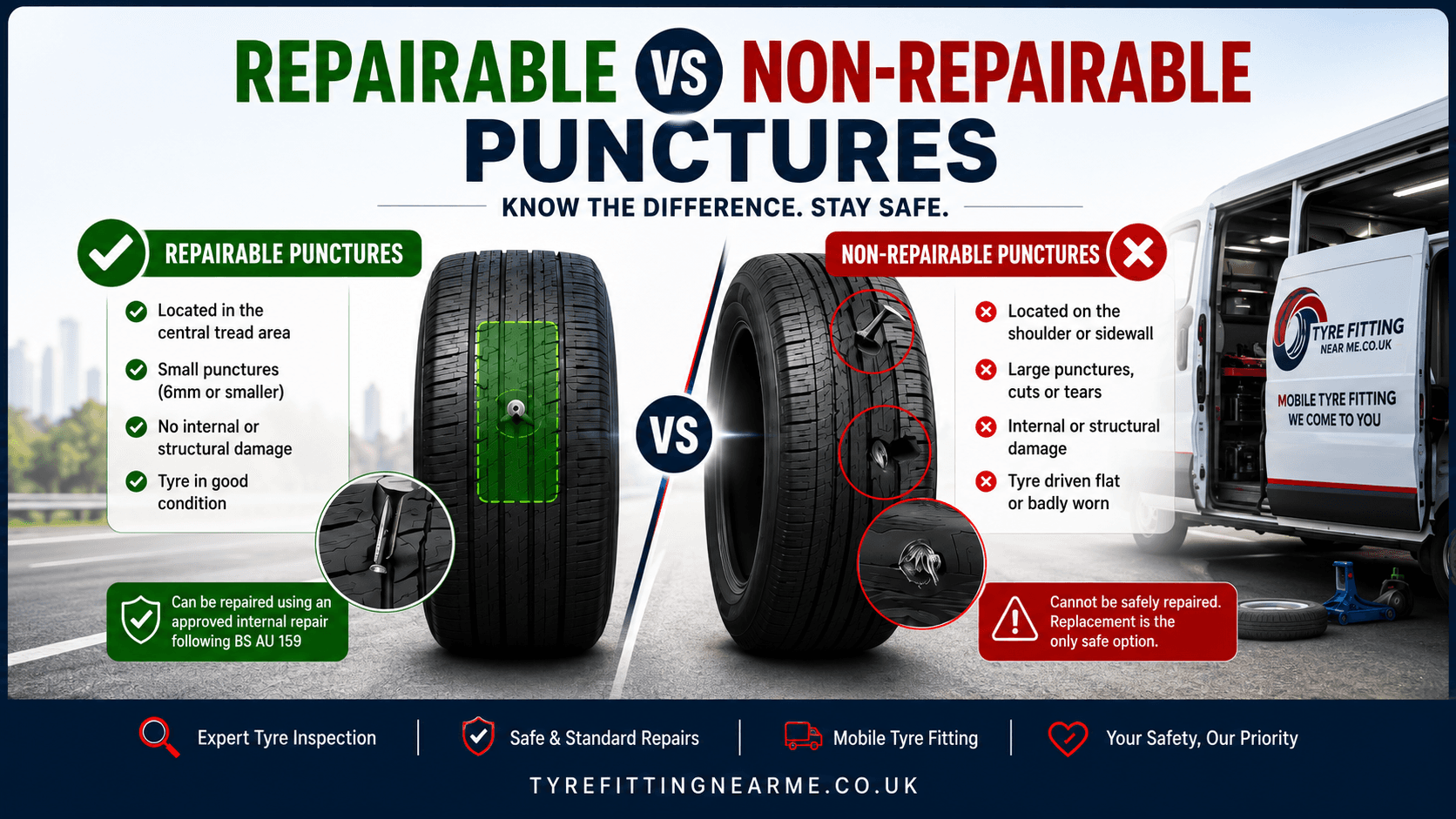
A tyre puncture is usually repairable only when the damage sits in the central tread area, is about 6 mm or smaller, and the tyre has no internal or structural damage. Punctures in the shoulder, sidewall, bead, badly worn tread, or tyres driven flat usually need professional replacement.
This guide helps UK drivers classify repairable vs non-repairable punctures before they book a tyre inspection, mobile puncture repair, or replacement tyre fitting. The page uses BS AU 159 repair logic, GOV.UK roadworthiness wording, TyreSafe safety guidance, and mobile tyre service context to explain location, size, internal damage, repair method, and roadside action without promising repair from an exterior view alone.
Can a tyre puncture be repaired or does it need replacing?
A tyre puncture can be repaired when the injury sits within the permitted central tread area, the hole diameter stays within the accepted minor repair limit, and the tyre structure remains sound after inspection. A tyre needs replacing when damage affects the shoulder, sidewall, bead, casing, cords, belts, inner liner, or tread condition. A technician confirms the outcome after removing and inspecting the tyre.
The repair decision depends on location, size, condition, and repair method. TyreSafe states that car tyre puncture repairs should follow British Standard BS AU 159, while GOV.UK states that cars and light vans need 1.6 mm tread depth for legal road use.
What makes a puncture potentially repairable?
A potentially repairable puncture has a clean injury inside the central tread or crown area. The hole usually comes from a nail or screw, and the tyre still holds enough structure for an approved internal repair.
The puncture sits in the central tread area.
The damaged area measures about 6 mm or smaller.
The casing, cords, belts, bead, and inner liner remain intact.
The tyre has not been driven flat enough to create hidden sidewall damage.
The tread depth and general condition meet roadworthiness requirements.
What makes a puncture non-repairable?
A non-repairable puncture affects a tyre area or structure that cannot safely hold an approved repair. The most common rejection reasons include sidewall damage, shoulder damage, bead damage, large cuts, exposed cords, internal separation, and low tread depth.
Potentially repairable Usually non-repairable Why the difference matters Small nail hole in central tread Nail near shoulder or sidewall The central tread has more stable structure than high-flex edge areas. Clean round puncture about 6 mm or smaller Large cut, split, gouge, or tear A large injury can weaken the casing beyond minor repair limits. Sound casing after internal inspection Casing separation, exposed cords, or belt damage Structural damage can cause tyre failure after the repair. Tyre not driven flat Tyre driven deflated with sidewall abrasion Deflated driving can crush the sidewall between rim and road.
Where is the repairable area on a tyre?
The repairable area on a car tyre usually sits in the central tread or crown, away from the shoulder, sidewall, and bead. TyreSafe describes tyre repairs as limited to the central three-quarters of the tyre tread under BS AU 159 guidance. A technician still checks the actual injury position because the shoulder boundary can look unclear from outside.
The central tread carries the main road contact patch and receives the most common nail or screw punctures. The shoulder forms the curved transition between tread and sidewall, so borderline damage needs professional judgement rather than a photo-only decision.
What is the central tread or crown area?
The central tread or crown area is the belt-supported section across the main tread face. A repairable puncture usually enters this area as a small, clean penetration and avoids the shoulder curve, sidewall rubber, and bead seating zone.
Where does the tyre shoulder begin?
The tyre shoulder begins where the flat tread face starts curving toward the sidewall. This transition area carries more flex than the central tread, so a puncture near the outer tread block may fall outside the permitted minor repair area.
Why are the sidewall and bead outside the repair zone?
The sidewall and bead sit outside the standard minor repair zone because both areas carry different mechanical stress. The sidewall flexes under load, while the bead seals the tyre against the wheel rim, so damage in either area can compromise pressure retention and structural safety.
Tyre region Repair status Reason Central tread or crown Potentially repairable The area has stronger belt support and lower flex than the sidewall. Shoulder Usually non-repairable The transition zone moves more and sits close to the excluded sidewall. Sidewall Non-repairable for standard puncture repair The wall flexes continuously and supports tyre shape under load. Bead area Non-repairable for standard puncture repair The bead must seal correctly against the wheel rim.
When a nail or screw sits on an outer tread block or close to the shoulder line, book a professional puncture inspection before assuming the tyre can be repaired.
What size puncture can be repaired safely?
A tyre puncture can usually be considered for minor repair when the damaged area measures about 6 mm or smaller and sits inside the permitted central tread zone. The measurement refers to the injury size in the tyre, not only the visible nail head. Larger holes, cuts, tears, splits, and gouges usually require replacement because they can weaken the casing.
The British Tyre Manufacturers’ Association describes minor damage to car and light van tyres as principally central tread punctures less than 6 mm in diameter, repaired under the prevailing BS AU 159 standard. That wording makes size only one eligibility factor, not the full repair decision.
How does the 6 mm puncture rule work?
The 6 mm rule works as a minor repair limit for the damaged area. A thin nail can leave a small repairable channel, while a larger bolt, jagged object, or stretched injury can create damage beyond the accepted minor repair envelope.
Which cuts, splits, gouges, or tears need replacement?
Cuts, splits, gouges, and tears usually need replacement because they are not simple round punctures. The injury shape can cut cords, expose belts, open the casing, or spread under driving loads after a repair unit has been installed.
Damage type Likely repair status Reason Small nail hole in central tread Potentially repairable The injury may accept a compliant internal repair after inspection. Screw hole around 6 mm or smaller Conditionally repairable The technician must check the injury channel and internal liner. Large bolt hole above minor repair size Usually replace The larger injury can exceed the accepted repair unit capacity. Sidewall cut or tread gouge Replace The cut shape can damage reinforcement and spread under load.
Why can’t sidewall and shoulder punctures usually be repaired?
Sidewall and shoulder punctures usually cannot be repaired because these tyre zones flex, deform, and carry stress differently from the central tread. A repair unit needs a stable area to bond and seal correctly. Sidewall movement, shoulder curvature, heat build-up, and casing distortion can make a standard puncture repair unsafe even when the visible hole looks small.
The sidewall works as a load-bearing and flexing structure, not just a rubber surface. A repair near that area can fail because the tyre sidewall bends with every wheel rotation and road impact.
How does sidewall flex weaken a repair?
Sidewall flex weakens a repair by repeatedly pulling on the damaged area and repair material. The tyre wall changes shape under vehicle weight, cornering force, braking load, and pothole impact, so a patch or stem in that zone cannot provide reliable structural support.
Why does shoulder damage create a borderline repair risk?
Shoulder damage creates a borderline repair risk because the injury sits near the edge of the tread belt package. The area transitions from stable tread to flexible sidewall, so a technician may reject a shoulder puncture even when part of the hole appears on the tread face.
Sidewall punctures risk casing weakness and air-loss failure.
Shoulder punctures sit close to high-flex sidewall movement.
Bead-area damage can affect the seal between tyre and wheel.
Outer tread damage can become non-repairable when the injury enters the shoulder transition.
If visible damage touches the tyre wall or sits below the outer tread blocks, mobile tyre replacement is the safer service route when the tyre fails inspection.
Does driving on a flat tyre make a puncture non-repairable?
Driving on a flat tyre can make a repair unsafe because the underinflated sidewall may be pinched, overheated, abraded, or internally separated before the car stops. A puncture in the central tread can become non-repairable after deflated driving. A technician must inspect the tyre internally before approving repair because hidden damage may not show outside.
A flat tyre loses the air pressure that normally holds its shape. The wheel rim can then compress the sidewall against the road surface, especially under speed, vehicle load, or cornering force. If the tyre is flat and the vehicle cannot be driven safely, use 24/7 emergency tyre fitting after moving to a safe location.
What hidden internal damage can happen after driving flat?
Hidden internal damage can include liner wrinkling, rubber dust, heat rings, casing abrasion, cord fatigue, and sidewall pinching. A tyre can look usable from the outside while the internal structure has already lost the strength needed for safe pressure retention.
What should a driver tell the tyre technician?
A driver should tell the technician how far the vehicle travelled after the pressure warning, how fast the vehicle moved, and whether the tyre reached zero pressure. The technician also needs to know vehicle load, motorway use, pothole impact, sealant use, and previous repair history.
Driver history Possible hidden damage Correct action Stopped quickly after pressure loss Lower risk of sidewall crushing Book internal inspection before repair approval. Drove slowly for a short distance Possible sidewall heat and abrasion Tell the fitter exact distance and speed. Drove on zero pressure High risk of casing and sidewall damage Expect replacement unless inspection proves otherwise. Used tyre sealant Possible liner contamination Tell the technician before demounting begins.
Before a mobile appointment, use the mobile tyre fitting checklist. If the locking wheel nut key is missing or damaged, locking wheel nut removal may be needed before the tyre can be demounted.
How does a technician confirm whether a puncture is repairable?
A technician confirms puncture repairability by removing the tyre from the wheel, inspecting the inner liner, checking the injury channel, assessing casing integrity, and testing the repaired tyre for air retention. TyreSafe states that permanent repairs can only be carried out after tyre removal allows internal and external inspection for hidden damage.
Our mobile tyre workflow treats an exterior photo as a triage clue, not a repair approval. The final decision comes after inspection because cords, belts, bead damage, liner deterioration, and internal separation can sit behind a small visible hole.
Why must the tyre be removed from the wheel?
The tyre must be removed from the wheel because the inner liner and casing carry the evidence that confirms repair safety. An exterior plug or photo cannot show liner damage, sidewall abrasion, casing separation, or cord exposure inside the tyre.
What internal tyre damage blocks a repair?
Internal tyre damage blocks a repair when the casing, cords, belts, bead, or liner has lost structural integrity. TyreSafe lists several repair exclusions, including casing damage, bead damage, exposed cords, liner deterioration, solvent contamination, and separation between tread, sidewall, or belt.
What does a proper final repair check include?
A proper final repair check includes inflation, leak testing, pressure verification, visual inspection, and wheel balancing where the service process requires it. The technician should also confirm that the repair unit seals both the inner liner and the puncture channel.
Inspection step What the technician checks Why the step matters External inspection Damage location, object type, sidewall condition, tread depth The first check identifies obvious repair exclusions. Tyre demounting Removal from wheel rim The technician gains access to hidden internal surfaces. Internal inspection Inner liner, casing, cords, belts, bead, separation signs The inspection confirms structural safety before repair. Repair unit selection Patch-plug size and injury-channel suitability The repair must match the puncture diameter and path. Pressure and leak test Air retention after repair The final test confirms the tyre holds pressure correctly.
For the practical BS AU 159 assessment and on-site repair process, see the mobile puncture repair service.
What repair methods are temporary or permanent?
A professional internal repair can be permanent when the tyre passes inspection and the repair unit seals both the inner liner and the injury channel. Exterior string plugs and emergency sealants are temporary mobility aids, not full professional confirmations of tyre integrity. A safe repair decision depends on tyre removal, internal inspection, correct repair material, and pressure testing.
Drivers often confuse a quick plug with a standards-aware puncture repair. A plug may stop air loss for a short period, but the method may not inspect the hidden casing or liner damage that decides repair safety.
What is a combination patch-plug repair?
A combination patch-plug repair uses a patch section to seal the inner liner and a stem section to fill the puncture channel. The method aims to restore airtightness through the injury path after the tyre has been removed, inspected, prepared, repaired, and tested.
Why are string plugs and sealants temporary fixes?
String plugs and sealants are temporary fixes because they can be installed without a full internal inspection. The material may slow air loss, but the fitter still needs to confirm whether the casing, cords, belts, bead, and inner liner remain safe for continued use.
Method Temporary or permanent Key limitation Combination patch-plug Permanent when approved and fitted correctly The tyre must pass internal inspection first. Internal patch only Limited use depending on injury type The puncture channel may still need proper sealing. Exterior string plug Temporary The method can miss hidden internal damage. Emergency sealant Temporary The sealant can contaminate the liner and complicate repair.
Exterior plugs and sealants should not be treated as substitutes for a professional internal repair after tyre removal and inspection.
Can a mobile tyre fitter repair the puncture at home or work?
A mobile tyre fitter can repair a puncture at home or work when the vehicle sits in a safe working location, the damage appears within the central tread, the tyre condition passes inspection, and the fitter can complete a proper internal repair. Mobile replacement becomes safer when the puncture sits in the shoulder, sidewall, bead, or structurally damaged tyre.
For the wider on-site workflow, read how mobile tyre fitting works, including wheel removal, balancing, safety checks, and final sign-off.
Mobile puncture repair should never be framed as live-lane repair or hard-shoulder work. A safe location matters because the fitter needs space, stability, lighting, equipment access, and enough time to inspect the tyre properly.
When can mobile puncture repair work?
Mobile puncture repair can work when the vehicle is parked at home, work, a driveway, a car park, or another safe off-road location. The fitter still needs a repairable puncture, suitable equipment, and an inspection result that supports repair rather than replacement.
For driveway and workplace access requirements, see how tyres can be fitted at home safely.
When does mobile replacement become safer than repair?
Mobile replacement becomes safer when the tyre has shoulder damage, sidewall damage, bead damage, exposed cords, low tread depth, internal separation, or severe underinflation damage. A replacement also becomes safer when the vehicle position prevents a proper repair process.
Situation Mobile repair possible? Safer action Small central tread puncture at home Yes, after inspection Book professional mobile puncture repair. Nail close to shoulder at workplace Uncertain until inspected Request inspection and prepare for replacement. Sidewall cut in car park No Book mobile tyre replacement. Flat tyre on motorway shoulder No safe repair context Move to safety and contact breakdown assistance.
Compare mobile tyre fitting vs garage repair limits when the puncture location and vehicle position affect the service choice.
Can run-flat, EV, or previously repaired tyres be repaired?
Run-flat, EV, foam-lined, and previously repaired tyres require extra checks because construction, weight, acoustic foam, zero-pressure history, and old repair positions can change repair eligibility. A technician should follow the tyre manufacturer’s policy and the relevant repair standard. TyreSafe advises drivers to check owner guidance for EV tyres and highlights the difficulty of assessing run-flat underinflation damage.
Specialist tyre repair should not follow a single rule from a generic puncture chart. Manufacturer restrictions, speed rating, load index, previous repair spacing, and internal condition can override the visible location of a small puncture.
Can run-flat tyres be repaired?
Run-flat tyres may be restricted or rejected for repair because reinforced sidewalls can hide damage after pressure loss. TyreSafe says run-flat tyres are designed only for limited emergency use after deflation, and underinflation damage can make the tyre unsuitable and unsafe to repair.
Can EV or foam-lined tyres be repaired?
EV or foam-lined tyres can sometimes be repaired, but the fitter must check the owner handbook, tyre manufacturer policy, vehicle load requirements, acoustic foam placement, and sealant contamination. The extra vehicle weight and tyre construction make inspection quality more important than a quick exterior decision.
Can a tyre be repaired twice?
A tyre can sometimes be repaired twice when the new injury sits far enough from the old repair and the previous repair complies with the relevant standard. A technician must reject overlapping injuries, clustered punctures, unsafe previous plugs, or internal damage around an old repair.
Tyre scenario Repair caveat Required check Run-flat tyre Hidden zero-pressure damage may be difficult to confirm Manufacturer policy and internal inspection EV tyre Vehicle load and tyre construction may affect policy Owner handbook and tyre manufacturer guidance Foam-lined acoustic tyre Foam can obstruct repair access or require specialist handling Foam placement and repair unit compatibility Previously repaired tyre Repair overlap can weaken the casing Repair spacing and prior repair quality
Read the run-flat tyre replacement guidance when the pressure warning appeared before the tyre was inspected.
Why did the garage say the tyre was non-repairable?
A garage may say the tyre is non-repairable because the puncture sits outside the permitted repair area, exceeds the minor repair size, or has caused structural damage inside the tyre. A valid rejection should connect to a visible or inspectable reason, such as sidewall damage, bead damage, exposed cords, casing separation, low tread depth, or unsafe previous repair.
Drivers often search this topic because replacement costs more than repair. A free tyre health check or second opinion should verify the rejection reason, not pressure the technician to repair a tyre that fails safety criteria. If replacement is required, compare part-worn vs new tyres on safety, tread, and long-term value before choosing.
Which repair rejection reasons are legitimate?
Legitimate repair rejection reasons include shoulder puncture, sidewall puncture, bead damage, oversized injury, exposed cords, belt damage, inner liner deterioration, casing separation, solvent contamination, low tread depth, and damage from driving while deflated. GOV.UK confirms 1.6 mm as the tread depth requirement for cars and light vans.
When should a driver ask for a second opinion?
A driver should ask for a second opinion when the rejection reason is unclear, the puncture appears near a borderline repair zone, or the shop gives no explanation beyond “not repairable.” The second opinion should come from a qualified tyre technician who can inspect the tyre internally.
Rejection reason Valid when What to ask for Too close to sidewall The injury enters the shoulder or sidewall area Ask the technician to show the repair-zone boundary. Damage larger than minor repair limit The hole or cut exceeds the safe repair envelope Ask whether the damage diameter was measured after inspection. Driven flat damage The inner sidewall shows heat, abrasion, or liner damage Ask to see the internal damage before disposal. Low tread depth The tyre no longer meets legal or serviceable condition Ask for tread readings across the tyre.
What should you do if you get a puncture on a motorway?
A driver with a motorway puncture should prioritise personal safety before tyre repair. National Highways and GOV.UK guidance support moving to a safer place, using hazard lights, exiting away from traffic when safe, waiting behind a barrier where possible, and contacting breakdown help. A driver should not attempt a repair in a live lane or unsafe shoulder position.
A tyre can be replaced later, but a live traffic environment can create immediate collision risk. The vehicle position decides whether mobile help, recovery, or a controlled relocation is the safe next action.
Where should you stop after a puncture?
A driver should stop in the safest available place away from moving traffic. A motorway refuge area, service area, exit road, or safe off-carriageway location gives recovery staff and tyre fitters a safer working environment than a live lane.
Why should you avoid changing a tyre on a hard shoulder?
A driver should avoid changing a tyre on a hard shoulder because fast traffic creates severe risk around the vehicle. National Highways treats hard shoulder misuse as a significant safety risk, and roadside tyre work should not happen where traffic exposure remains uncontrolled.
Move away from traffic when the vehicle can reach a safer place.
Switch on hazard warning lights to alert approaching drivers.
Leave the vehicle from the left side when safe.
Wait behind a barrier or in another protected position when available.
Call breakdown recovery or a professional tyre service for safe assistance.
If the tyre still holds pressure, do not treat that as proof it is safe for motorway-speed driving. Arrange professional inspection before continuing at speed.
Book a professional tyre inspection or puncture repair. Share the puncture location, pressure-loss history, driving distance, and tyre size before booking. If you do not know the size, use the tyre size guide. A technician can confirm repair eligibility, replace unsafe tyres, and arrange professional tyre puncture repair service at a safe location.
What questions do drivers ask about repairable and non-repairable punctures?
Drivers ask repairability questions because a puncture creates safety, cost, and travel uncertainty at the same time. The strongest answers use the same decision chain every time: locate the damage, measure the injury, check tyre condition, inspect the internal structure, choose a compliant repair method, and replace the tyre when any safety criterion fails.
How do you know if a puncture is repairable?
A puncture is repairable when the damage sits in the central tread area, stays within the minor repair size, and passes internal inspection. A technician must remove the tyre from the wheel and check the casing, cords, belts, liner, and bead before approving repair. A visible nail in the tread only means the tyre is potentially repairable.
Which punctures cannot be repaired?
Punctures cannot usually be repaired when they affect the shoulder, sidewall, bead, casing, cords, belts, or inner liner. Large holes, cuts, splits, gouges, exposed reinforcement, sidewall bulges, low tread depth, and damage from driving flat also block repair. The technician should explain the specific rejection reason before recommending tyre replacement.
Can a nail in the central tread be repaired?
A nail in the central tread can often be repaired when the hole is small and the tyre remains structurally sound. The technician must inspect the inside of the tyre, remove the object, assess the injury channel, and fit an approved repair unit. A repair should not proceed when the nail has caused casing damage or hidden liner damage.
Can a nail near the sidewall be repaired?
A nail near the sidewall usually cannot be repaired when the injury enters the shoulder or sidewall zone. The outer tread block can look repairable from above, but the puncture path may still sit outside the permitted repair area. A technician should inspect the location and show the repair-zone boundary before confirming replacement.
How close to the sidewall can a tyre be patched?
A tyre can be patched only when the injury remains inside the permitted central tread repair area. The exact distance from the sidewall depends on tyre width, tread shape, injury angle, and the applicable repair standard. A technician should not approve repair from an exterior photograph because the shoulder boundary and internal injury path need inspection.
Can a slow puncture be repaired?
A slow puncture can be repaired when the air loss comes from a small repairable injury in the central tread and the tyre condition passes inspection. Slow pressure loss can also come from a valve fault, rim leak, bead issue, sidewall damage, cracked rubber, or a TPMS fault. If the warning light remains on after pressure correction, book a TPMS service. The leak source determines whether repair, valve service, rim attention, or replacement is needed.
Is a tyre plug a permanent repair?
An exterior tyre plug should be treated as a temporary fix, not a full professional repair. A proper permanent repair normally requires tyre removal, internal inspection, correct injury preparation, repair-unit installation, and leak testing. A combination patch-plug can seal the inner liner and injury channel after the technician confirms the tyre remains structurally safe.
Can a tyre be repaired after being driven flat?
A tyre can be repaired after being driven flat only when internal inspection shows no structural damage. Deflated driving can crush the sidewall, overheat the casing, abrade the liner, and leave rubber dust inside the tyre. A technician must inspect the internal surfaces before deciding whether repair remains safe or replacement is required.
How much does tyre puncture repair cost?
Tyre puncture repair cost depends on the service type, location, tyre size, repair method, call-out requirement, and whether replacement becomes necessary. A small central tread repair usually costs less than a replacement, but a worn or damaged tyre may make replacement better value. For broader call-out, fitting, and replacement cost factors, see the mobile tyre fitting price guide before booking.