
Mobile vs garage tyre fitting
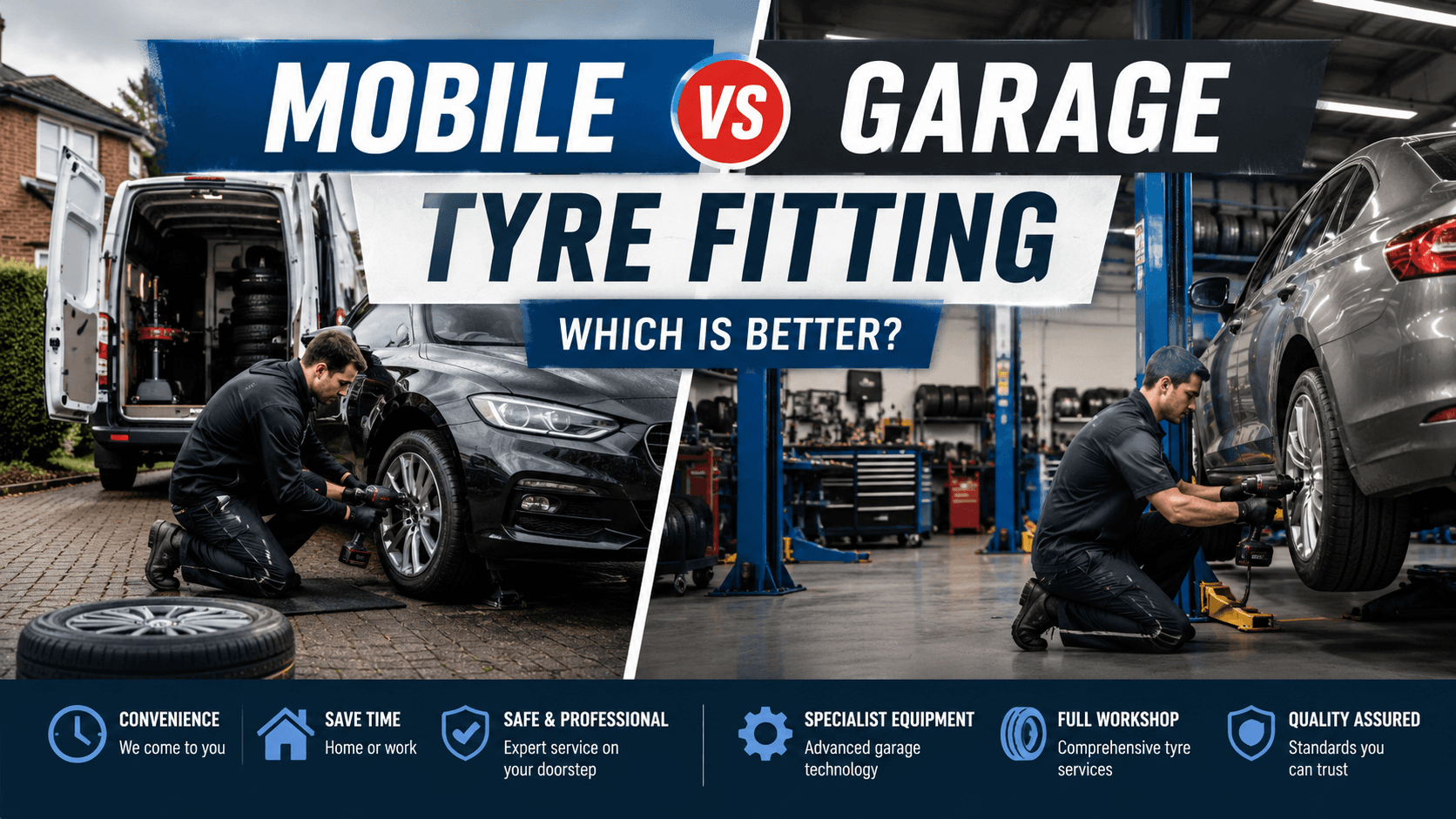
Mobile vs garage tyre fitting depends on your situation. Mobile fitting suits drivers who need tyres fitted at home, at work, or when the vehicle is unsafe to drive. Garage fitting suits vehicles that need wheel alignment, MOT checks, brake work, suspension checks, or deeper workshop inspection.
This comparison explains how UK drivers should choose between mobile tyre fitting and garage tyre fitting. The guide compares convenience, cost, equipment, wheel balancing, tyre damage, puncture repair, roadside safety, and specialist vehicle needs. The page uses safety framing from GOV.UK MOT tyre inspection guidance, National Highways motorway guidance, and TyreSafe puncture repair advice.
What is the difference between mobile and garage tyre fitting?
Mobile tyre fitting sends a tyre technician to your home, workplace, driveway, or another safe location. Garage tyre fitting requires the vehicle to visit a workshop or tyre centre. Mobile fitting solves convenience and unsafe-driving problems, while garage fitting supports wider vehicle checks, workshop equipment, wheel alignment, MOT work, and extra mechanical services.
What mobile tyre fitting means
Mobile tyre fitting means a trained technician brings tyre fitting equipment to the vehicle. The technician usually carries a mobile tyre changer, compressor, jack, torque wrench, wheel balancing equipment, valves, and selected tyres in a fitting van. The service works best when the vehicle has safe access, enough space, keys available, and the locking wheel nut ready.
What garage tyre fitting means
Garage tyre fitting means a tyre technician fits replacement tyres inside a fixed workshop. The garage usually has service bays, stock storage, ramps, hydraulic lifts, alignment equipment, and access to broader repair tools. The workshop setting helps when the vehicle also needs tracking, brake checks, suspension inspection, MOT preparation, or another mechanical diagnosis.
What the user is really deciding
Drivers compare mobile and garage tyre fitting because both options solve different parts of the tyre replacement journey. The decision depends on location, urgency, safety, cost, tyre size, tyre condition, equipment need, and appointment availability. A simple comparison helps the driver match the fitting source to the vehicle problem.
Decision Factor Mobile Tyre Fitting Garage Tyre Fitting Service location Home, workplace, driveway, or safe parked location Workshop, tyre depot, service bay, or garage Best use case Convenience, flat tyre, no spare wheel, unsafe drive Alignment, MOT checks, brake checks, deeper inspection Main limitation Location safety, stock, weather, and equipment boundaries Travel, waiting time, appointment availability, vehicle drivability
Is mobile tyre fitting as good as garage fitting?
Mobile tyre fitting can match garage fitting for standard tyre replacement when a reputable technician uses professional equipment and follows correct fitting, balancing, pressure, and torque procedures. Garage fitting becomes better when the vehicle needs wheel alignment, MOT inspection, suspension diagnosis, brake checks, or workshop-only equipment after the tyre change.
Technician skill and workmanship
Tyre fitting quality depends more on the technician and process than the building around the vehicle. A skilled mobile fitter removes the old tyre, checks the wheel, fits the replacement tyre, balances the wheel, checks tyre pressure, tightens wheel nuts correctly, and confirms the vehicle can leave safely. Our workshop review process treats tyre condition, access, and torque checks as non-negotiable service points.
Mobile fitting van equipment
A professional mobile fitting van carries compact equipment designed for tyre replacement away from a workshop. The van can include a tyre changer, bead breaker, compressor, wheel balancer, air tools, hand tools, jack, torque wrench, and disposal space for old tyres. The equipment supports standard fitting and balancing when the vehicle sits in a safe and accessible place.
Garage workshop advantages
A garage has stronger coverage when the tyre problem connects with another mechanical issue. The workshop can place the vehicle on a lift, inspect suspension components, check brakes, perform wheel alignment, and investigate abnormal tyre wear more easily. That broader inspection capacity makes garage fitting more suitable when tyre wear shows a deeper steering, suspension, or alignment problem.
Quality Factor Mobile Tyre Fitting Garage Tyre Fitting Standard tyre replacement Suitable when access and equipment match the job Suitable for routine and complex fitting jobs Wheel balancing Available with professional mobile balancing equipment Available with fixed workshop balancing equipment Wheel alignment Usually limited or unavailable on mobile visits Better suited through tracking and alignment equipment
Is mobile tyre fitting cheaper than a garage?
Mobile tyre fitting is not always cheaper or more expensive than garage fitting. The final price depends on tyre brand, tyre size, fitting fee, balancing, valve replacement, disposal, appointment time, and any call-out charge. Mobile fitting can still offer better value when it avoids travel, waiting time, towing, or lost working hours.
Tyre price, fitting fee and balancing cost
Tyre price usually changes because of brand, size, load rating, speed rating, and seasonal pattern. The fitting method does not automatically change the tyre itself. A transparent quote should separate the replacement tyre, fitting labour, wheel balancing, valve replacement, and old tyre disposal so the driver can compare mobile and garage prices fairly.
Call-out fees, disposal fees and hidden costs
Mobile tyre fitting can include a call-out fee because the technician travels to the vehicle. Emergency appointments, evening slots, weekend visits, unusual tyre sizes, and remote locations can increase the total charge. Garage fitting can also include separate fees for valves, balancing, disposal, tracking checks, or additional workshop work after inspection.
Time, travel and towing cost
Drivers should compare the full cost of the service rather than the tyre invoice alone. A garage visit can require fuel, public transport, taxi fare, lost working time, childcare changes, or recovery if the vehicle cannot be driven safely. Mobile fitting can reduce those indirect costs because the technician works where the vehicle already sits.
Cost Component Mobile Tyre Fitting Garage Tyre Fitting Comparison Note Tyre price Depends on tyre size, brand, load rating, and speed rating Depends on tyre size, brand, load rating, and speed rating The tyre specification drives the base product price Fitting and balancing Usually included or itemised in the mobile quote Usually included or itemised in the garage quote The quote should show whether balancing is included Call-out or travel May apply depending on provider, time, and area Usually paid indirectly through customer travel time The cheaper choice depends on total time and travel cost Extra workshop services Limited to mobile-capable tyre services Can include alignment, checks, and repairs Garage cost can rise when extra faults are found
When is mobile tyre fitting better?
Mobile tyre fitting is better when convenience, safety, and location matter more than workshop access. The service suits drivers who need tyres fitted at home, at work, on a driveway, or beside a safely parked vehicle. Mobile fitting also helps when a flat tyre, puncture, or missing spare makes driving unsafe.
Tyres fitted at home or work
Home and workplace fitting removes the need to drive to a tyre garage. The technician can fit tyres on a driveway, private parking space, or office car park when the area gives enough working room. This source context helps busy drivers avoid waiting rooms, rearranged lifts, and wasted travel time.
Flat tyre, no spare wheel or unsafe vehicle
Mobile fitting has strong value when a tyre fault makes the vehicle unsafe to move. A flat tyre, sudden pressure loss, or no spare wheel can turn a garage trip into a recovery problem. National Highways safety guidance also supports leaving dangerous motorway locations rather than treating a hard shoulder as a normal repair space.
Same-day convenience and busy schedules
Same-day mobile fitting can reduce disruption when tyre stock and technician availability match the job. Families, shift workers, fleet managers, disabled drivers, and office-based professionals often value a timed appointment at the vehicle location. The service works best when the driver confirms tyre size, postcode, parking access, keys, and locking wheel nut before arrival.
Situation Why Mobile Helps Driver Requirement Vehicle parked at home The fitter attends the driveway or safe parking space The vehicle needs space around the wheel area Vehicle parked at work The driver avoids garage travel during working hours The car park must allow safe technician access Tyre unsafe to drive The driver avoids further tyre, wheel, or suspension damage The vehicle must sit in a safe fitting location
Emergency mobile tyre fitting for unsafe tyres gives a safer route when the vehicle should not be driven to a garage.
When is garage tyre fitting better?
Garage tyre fitting is better when the vehicle needs more than a tyre replacement. A workshop suits wheel alignment, tracking, MOT checks, brake inspection, suspension diagnosis, and deeper tyre-wear investigation. Garage fitting also helps when a technician needs a hydraulic lift, specialist tools, multiple technicians, or broader stock access.
Wheel alignment and tracking
Wheel alignment and tracking are different from tyre fitting and wheel balancing. Tyre fitting places the tyre on the wheel, while balancing helps the wheel rotate smoothly. Wheel alignment adjusts the angles of the wheels, so a garage or alignment centre usually handles full tracking checks with specialist equipment.
MOT, brakes, suspension and broader repair checks
A garage is stronger when tyre wear points to another vehicle fault. Uneven tread wear, steering pull, vibration, brake noise, or suspension movement can need inspection beyond a mobile tyre change. GOV.UK MOT tyre inspection guidance treats tyre condition, tread, damage, valves, and tyre pressure monitoring concerns as roadworthiness issues.
Specialist workshop inspections
Workshop inspection becomes more useful when the vehicle has unusual wear, accident damage, seized wheel nuts, or repeated pressure loss. A garage can lift the vehicle, inspect the wheel assembly, check surrounding components, and carry out related mechanical work. That wider diagnostic capacity helps when the tyre problem is only one symptom.
Garage-Suitable Situation Workshop Advantage Reason Uneven tyre wear Alignment and suspension checks The tyre pattern may show a geometry or component issue MOT-related tyre concern Roadworthiness inspection The garage can check wider vehicle condition Brake or suspension symptoms Mechanical diagnosis The tyre issue may connect with another safety system
Can mobile tyre fitters balance wheels?
Professional mobile tyre fitters can balance wheels when their van carries the correct wheel balancing equipment. Wheel balancing helps reduce vibration after a tyre change by correcting uneven weight around the wheel assembly. Wheel alignment is different because it adjusts wheel angles, so full tracking usually needs garage or alignment-centre equipment.
Mobile wheel balancing equipment
Mobile wheel balancing uses a portable balancer and balancing weights after the tyre has been fitted. The technician checks the wheel assembly and adds weights where needed to support smoother rotation. The process helps reduce steering vibration, uneven ride feel, and premature tyre wear after replacement.
Wheel balancing vs wheel alignment
Wheel balancing and wheel alignment solve different tyre-related problems. Balancing corrects weight distribution on the wheel, while alignment corrects the direction and angle of the wheels against manufacturer geometry. This distinction matters because many drivers expect a mobile fitter to handle tracking when the correct service is a garage alignment check.
Service What It Does Mobile or Garage? Tyre fitting Removes the old tyre and fits the replacement tyre Mobile and garage Wheel balancing Corrects uneven weight around the wheel assembly Mobile and garage when equipment is available Wheel alignment Adjusts wheel angles and tracking geometry Usually garage or alignment centre
Mobile wheel balancing for vibration after fitting supports drivers who need balancing with a tyre replacement appointment.
Can mobile tyre fitters repair punctures or replace damaged tyres?
Mobile tyre fitters can repair some punctures or replace damaged tyres when the tyre condition allows safe work. A professional must inspect the tread, sidewall, valve, pressure loss, and damage location before repair. TyreSafe puncture repair guidance links repairability to British Standard limits, so sidewall or critical-area damage usually requires replacement.
Repairable punctures and tread-area limits
Puncture repair depends on the tyre damage location and tyre condition. TyreSafe advises that professional repair standards follow British Standard BS AU 159, which limits repairs to suitable areas and conditions. A mobile fitter should inspect the puncture before deciding whether the tyre can be repaired or must be replaced.
Sidewall damage, valves, TPMS and tyre condition
Sidewall damage usually changes the decision from repair to replacement because the tyre structure may be weakened. Valve faults, pressure loss, visible cords, bulges, cuts, and TPMS warning lights can also signal a tyre safety issue. GOV.UK MOT inspection guidance includes tyre condition, pressure monitoring, valves, tread, and structural damage within roadworthiness checks.
Tyre Issue Possible Outcome Why Inspection Matters Small tread-area puncture Repair may be possible The technician must confirm location, size, and internal condition Sidewall damage Replacement is usually required The sidewall supports tyre structure and load TPMS warning or rapid pressure loss Inspection is required before repair or replacement The pressure issue may involve tyre, valve, or sensor-related faults
Mobile puncture repair for tread-area damage helps when a technician can inspect the tyre safely at the vehicle location.
Is it safe to drive to a garage with a flat or damaged tyre?
Driving to a garage with a flat or badly damaged tyre can be unsafe because the tyre may lose structure, damage the wheel, reduce control, or fail further. A driver should avoid driving when the tyre is flat, visibly damaged, below legal tread depth, losing pressure quickly, or causing severe vibration.
Unsafe-to-drive warning signs
Unsafe tyre signs should stop a driver from treating the journey as normal. A flat tyre, exposed cords, bulges, sidewall cuts, rapid deflation, severe vibration, damaged valve, or dashboard TPMS warning can indicate a roadworthiness problem. The safer action is a mobile fitting appointment, recovery, or inspection from a safe parked location.
Roadside, motorway and hard shoulder safety limits
Motorway tyre problems need safety-first handling before any fitting decision. National Highways guidance tells drivers to leave the motorway at the next exit or emergency area when possible and to keep clear of live traffic. A mobile tyre service should not be presented as normal work on live lanes or unsafe hard shoulders.
When mobile fitting or recovery is safer
Mobile fitting becomes safer when the vehicle can be moved or parked in a suitable place. A driveway, private car park, forecourt, or off-road location gives a technician a controlled work area. Recovery becomes the better option when the vehicle remains exposed to traffic, blocks a carriageway, or cannot be reached safely.
Condition Drive to Garage? Better Action Fully flat tyre No, unless professional advice confirms safe movement Use mobile fitting or recovery from a safe location Sidewall bulge or cut No Arrange inspection and likely tyre replacement Minor pressure warning only Maybe, after pressure check and visible inspection Check tyre condition before deciding Vehicle on motorway hard shoulder No normal fitting decision applies Follow National Highways safety guidance and request help
Can mobile tyre fitting work for EVs, vans, run-flats and SUVs?
Mobile tyre fitting can work for EVs, vans, SUVs, run-flats, and low-profile tyres when the technician has the correct tyre, load rating, equipment, and safe access. Specialist vehicles need confirmation before booking because tyre weight, wheel size, TPMS, reinforced sidewalls, and commercial load requirements can affect fitting suitability.
EV tyres and load rating
EV tyre fitting needs correct size, load rating, speed rating, and pressure requirements because electric vehicles can carry heavy battery weight. Many EVs also use TPMS, low rolling resistance tyres, or manufacturer-specific tyre specifications. A mobile fitter should confirm the tyre specification before accepting the booking.
Van, SUV and fleet tyre fitting
Van and SUV tyre fitting depends on load index, wheel size, parking access, and vehicle weight. Fleet vehicles add downtime pressure because each hour off-road can affect work schedules. Mobile fitting can reduce fleet disruption when the technician carries the correct commercial tyre and the vehicle is parked safely.
Run-flat and low-profile tyre limits
Run-flat and low-profile tyres can need stronger equipment control because the sidewalls and wheel profiles can be harder to handle. A mobile fitter may still replace them when the van equipment matches the tyre and wheel combination. The driver should confirm tyre type, wheel size, and vehicle model before appointment confirmation.
Vehicle or Tyre Type Mobile Suitability Check Before Booking Electric vehicle Suitable when tyre specification and equipment match Load rating, speed rating, TPMS, tyre size Commercial van Suitable when commercial tyre stock is available Load index, parking access, wheel size SUV or 4x4 Suitable for many standard replacements Tyre size, vehicle weight, safe jacking points Run-flat tyre Possible when equipment supports the tyre construction Run-flat type, wheel size, technician capability
How do you choose between mobile fitting and a garage?
Choose mobile tyre fitting when the vehicle needs a standard tyre replacement at home, work, or another safe location. Choose garage tyre fitting when the vehicle needs alignment, MOT work, brake checks, suspension checks, or deeper inspection. Do not drive when the tyre is flat, badly damaged, illegal, or unsafe.
Quick decision table
The quickest way to choose is to match the service source to the vehicle need. Mobile fitting solves location and convenience problems. Garage fitting solves broader workshop inspection and alignment problems.
Driver Situation Choose Mobile Choose Garage Reason Routine tyre replacement at home Yes Optional Mobile fitting saves travel and waiting time Flat tyre on driveway Yes No, unless recovered The vehicle may be unsafe to drive Uneven tyre wear and steering pull Maybe for tyre replacement Yes The vehicle likely needs alignment or inspection Need MOT, brakes, and tyres together No Yes The garage can handle multiple workshop services
Choose mobile if
The vehicle has a flat tyre at home or work.
The driver wants tyres fitted on a driveway or safe car park.
The vehicle has no usable spare wheel.
The driver wants to avoid garage travel and waiting time.
The tyre replacement does not need alignment or broader repairs.
Choose garage if
The vehicle needs wheel alignment or tracking.
The vehicle needs MOT work or a roadworthiness inspection.
The driver notices brake, steering, or suspension symptoms.
The tyre wear pattern suggests a deeper mechanical issue.
The tyre size or vehicle type needs specialist workshop handling.
Do not drive if
The tyre is fully flat or losing pressure quickly.
The tyre has visible sidewall damage, cords, bulges, or cuts.
The vehicle vibrates severely or pulls sharply after tyre damage.
The tyre appears below legal tread depth or fails roadworthiness checks.
The vehicle sits on a motorway hard shoulder or live traffic area.
Book Mobile Tyre Fitting After This Comparison
Mobile tyre fitting service at home or work helps when your vehicle needs a safe, convenient tyre replacement without a garage visit. Check your tyre size, postcode, parking access, and locking wheel nut, then book a mobile technician for the right fitting slot.
Book mobile tyre fitting service at home or work
What questions do drivers ask about mobile vs garage tyre fitting?
Drivers usually ask whether mobile tyre fitting is cheaper, safer, faster, and as professional as garage tyre fitting. The best answer depends on tyre condition, vehicle location, fitting equipment, alignment needs, and emergency risk. The FAQs below answer the comparison questions that affect booking decisions.
Is mobile tyre fitting better than garage tyre fitting?
Mobile tyre fitting is better when convenience and safe vehicle location matter most. The service suits home fitting, workplace fitting, flat tyres, no spare wheel situations, and drivers who cannot waste time travelling to a garage. Garage fitting is better when the vehicle needs wheel alignment, MOT checks, brake inspection, suspension diagnosis, or broader workshop support after tyre replacement.
Is mobile tyre fitting cheaper than garage fitting?
Mobile tyre fitting is not automatically cheaper than garage fitting. The final cost depends on tyre brand, tyre size, fitting labour, balancing, valve replacement, disposal, call-out charge, and appointment time. Mobile fitting can offer better total value when it saves travel, waiting time, taxi cost, recovery cost, or lost working hours.
Are mobile tyre fitters reliable?
Mobile tyre fitters are reliable when the provider uses trained technicians, professional equipment, clear pricing, and safe fitting procedures. A good technician checks tyre size, fits the tyre correctly, balances the wheel, checks pressure, tightens wheel nuts correctly, and removes the old tyre. Drivers should check reviews, insurance, availability, and service limitations before booking.
Can mobile tyre fitters balance wheels?
Mobile tyre fitters can balance wheels when their van carries a suitable wheel balancing machine. Wheel balancing corrects uneven weight around the wheel assembly after tyre fitting. The process helps reduce vibration and supports smoother rotation. Wheel alignment is a separate service because alignment adjusts wheel angles and usually needs garage or alignment-centre equipment.
Can mobile tyre fitters do wheel alignment?
Mobile tyre fitters usually cannot complete full wheel alignment during a standard tyre fitting visit. Wheel alignment, also called tracking, adjusts wheel geometry with specialist equipment. A garage or alignment centre is normally better for that work. Drivers should book alignment when tyres wear unevenly, steering pulls, or the vehicle feels unstable after tyre replacement.
Can I get tyres fitted at home or work?
You can get tyres fitted at home or work when the vehicle has safe access and enough space around the wheel area. A driveway, private parking bay, or office car park usually works better than a narrow road. The driver should provide keys, confirm tyre size, clear the work area, and keep the locking wheel nut available.
Can mobile fitters replace tyres at the roadside?
Mobile fitters can replace tyres at the roadside only when the location is safe for the technician and vehicle. A quiet off-road place, private car park, or safe lay-by can be suitable. A motorway hard shoulder, live lane, or exposed traffic location is not a normal fitting environment. Drivers should follow National Highways safety guidance first.
When should I choose a garage instead?
You should choose a garage when the vehicle needs more than a standard tyre replacement. Wheel alignment, MOT checks, brake repairs, suspension inspection, seized wheel nuts, and repeated uneven tyre wear usually need workshop equipment. A garage also helps when the technician must lift the vehicle, inspect surrounding parts, or complete related mechanical work.
Can mobile fitters replace run-flat tyres?
Mobile fitters can replace some run-flat tyres when their equipment supports the tyre construction and wheel size. Run-flat tyres have reinforced sidewalls, so fitting can require stronger equipment and careful handling. The driver should confirm the vehicle model, tyre size, run-flat status, and TPMS setup before the appointment is accepted.
Do I need wheel alignment after new tyres?
You do not always need wheel alignment after new tyres. Alignment becomes more important when the old tyres showed uneven wear, the steering pulls, the vehicle vibrates, or the car recently hit a kerb or pothole. New tyres can wear faster when wheel geometry is incorrect, so a garage alignment check helps protect the replacement tyres.