Can you drive on a flat tyre
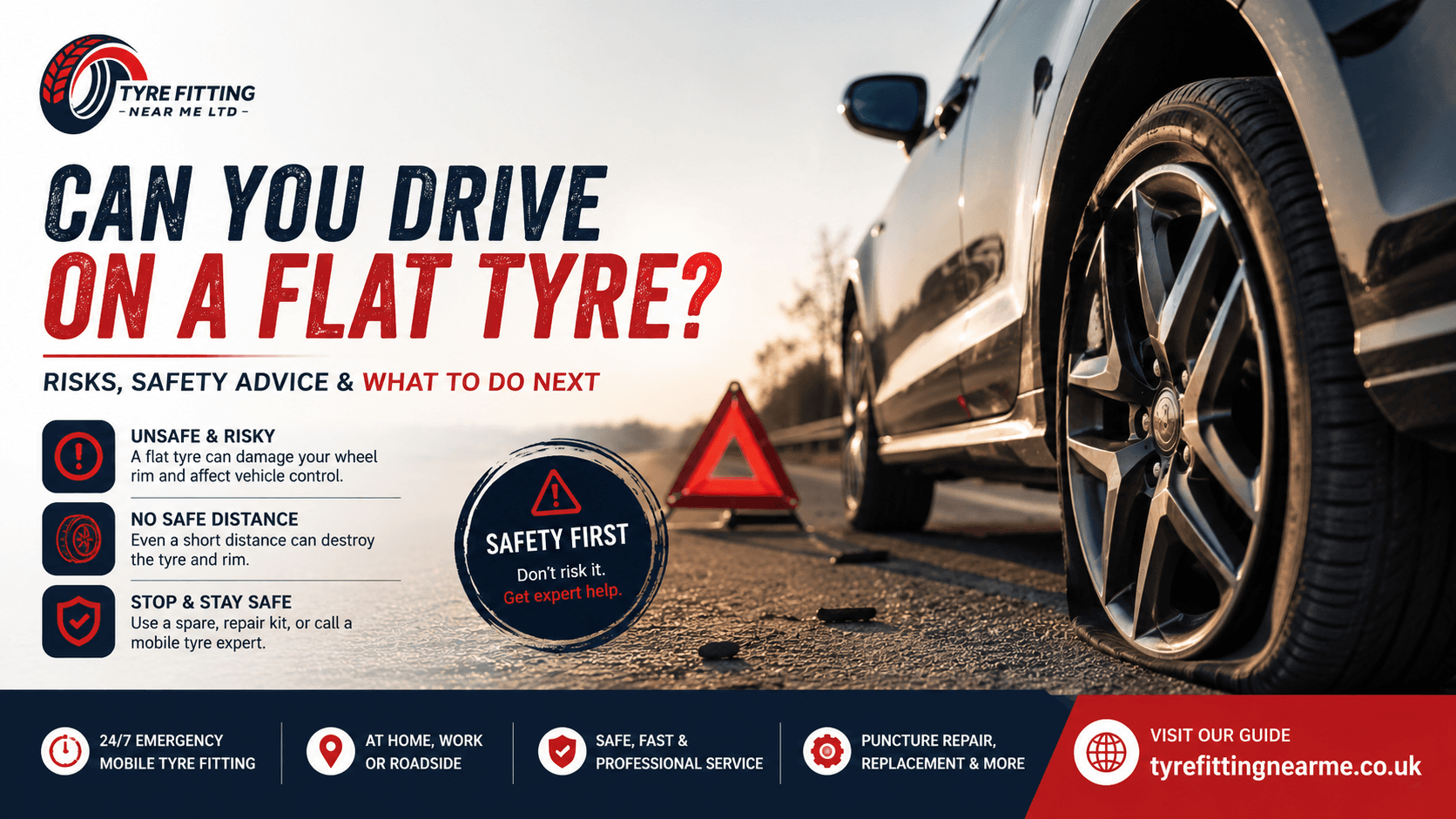
Do not continue driving on a fully flat conventional tyre. A flat tyre reduces steering control, affects braking, damages the tyre sidewall, and can expose the wheel rim to road contact. Stop in a safe place, then use a spare tyre, suitable mobility kit, roadside assistance, or mobile tyre fitter.
This guide explains when a driver should stop, when minimal emergency movement may be justified, and how tyre type changes the answer. The page separates a fully flat conventional tyre, low tyre pressure, slow puncture, run-flat tyre, motorway breakdown, and temporary repair choice, so the driver can make a safe roadside decision.
Can you drive on a flat tyre?
You should not drive on a fully flat conventional tyre because the tyre no longer supports the vehicle correctly. The collapsed sidewall reduces vehicle stability, weakens steering response, and increases the risk of wheel rim damage. The safest action is to stop as soon as traffic conditions allow and choose repair, replacement, or recovery.
What is the safest answer for a conventional tyre?
A conventional tyre needs air pressure to carry vehicle load. A fully flat conventional tyre places the vehicle weight on the tyre sidewall and rim edge, so normal onward driving becomes unsafe. The driver should stop in a safe location and review the repairable vs non-repairable puncture guide before deciding whether the tyre needs repair or replacement.
When is moving the car only a few metres acceptable?
Emergency movement may be acceptable when the vehicle blocks a live traffic lane or creates an immediate collision risk. The driver should move only the shortest necessary distance at walking speed to reach a safer position. This exception does not make driving to a garage safe.
Why does a flat tyre change vehicle control?
A flat tyre changes vehicle control because the tyre loses its shape, grip, and load support. The vehicle may pull to one side, respond poorly to steering, and brake unevenly. These control changes increase danger before visible wheel damage appears.
How far can you drive on a flat tyre?
No universal safe distance exists for a fully flat conventional tyre. A few metres may be justified only to escape immediate danger, but 500 metres, one mile, or ten minutes can damage the tyre and rim. Distance risk depends on pressure state, tyre type, road surface, vehicle load, and speed.
Scenario Is it safe? Main risk Best action A few metres from danger Only when necessary Sidewall crushing and rim contact Move to safety at walking speed 500 metres on a fully flat tyre No reliable safe distance Tyre destruction and rim scraping Stop and arrange repair or recovery One mile on a fully flat tyre Unsafe for a conventional tyre Wheel rim, sidewall, and suspension stress Call roadside assistance or mobile fitting Run-flat tyre after pressure loss Conditionally limited Heat, friction, and manufacturer limit breach Follow vehicle handbook and tyre guidance
Can you drive 500 metres on a flat tyre?
You should not plan to drive 500 metres on a fully flat conventional tyre. That distance can crush the sidewall and expose the wheel rim, especially on rough roads. The safer option is stationary repair, spare wheel fitting, mobile tyre fitting, or recovery.
Can you drive one mile on a flat tyre?
You should not drive one mile on a fully flat conventional tyre. One mile gives the tyre more time to overheat, tear, and separate from its usable structure. The wheel rim may contact the road after the tyre stops cushioning the wheel.
Can you drive five or ten minutes on a flat tyre?
Time does not create a safe flat tyre limit. Five minutes at low speed and ten minutes in traffic can both damage the tyre when pressure has dropped to zero. Tyre type, speed, road surface, load, and remaining air pressure create the real risk profile.
What distance risks damaging the wheel rim?
Any movement on a fully flat tyre can risk wheel rim damage. The risk increases when the tyre sidewall collapses and the rim edge begins carrying load directly. Alloy wheels face scraping, bending, or cracking when the tyre no longer cushions road impact.
Can you drive slowly on a flat tyre?
Slow driving does not make a fully flat conventional tyre safe. Lower speed may reduce impact force, but it does not restore tyre pressure, sidewall support, road grip, or rim protection. A driver should treat slow driving as an emergency movement option only, not a method for reaching a garage.
Why does low speed not make a flat tyre safe?
Low speed fails to solve the main tyre problem. The tyre still lacks internal pressure, so the sidewall folds, heats, and carries load incorrectly. The wheel rim can still touch the road, and the vehicle can still pull, wobble, or brake unevenly.
What should you do instead of driving slowly?
The driver should stop in a safe place, switch on hazard lights, and assess the tyre condition. A spare tyre, suitable mobility kit, roadside assistance, or mobile tyre fitting for flat tyre replacement prevents extra damage. Drivers arranging help at their property can also read can you get tyres fitted at home. The next decision depends on whether the tyre is low, punctured, fully flat, or run-flat.
Can you drive to a garage on a flat tyre?
You should not drive to a garage on a fully flat conventional tyre. A nearby garage does not remove the risk of tyre sidewall failure, rim damage, and reduced vehicle control. Read the mobile vs garage tyre fitting comparison before choosing how to get help. A garage journey may be reasonable only when the tyre still holds pressure, the leak is slow, and the vehicle remains controllable.
Tyre condition Can you drive? Safer option Fully flat conventional tyre No normal onward driving Use spare, mobile fitter, or recovery Low pressure but tyre holds shape Only after pressure check and inspection Inflate to correct pressure and visit a tyre centre Slow puncture Conditionally, with prompt inspection Read can a puncture be repaired and book prompt inspection Visible sidewall tear or blowout No Call roadside assistance or recovery
What if the tyre is fully flat?
A fully flat tyre should stop the journey. The tyre has lost the pressure needed to support the vehicle, so the sidewall and rim absorb forces that the tread normally manages. A mobile fitter or recovery service protects the wheel from avoidable damage.
What if the tyre is low but still holding air?
A low-pressure tyre needs inspection before further travel. The driver should check pressure with a gauge, inspect the tread and sidewall, and inflate to the vehicle’s recommended pressure when safe. Falling pressure after reinflation signals a puncture or valve issue.
What if the garage is very close?
A close garage still does not create a guaranteed safe distance. A collapsed tyre can fail within metres when the rim edge pinches the sidewall. The driver should choose stationary help when visible flattening, sidewall damage, or heavy steering appears.
Can you drive to a petrol station for air?
You can drive to a petrol station for air only when the tyre is low, still shaped, and not visibly damaged. A fully flat tyre, sidewall tear, blowout, or rim contact needs stopping and recovery. An inflator helps pressure loss only when the tyre can still hold air.
When can an inflator help?
An inflator can help when the tyre has low pressure or a slow leak. The tyre must still hold shape, and the driver must check whether pressure drops again after inflation. A repeated pressure drop requires tyre pressure warning light diagnosis or professional inspection.
When should you not inflate and drive?
A driver should not inflate and drive after a blowout, sidewall tear, large tread hole, exposed cords, or visible wheel damage. Tyre sealant and air cannot restore a structurally damaged tyre. Recovery becomes safer when the tyre cannot hold pressure.
What pressure should you inflate to?
The correct tyre pressure comes from the vehicle handbook, fuel flap label, or driver-side door pillar sticker. The driver should avoid guessing because front and rear tyre pressures can differ. Correct pressure supports handling, braking, and tyre temperature control.
How far can you drive on run-flat tyres?
Run-flat tyres may allow limited travel after pressure loss, but the limit belongs to the tyre and vehicle manufacturer. Many references mention around 50 miles and restricted speed, but that guidance must not be applied to ordinary tyres. The driver should check sidewall markings, handbook instructions, and dashboard warnings, then arrange mobile run-flat tyre replacement when the tyre has reached its permitted limit.
Tyre type Distance guidance Speed guidance Qualification Conventional tyre No safe planned distance when fully flat Emergency movement only Stop and recover the vehicle Run-flat tyre Manufacturer-specific limited range Manufacturer-specific restricted speed Check vehicle handbook and tyre markings Temporary spare Short emergency use only Speed-limited by vehicle guidance Follow the vehicle handbook for spare tyre distance and speed restrictions
What makes a run-flat tyre different?
A run-flat tyre uses reinforced support to maintain limited shape after pressure loss. The design gives the driver enough controlled mobility to reach a safer place in many cases. The reinforced structure does not make the tyre indestructible.
Do all run-flat tyres allow 50 miles?
All run-flat tyres do not share one universal limit. The vehicle manufacturer and tyre manufacturer define the permitted distance, permitted speed, vehicle load, and replacement requirements. Generic “50 miles” advice becomes unsafe when applied without checking the handbook.
How do you know whether your tyres are run-flat?
The driver can check run-flat status through sidewall markings, vehicle handbook details, and professional tyre inspection. Visual shape alone can mislead because run-flat tyres may resemble conventional tyres. A tyre centre can confirm the correct specification before the driver relies on restricted travel.
What is the difference between a flat tyre, slow puncture and low tyre pressure?
A flat tyre, slow puncture, and low-pressure tyre describe different pressure states. A flat tyre has lost most or all air, a slow puncture loses air gradually, and low pressure may result from temperature change, valve leakage, or underinflation. The correct action depends on visible shape, pressure reading, and leak rate.
Condition Common signs Risk level Correct action Fully flat tyre Collapsed sidewall, heavy steering, flapping noise High Stop and arrange replacement or recovery Slow puncture Gradual pressure loss, nail in tread, repeated TPMS alert Medium to high Inflate if safe and book prompt inspection Low tyre pressure Warning light, softer handling, no visible collapse Medium Check pressure and inflate to specified value Tyre blowout Bang, rapid deflation, sudden instability Critical Stop safely and call professional assistance
How can you tell if the tyre is fully flat?
A fully flat tyre often shows a collapsed sidewall, rim sitting close to the road, heavy steering, or a flapping sound. The vehicle may pull sharply toward the damaged side. The driver should stop before the rim starts scraping the road surface.
How can you tell if it is a slow puncture?
A slow puncture usually creates gradual pressure loss across hours or days. A nail, screw, valve leak, or bead leak can allow air to escape while the tyre still looks partly inflated. The driver should arrange puncture repair eligibility after tyre pressure loss before the tyre becomes fully flat.
How should you respond to a TPMS warning light?
A TPMS warning light means tyre pressure has fallen below the vehicle’s monitored threshold. Pirelli’s supplied guidance states modern TPMS systems alert when pressure drops more than 25% below normal value. The driver should stop safely, check pressure, inspect the tyre, and avoid assuming the tyre is still safe.
What damage does driving on a flat tyre cause?
Driving on a flat tyre can damage the tyre sidewall, wheel rim, steering response, braking behaviour, suspension parts, and wheel alignment. The damage begins when tyre pressure can no longer hold the tyre shape under vehicle load. Continued movement increases heat, friction, rim exposure, and repair cost.
Component Damage mechanism Why it matters Tyre sidewall Crushing, folding, overheating, tearing Sidewall damage often prevents safe repair Wheel rim Road contact, scraping, bending, cracking Rim damage can require wheel repair or replacement Steering and braking Uneven grip and unstable load transfer Vehicle control becomes less predictable Suspension and alignment Extra shock and uneven wheel movement Inspection may be needed after extended driving
How does a flat tyre damage the sidewall?
A flat tyre damages the sidewall by forcing rubber and internal structure to fold under load. Heat and friction build as the wheel rolls over the collapsed tyre. Tyre sidewall damage and repair limits often make replacement safer than repair.
How does a flat tyre damage the wheel rim?
A flat tyre damages the wheel rim when the tyre no longer cushions the wheel from the road. The rim edge can scrape, bend, or crack after direct impact. Wheel rim damage from driving on a flat tyre needs inspection before normal driving resumes. A free tyre health check can assess tread, sidewall, pressure, valve, age, and wear pattern.
Can a flat tyre affect steering, braking or suspension?
A flat tyre can affect steering, braking, and suspension because one wheel loses stable contact geometry. The car may pull, vibrate, or stop unevenly. Suspension components may experience extra stress when the rim and tyre absorb road impact incorrectly.
Can the tyre still be repaired after being driven flat?
A tyre driven flat may be repairable only after professional internal inspection. The technician must check sidewall damage, tread puncture location, bead condition, and carcass integrity. A visually small puncture can hide internal damage. When replacement is required, the part-worn vs new tyres guide explains the safety, legality, tread-life, and value differences.
What should you do when you get a flat tyre?
You should reduce speed smoothly, stop in a safe place, switch on hazard lights, and keep passengers away from traffic. The next action depends on tyre condition, road position, available equipment, and personal safety. A spare tyre, mobility kit, roadside assistance, or mobile tyre fitter can resolve the incident.
How should you stop safely?
The driver should hold the steering wheel firmly and avoid sudden braking.
The driver should slow down gradually while checking traffic around the vehicle.
The driver should move toward a safe lay-by, car park, or refuge when available.
The driver should switch on hazard lights after reaching a safer stopping position.
Passengers should leave the vehicle only when the road position allows safe exit.
Should you fit a spare tyre or use a mobility kit?
A spare tyre helps when the vehicle has a safe changing location and correct equipment. A mobility kit helps only with compatible punctures, usually minor tread damage. The driver should avoid roadside wheel changes when traffic, darkness, weather, or ground conditions create danger.
When should you call roadside assistance or a mobile tyre fitter?
The driver should call help when the tyre is fully flat, the sidewall is damaged, no spare tyre exists, or the road position is unsafe. Roadside assistance for a flat tyre emergency protects the driver from traffic exposure and prevents extra vehicle damage.
What should you do with a flat tyre on a motorway?
A motorway flat tyre requires personal safety before tyre repair. The driver should leave the live carriageway if possible, stop in the safest available place, switch on hazard lights, and wait away from traffic. A roadside tyre change on a motorway can expose passengers and the driver to high-speed vehicles.
Should you change a tyre on the motorway?
A driver should not normally change a tyre beside motorway traffic. Fast-moving vehicles, narrow shoulders, poor visibility, and unstable ground increase risk. Professional recovery or roadside assistance offers a safer process than a roadside wheel change.
Where should you wait for help?
The driver and passengers should wait away from traffic when safe exit is possible. A barrier side or designated refuge offers better protection than sitting near live lanes. Hazard lights and visible clothing improve visibility while assistance arrives.
When is minimal movement justified?
Minimal movement is justified when the vehicle’s current position creates immediate danger. The driver should move only far enough to reduce collision risk, then stop again. This movement remains an emergency action, not permission to continue the journey.
Can tyre foam, sealant, an inflator or a mobility kit fix a flat tyre?
Tyre foam, sealant, an inflator, or a mobility kit may provide temporary mobility for minor tread punctures, but they cannot fix every flat tyre. Sidewall damage, large holes, blowouts, wheel damage, and severe pressure loss need professional help. Temporary repairs should lead directly to inspection, repair, or replacement.
Tool Suitable for Not suitable for Next step Tyre inflator Low pressure or slow leak Blowout or sidewall tear Check pressure again and visit a tyre centre Tyre sealant Small tread puncture Large hole, sidewall damage, rim damage Drive only within kit instructions to inspection Mobility kit Temporary roadside mobility Shredded tyre or multiple flats Arrange professional tyre inspection Spare tyre Replacing one damaged tyre temporarily Unsafe road position or missing tools Follow spare speed and distance restrictions
When does tyre sealant help?
Tyre sealant helps when a small puncture sits in the tyre tread and the tyre can still hold pressure. The sealant blocks air loss temporarily and allows restricted movement under kit instructions. The driver still needs professional inspection because internal damage remains possible.
When does a mobility kit not work?
A mobility kit does not work for sidewall tears, blowouts, large tread holes, damaged wheels, or tyres already destroyed by flat driving. Sealant cannot rebuild tyre structure. Roadside recovery or mobile replacement becomes the safer choice in those cases.
Why is professional inspection still needed?
Professional inspection is needed because external appearance cannot confirm internal tyre safety. A technician checks tread injury, sidewall condition, bead seating, wheel rim condition, and pressure retention. The safest repair decision requires tyre removal and internal assessment.
Need help with a flat tyre now?
A fully flat tyre needs safe action, not guesswork. Book mobile tyre fitting, roadside assistance, or a professional puncture inspection before extra rim, sidewall, or suspension damage develops.
Frequently Asked Questions About Driving on a Flat Tyre
Can I drive 500 metres on a flat tyre?
No, you should not plan to drive 500 metres on a fully flat conventional tyre. That distance can damage the sidewall and expose the wheel rim to road contact. A few metres may be justified only when the vehicle blocks traffic or creates immediate danger. The safer option is spare tyre fitting, mobile tyre fitting, or recovery.
Can I drive one mile on a flat tyre?
No, one mile on a fully flat conventional tyre creates a high risk of tyre and rim damage. The tyre loses structural support when pressure drops to zero, so the sidewall can fold and tear. The vehicle may also pull to one side. A driver should stop safely and arrange professional help.
Can I drive ten minutes on a flat tyre?
No, ten minutes is not a safe measure for a fully flat tyre. Time does not define damage risk because speed, load, road surface, remaining pressure, and tyre type change the outcome. A short journey can still destroy the tyre. The driver should stop and inspect the tyre before moving again.
Can I drive slowly to a garage?
No, slow driving does not make a fully flat conventional tyre safe. Low speed reduces some impact force, but the tyre still lacks pressure and sidewall support. The wheel rim can still scrape the road. A nearby garage is safer to reach through a spare tyre, mobile fitter, or roadside recovery.
Can I drive to get air?
You can drive to get air only when the tyre is low, still shaped, and not visibly damaged. A fully flat tyre should not be driven to an air pump because the rim and sidewall may already be under stress. Use a portable inflator where safe or call professional help when the tyre cannot hold pressure.
How far can run-flat tyres travel?
Run-flat tyres can travel only within the tyre and vehicle manufacturer’s stated limits. Many general references mention around 50 miles with a restricted speed, but that figure should never apply to conventional tyres. The driver should check the vehicle handbook, sidewall markings, dashboard warning, and manufacturer guidance before relying on run-flat mobility.
Does driving on a flat tyre ruin the tyre?
Yes, driving on a fully flat tyre often ruins the tyre. The sidewall can fold, overheat, tear, and suffer hidden internal structural damage. A puncture that may have been repairable can become non-repairable after flat driving. A tyre technician must inspect the tyre internally before approving any repair.
Can driving on a flat tyre damage the rim?
Yes, driving on a flat tyre can damage the wheel rim. The tyre normally cushions the wheel from the road, but a collapsed tyre lets the rim edge contact the surface. Alloy wheels can scrape, bend, or crack. A visible flat tyre should prompt stopping before wheel damage increases.
Can a punctured tyre be repaired after being driven flat?
A punctured tyre may be repaired after being driven flat only when professional inspection confirms safe structure. The technician must assess puncture location, sidewall condition, tread injury, bead condition, and internal carcass damage. Sidewall damage or heat damage usually makes replacement safer. Repair eligibility cannot be confirmed by external viewing alone.
What should I do on a motorway with a flat tyre?
You should prioritise personal safety on a motorway with a flat tyre. Move out of live traffic only if you can do so safely, switch on hazard lights, and wait away from the carriageway. A motorway tyre change exposes people to high-speed traffic. Roadside assistance or recovery is the safer response.