
What to do if you get a flat tyre
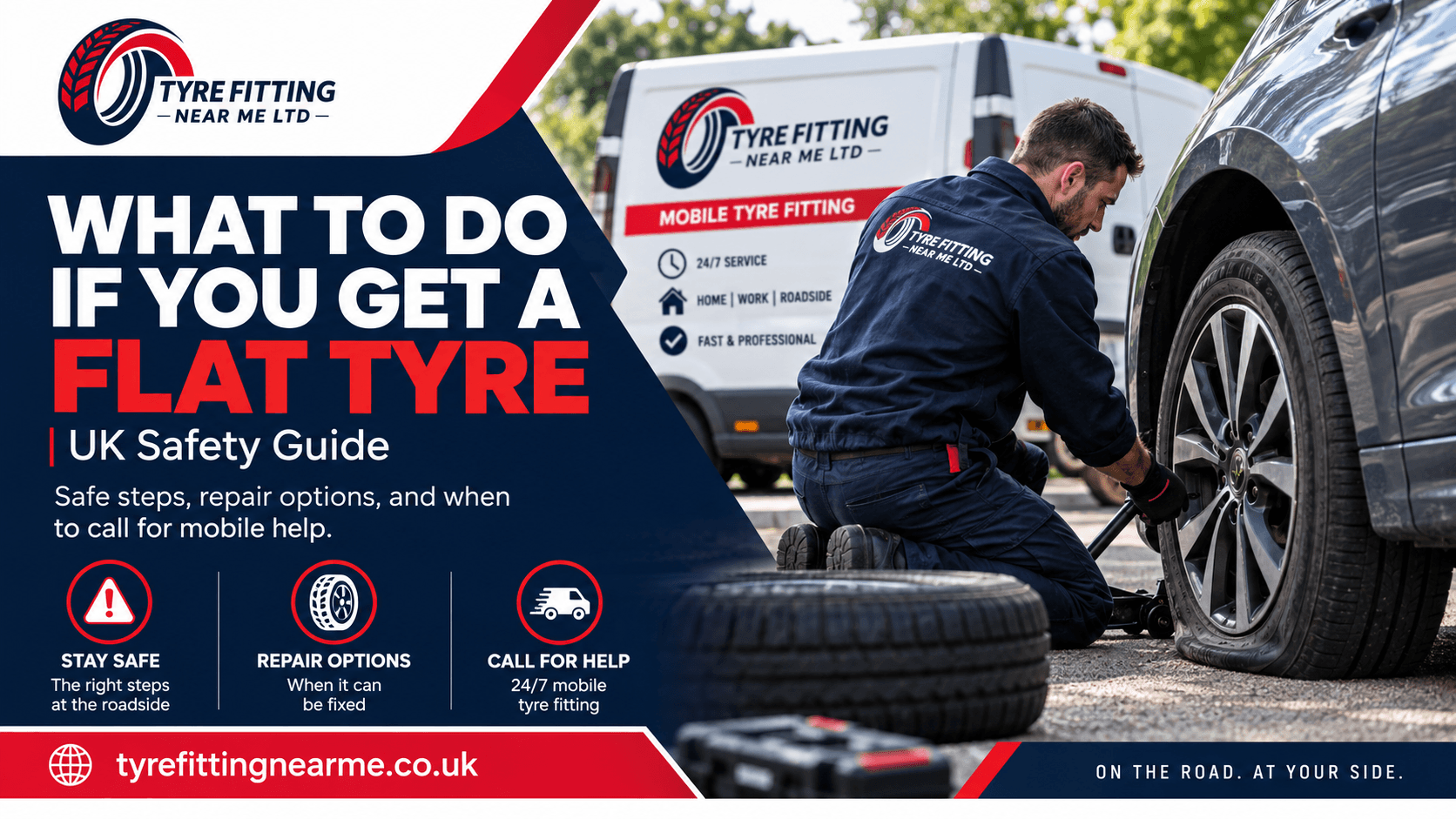
If you get a flat tyre, slow down gently, stop somewhere safe, turn on your hazard lights, apply the handbrake, and do not keep driving on the flat tyre. Check whether the tyre can hold air, whether you have a spare wheel or repair kit, and whether you need mobile help.
A flat tyre can happen on a driveway, in a car park, at work, or on the roadside. The safest next step depends on tyre pressure, visible damage, your location, available tools, and your confidence changing a wheel. Tyre Fitting Near Me Ltd helps drivers with mobile tyre fitting, puncture repair, emergency tyre fitting, and tyre safety checks at home, work, or roadside.
What should you do first if you get a flat tyre?
The first step after a flat tyre is safety. The driver should control the car, stop away from moving traffic, warn other road users, and avoid driving on the flat tyre unless movement is needed to reach a safer place. After stopping, the driver should inspect the tyre, check available equipment, and decide between inflation, repair, replacement, or callout help.
How should you stop safely?
Keep the steering wheel steady and avoid sudden steering movements.
Slow down gradually without harsh braking.
Move toward a safe stopping place, such as a lay-by, driveway, car park, or service area.
Switch on your hazard warning lights after stopping.
Apply the handbrake before checking the tyre.
A driver should not try to fix a tyre beside fast-moving traffic. A safe parking position gives the driver time to check tyre pressure, visible damage, repair-kit availability, and callout options.
What should you check before moving the car?
Check whether the tyre is fully flat or only partly low.
Check whether the wheel rim is touching the ground.
Check for a nail, screw, cut, bulge, split, or sidewall damage.
Check whether the car has a spare wheel, compressor, sealant kit, jack, and locking wheel nut key.
Check whether the location is safe enough for a tyre fitter to work.
If the car is unsafe to drive or the tyre will not hold air, book 24/7 emergency tyre fitting for flat tyres instead of risking wheel or tyre damage.
Can you drive on a flat tyre?
You should not drive on a flat tyre when the tyre has no usable pressure. A flat tyre cannot support the vehicle correctly, and continued driving can damage the tyre sidewall, inner liner, wheel rim, steering control, and braking stability. Short movement is only sensible when the car must be moved away from immediate danger.
What happens if you keep driving?
Driving condition Damage risk Safer action Tyre is fully flat Sidewall and inner liner damage Do not drive. Call mobile help. Wheel rim touches the road Bent, cracked, or scraped rim Stop and arrange repair or replacement. Car pulls heavily to one side Reduced steering and braking control Stop in the safest available place. Tyre holds pressure after inflation Possible slow puncture Drive only a short local distance for inspection.
Can you drive less than one mile to a garage?
You should not drive even one mile while the tyre remains flat. A short garage journey may be possible only when the tyre inflates, holds pressure, has no visible sidewall or rim damage, and the vehicle handles normally. If the tyre loses air again, use mobile repair instead.
Drivers who see repeated pressure loss should read the slow puncture causes and what to do guide before deciding whether the tyre needs repair or replacement.
How can you tell whether the tyre needs repair or replacement?
A tyre repair depends on damage location, puncture size, tread condition, sidewall condition, previous repairs, and internal tyre structure. A central tread puncture may be repairable after inspection. Sidewall damage, shoulder damage, bead damage, exposed cords, or damage caused by driving flat usually means the tyre needs replacement.
When can a puncture be repaired?
Tyre condition Repair chance Correct next step Small puncture in central tread Possible after inspection Book mobile puncture repair. Nail or screw in tread Possible if repair zone is safe Leave the object in place and get it inspected. Sidewall cut, bulge, or split Not normally repairable Arrange tyre replacement. Tyre driven while flat Often not repairable Ask for internal inspection before repair.
When should you book mobile puncture repair?
Book mobile puncture repair for nails, screws and slow leaks when the tyre may still be repairable and the car is parked safely. A technician can inspect the tyre, confirm whether the puncture meets repair rules, repair the tyre where safe, and reset pressure before the vehicle returns to the road.
What should you do if the flat tyre is at home or in a car park?
A flat tyre at home or in a car park gives you more time and safer working space than a live roadside location. The driver should check tyre pressure, inflate the tyre if safe, monitor pressure loss, inspect visible damage, and avoid driving if the tyre cannot support the vehicle.
Should you inflate the tyre first?
Check the tyre for sidewall damage, rim damage, bulges, cuts, and exposed cords.
Find the recommended tyre pressure on the door sticker, fuel flap, or vehicle handbook.
Inflate the tyre with a compressor only when the tyre looks structurally safe.
Wait and check whether the tyre loses pressure again.
Call a mobile fitter if the tyre drops quickly or remains flat.
When is a mobile fitter better than a garage?
A mobile fitter is usually better when the car cannot be driven safely, the tyre is fully flat, the driver has no spare wheel, or the garage trip risks extra damage. Book mobile tyre fitting at home, work or roadside when the tyre needs replacing where the vehicle is parked.
What should you do if you have no spare tyre?
Many modern cars carry a tyre repair kit instead of a spare wheel. The driver should check the boot floor, side compartments, toolkit area, handbook, compressor, sealant bottle, jack, and locking wheel nut key before deciding that no equipment is available.
What equipment should you look for?
Item Common location Why it matters Spare wheel Under boot floor or under vehicle Allows temporary wheel replacement. Compressor Boot storage or repair-kit pouch Inflates tyre after pressure loss. Sealant bottle Repair-kit pouch Temporarily seals some tread punctures. Locking wheel nut key Glove box, boot toolkit, or wheel bag Allows the wheel to be removed safely.
What if the locking wheel nut key is missing?
A missing locking wheel nut key can stop a spare-wheel change, tyre repair, or tyre replacement. The driver should check the glove box, boot, under-seat storage, and wheel brace bag. If the key is lost, book mobile locking wheel nut removal without alloy damage.
How do you use a tyre repair kit or sealant?
A tyre repair kit is a temporary mobility tool, not a permanent tyre repair. The kit usually includes sealant and a compressor. The driver should use it only when the puncture is small, the tyre has no sidewall damage, the wheel is not damaged, and the vehicle handbook allows kit use.
When can sealant help?
The puncture sits in the tread area.
The hole is small enough for the kit instructions.
The tyre can inflate and hold pressure.
The sidewall has no split, bulge, or visible structure damage.
The driver can reach a tyre specialist soon after using the kit.
What should you do after using sealant?
After using sealant, drive only as far as the kit instructions allow and arrange professional inspection quickly. Tell the technician that sealant was used because some products can affect later repair work. A sealed tyre still needs internal assessment, pressure correction, and a repair or replacement decision.
What should you do if the TPMS warning light comes on?
A TPMS warning light means the tyre pressure monitoring system has detected a pressure issue or sensor fault. The driver should check tyre pressure, inspect the tyre for visible damage, inflate only to the recommended pressure, and avoid ignoring a warning that returns after inflation.
When does TPMS mean a puncture?
A TPMS warning often points toward a puncture when the same tyre loses pressure again after inflation. The cause may be a nail, screw, valve leak, bead leak, damaged rim, or slow puncture. A pressure warning that returns within hours needs tyre inspection.
When does TPMS need sensor service?
A TPMS fault may need sensor diagnosis when tyre pressures are correct but the dashboard warning remains active. Tyre Fitting Near Me Ltd provides mobile TPMS diagnosis, sensor replacement and reset for pressure warnings that do not clear after tyre checks.
What should you do if you have run-flat tyres?
Run-flat tyres are built differently from standard tyres. A run-flat tyre can sometimes support limited movement after pressure loss, but the driver should still follow the vehicle handbook, dashboard warnings, tyre manufacturer instructions, and safety limits before continuing the journey.
Can run-flat tyres be repaired?
Run-flat tyres are often replaced rather than repaired because hidden structural damage can occur after underinflated driving. A driver should not assume repair is safe from the outside appearance. Tyre Fitting Near Me Ltd offers mobile run-flat tyre replacement with correct specification fitting.
How should you handle a run-flat warning?
A run-flat warning should trigger a controlled speed reduction, safe stopping choice, pressure check, and service decision. The driver should avoid long journeys, high speed, or repeated use after pressure loss because the tyre may hide internal damage.
When should you call a mobile tyre fitter?
Call a mobile tyre fitter when the car is unsafe to drive, the tyre is fully flat, the sidewall is damaged, the spare wheel is missing, the locking wheel nut key is missing, or the driver does not feel confident changing the tyre. A mobile fitter brings the tyre service to the vehicle.
What details should you give when booking?
Your postcode, road name, car park name, or precise location.
Your vehicle registration, make, and model.
Your tyre size if you can read it from the sidewall.
The damaged wheel position, such as front left or rear right.
The problem type, such as flat tyre, nail, screw, bulge, or blowout.
Whether you have the locking wheel nut key.
If you are unsure about the tyre size, use the website guide or send a tyre photo on WhatsApp before booking.
How does mobile fitting work after booking?
A fitter confirms the tyre size, location, access, and service requirement before travelling to the vehicle. The technician then removes the wheel, fits or repairs the tyre where suitable, balances the wheel, checks pressure, and torques the wheel nuts. Read how mobile tyre fitting works step by step for the full process.
How long does flat tyre help take?
Mobile tyre help time depends on postcode, fitter availability, traffic, tyre size, vehicle access, weather, wheel condition, and whether the job needs repair or replacement. A clear driveway or open car park usually gives better working conditions than a narrow roadside position.
What can slow the job down?
A missing locking wheel nut key can delay wheel removal.
A tight car park can reduce safe working space.
A run-flat tyre can require specialist equipment.
A damaged valve or TPMS sensor can add extra checks.
A corroded wheel or seized nut can increase job time.
Where can you check fitting time?
Drivers who need a time estimate should read how long mobile tyre fitting takes by tyre quantity and location. The guide explains one-tyre, two-tyre, and full-set fitting times with access, balancing, TPMS, and locking wheel nut factors.
What happens after the tyre is repaired or replaced?
After a flat tyre is repaired or replaced, the driver should check pressure, wheel-nut torque, tyre size, tread depth, TPMS status, and steering feel. The wheel should be balanced after tyre fitting or puncture repair because imbalance can create steering vibration and uneven tyre wear.
Why does wheel balancing matter?
Wheel balancing spreads the wheel and tyre weight evenly during rotation. An unbalanced wheel can cause vibration through the steering wheel, uneven tread wear, and reduced ride quality. Book mobile wheel balancing for steering vibration and uneven tyre wear when vibration appears after tyre work.
What final checks should the driver make?
Check that the tyre pressure matches the vehicle placard.
Check that the TPMS warning clears after reset or driving calibration.
Check that the steering feels stable and straight.
Check that the damaged tyre has been repaired, replaced, or removed safely.
Check that the spare wheel or sealant kit has been restored for future use.
Need help with a flat tyre now?
Tyre Fitting Near Me Ltd comes to your home, workplace, car park, or safe roadside location. Call 0788 328 8831 or send a tyre photo on WhatsApp for mobile tyre fitting, puncture repair, run-flat replacement, TPMS help, or emergency tyre callout.
Flat Tyre FAQs
Can I drive on a flat tyre?
No, you should not drive on a flat tyre when the tyre has no usable pressure. A flat tyre can damage the sidewall, inner liner, rim, and vehicle control. Move the car only when the current position creates immediate danger and the vehicle must reach a safer stopping place.
Can I pump up a flat tyre?
Yes, you can pump up a flat tyre only when the tyre has no visible structural damage. Check for sidewall cuts, bulges, exposed cords, and rim damage first. If the tyre inflates and holds pressure, drive only a short distance to inspection. If air escapes quickly, call mobile help.
What if I have no spare wheel?
Check the boot floor, side compartments, handbook, repair-kit pouch, compressor, sealant, jack, and locking wheel nut key. Many cars use repair kits instead of spare wheels. If you cannot find safe equipment or cannot use it confidently, book mobile tyre fitting or puncture repair.
Should I remove a nail or screw from the tyre?
No, you should usually leave a nail or screw in place until a tyre professional inspects it. Removing the object can make the puncture larger and increase air loss. A technician can remove the object, inspect the inner liner, and decide whether repair or replacement is safe.
Is tyre sealant a permanent repair?
No, tyre sealant is a temporary get-you-moving measure. Sealant can help with some small tread punctures, but it does not replace internal inspection or professional repair. Tell the technician if you used sealant because some products can affect later plug-patch repair work.
Can sidewall damage be repaired?
Sidewall damage is normally not repairable because the sidewall carries structural flex and load. A cut, bulge, split, or tear on the sidewall usually means the tyre needs replacement. A technician should inspect the tyre before any repair decision is made.
What should I do if the tyre went flat overnight?
Inspect the tyre, check for visible damage, inflate it only if safe, and monitor whether pressure drops again. One tyre going flat overnight often points to a slow puncture, valve leak, bead leak, rim issue, or embedded object. Rapid pressure loss needs mobile inspection.
Can a mobile fitter come to a car park?
Yes, a mobile fitter can usually attend a car park when the vehicle has safe access, enough working space, and a stable surface. The driver should provide the postcode, parking level, bay location, contact number, tyre size, and locking wheel nut key status before dispatch.