
How long does mobile tyre fitting take
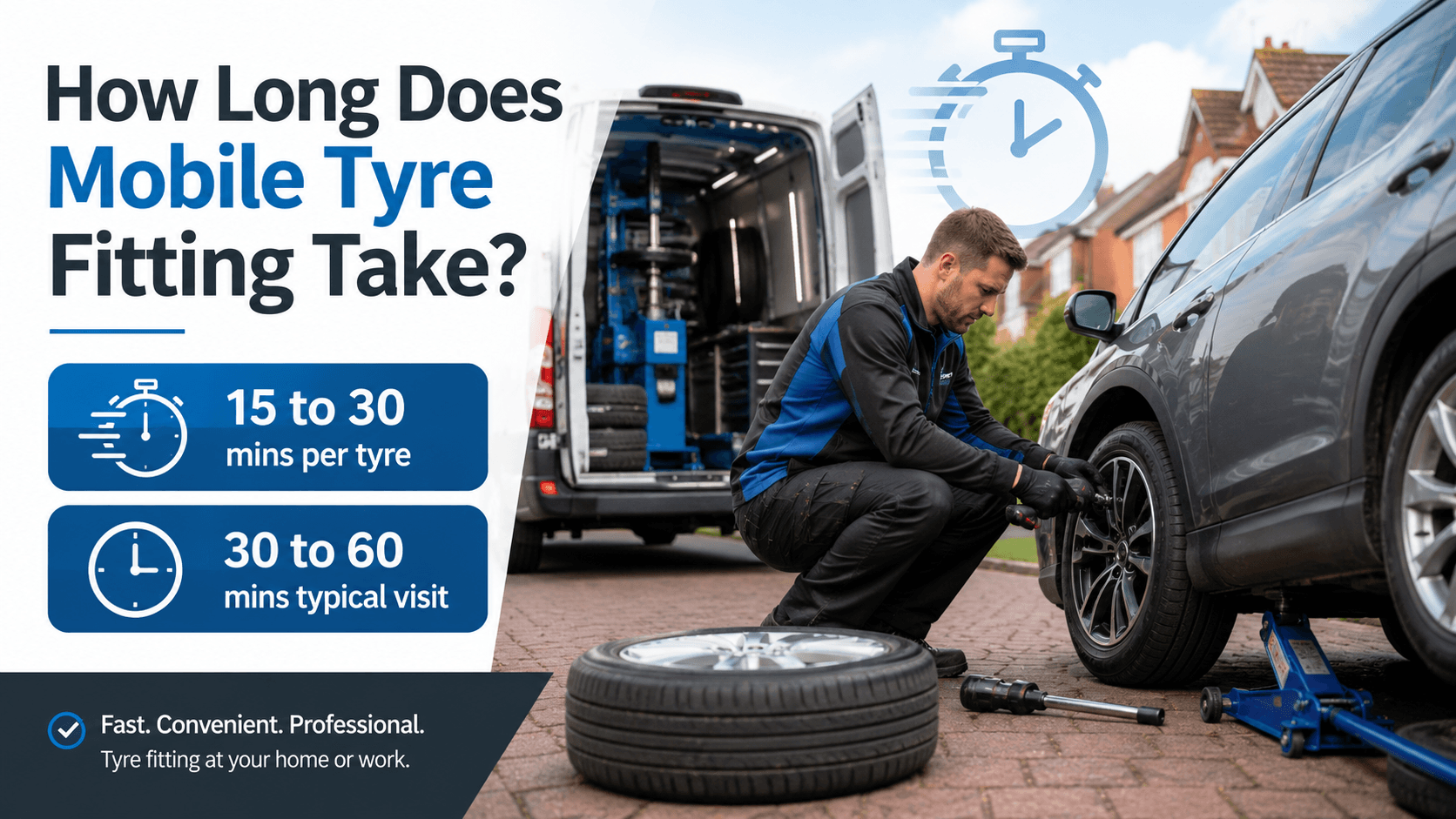
Mobile tyre fitting usually takes 30 to 60 minutes once the fitter arrives. One tyre can take around 15 to 30 minutes, while four tyres can take 60 to 120 minutes depending on tyre size, vehicle type, wheel balancing, access, weather, and locking wheel nut issues.
This guide explains mobile tyre fitting time through appointment stages, tyre quantity, vehicle type, emergency response, service inclusions, safety limits, and preparation steps. UK drivers use this page when they need tyres fitted at home, work, or a safe roadside location and want a realistic time estimate before booking.
How Long Does Mobile Tyre Fitting Take?
Mobile tyre fitting takes 30 to 60 minutes for most standard cars once the fitter reaches the vehicle. One tyre normally takes 15 to 30 minutes, while two tyres take about 30 to 60 minutes. Four tyres can take 60 to 120 minutes when the appointment includes setup, wheel removal, fitting, balancing, pressure checks, torque checks, and cleanup.
Mobile tyre fitting time depends on the hands-on work and the service setting. A clear driveway with the locking wheel nut key ready creates the fastest appointment. A tight car park, large SUV, run-flat tyre, or seized wheel nut can add extra time because the fitter must protect the wheel, vehicle, and work area.
How long does one mobile tyre fitting take?
One mobile tyre fitting usually takes 15 to 30 minutes after setup. The technician confirms the tyre size, lifts the vehicle, removes the wheel, changes the tyre, balances the wheel, refits the wheel, checks pressure, and tightens the wheel nuts to the correct torque.
How long does a full mobile tyre fitting take?
A full mobile tyre fitting for four tyres usually takes 60 to 120 minutes. The fitter repeats the same safe process for each wheel, and larger wheels, run-flat tyres, TPMS checks, stuck wheel nuts, or limited access can push the appointment toward the longer end.
How Long Does Mobile Tyre Fitting Take by Number of Tyres?
Mobile tyre fitting time increases with the number of tyres, but a full set does not always take four times longer than one tyre. The fitter sets up once, then repeats wheel removal, tyre mounting, balancing, refitting, and final checks. Most standard appointments take 15 to 30 minutes for one tyre and 60 to 120 minutes for four tyres.
Number of Tyres Typical Mobile Fitting Time Best-Case Condition What Can Add Time 1 tyre 15 to 30 minutes Clear access, standard wheel, correct tyre ready Locking wheel nut issue, corroded hub, run-flat tyre 2 tyres 30 to 60 minutes Flat driveway, matching axle pair, easy wheel removal Large wheels, TPMS reset, poor parking angle 3 tyres 45 to 90 minutes Standard car, normal tyre size, no seized nuts Wheel balancing corrections, damaged valves, weather delay 4 tyres 60 to 120 minutes All tyres on-site, safe work area, standard rims Van tyres, EV tyres, run-flat tyres, hub corrosion
How long does one tyre take?
One tyre takes the shortest time because the fitter completes one wheel cycle. A simple replacement on a standard car can finish near 15 minutes, while balancing, valve replacement, or a tight locking nut can move the job closer to 30 minutes.
How long do two tyres take?
Two tyres usually take 30 to 60 minutes because the fitter handles both wheels on one axle. Many drivers replace tyres in pairs because matching tread depth and tyre condition across an axle supports steadier handling and more predictable braking.
How long do four tyres take?
Four tyres usually take 60 to 120 minutes because the fitter completes the full fitting process on every wheel. A full set can feel efficient because setup happens once, but balancing, TPMS checks, and final pressure checks still apply to each wheel.
What Is the Difference Between Arrival Time, Fitting Time, and Appointment Time?
Arrival time means the period before the mobile fitter reaches the vehicle. Fitting time means the hands-on tyre replacement work. Total appointment time means the full visit, including setup, wheel removal, tyre fitting, balancing, final checks, payment, and old tyre handling. Drivers should separate these timings before judging speed.
Time Type What It Includes Typical Range Why It Varies Arrival time Travel from the fitter to the vehicle Same-day slot or emergency response window Traffic, distance, tyre stock, booking load Actual fitting time Wheel removal, tyre change, balancing, refitting 15 to 30 minutes per tyre Wheel size, tyre type, wheel nut condition Total appointment time Setup, fitting, checks, cleanup, payment 30 to 60 minutes for many standard jobs Access, weather, tyre quantity, extra checks
What is actual fitting time?
Actual fitting time covers the physical tyre replacement process. The fitter removes the wheel, strips the old tyre, fits the new tyre, inflates it, balances the wheel, refits the wheel, and checks torque and pressure before the vehicle moves.
What is mobile fitter arrival time?
Mobile fitter arrival time covers the journey before the appointment starts. Distance, traffic, previous jobs, tyre availability, and emergency demand affect this stage, so a same-day booking can still carry a response window before hands-on work begins.
What is total appointment time?
Total appointment time covers the full customer visit from safe setup to final cleanup. The appointment includes vehicle access, equipment positioning, tyre confirmation, fitting, balancing, pressure adjustment, old tyre loading, payment, and any digital invoice or job completion record.
What Happens During a Mobile Tyre Fitting Appointment?
A mobile tyre fitting appointment follows a controlled sequence. The fitter confirms the tyre size, checks the work area, lifts the vehicle, removes the wheel, removes the old tyre, fits the new tyre, balances the wheel, refits the wheel, checks pressure, checks wheel nut torque, and clears the work area.
The fitter arrives and confirms the vehicle, tyre size, and fitting location.
The fitter checks the parking position and creates a safe working area.
The fitter loosens wheel nuts and lifts the vehicle at a safe jacking point.
The fitter removes the wheel and separates the old tyre from the rim.
The fitter installs the new valve or valve core where required.
The fitter mounts the new tyre and inflates it to the correct pressure.
The fitter balances the wheel and adds weights where needed.
The fitter refits the wheel and checks the wheel nut torque.
The fitter completes pressure checks, cleanup, payment, and old tyre handling.
What happens when the fitter arrives?
The fitter starts with vehicle confirmation and safety checks. The technician matches the tyre size, confirms the tyres ordered, locates the locking wheel nut key, checks the work surface, positions the mobile fitting van, and prepares the tyre changer, balancer, jack, compressor, and torque wrench.
What happens when the wheel and old tyre are removed?
The wheel removal stage creates the main mechanical work. The fitter loosens the wheel nuts, lifts the vehicle, removes the wheel, breaks the tyre bead, removes the old tyre from the rim, checks the rim condition, and prepares the wheel for the replacement tyre.
What happens after the new tyre is fitted?
The final stage confirms safety before the vehicle leaves the fitting position. The fitter seats the tyre bead, inflates the tyre, balances the wheel, refits the wheel, tightens the nuts, checks torque, adjusts pressure, loads the old tyre, and tidies the working area.
What Can Make Mobile Tyre Fitting Take Longer?
Mobile tyre fitting can take longer when the fitter faces large wheels, run-flat tyres, heavy vehicles, missing locking wheel nut keys, seized wheel nuts, corroded hubs, poor parking access, bad weather, unsafe ground, TPMS work, or damaged wheels. Each issue adds time because the fitter must protect safety, equipment, and the vehicle.
Delay Factor Why It Adds Time Possible Added Time Customer Preparation Locking wheel nut key missing The fitter cannot remove the wheel normally 10 to 30 minutes or separate service Place the key in the glovebox or boot before arrival Corroded wheel nuts or hub The wheel may resist removal 10 to 30 minutes Tell the fitter about older wheels or recent issues Run-flat or low-profile tyres Stiffer sidewalls need careful handling 10 to 25 minutes Confirm tyre type during booking Large SUV, van, or EV Heavier wheels require more controlled lifting and balancing 10 to 30 minutes Provide registration and tyre size accurately Poor access or unsafe ground The fitter may need to reposition the vehicle 10 to 20 minutes Park on flat, firm, accessible ground
How do vehicle type and tyre size affect fitting time?
Vehicle type affects fitting time because wheel weight, rim size, and tyre construction change the handling required. Vans, SUVs, 4x4 vehicles, EVs, run-flat tyres, and low-profile tyres often need slower mounting, careful balancing, and controlled lifting.
How do locking wheel nuts and corrosion affect fitting time?
Locking wheel nuts and corrosion create common appointment delays. A missing locking wheel nut key can stop normal wheel removal, while seized nuts or hub corrosion can force the fitter to spend extra time loosening, cleaning, or safely freeing the wheel.
How do weather, access, and parking affect fitting time?
Weather, access, and parking affect the safety of mobile fitting. A flat driveway gives the fitter a stable setup, while tight parking, soft verges, poor visibility, heavy rain, or awkward vehicle angles can slow the work or require a safer position.
Does Mobile Tyre Fitting Include Wheel Balancing, Valves, and TPMS Checks?
Mobile tyre fitting usually includes tyre removal, new tyre fitting, inflation, wheel balancing, pressure checks, wheel refitting, torque checks, and old tyre handling. Valve replacement, TPMS reset, puncture inspection, and disposal rules can vary by provider, tyre type, and vehicle system, so drivers should confirm inclusions during booking.
Service Item Usually Included? Why It Matters Time Impact Wheel balancing Usually included with replacement Balanced wheels reduce vibration and uneven wear 5 to 10 minutes per wheel Valve or valve core Often included or offered A healthy valve helps hold air pressure A few minutes per wheel Tyre pressure check Usually included Correct pressure supports safety and tyre wear A few minutes total TPMS reset Provider and vehicle dependent TPMS warnings need correct sensor communication 5 to 15 minutes where required Old tyre disposal Often included or charged separately Used tyres need responsible handling A few minutes during cleanup
Does mobile tyre fitting include wheel balancing?
Mobile tyre fitting commonly includes wheel balancing when the fitter replaces a tyre. The fitter spins the wheel on a mobile balancer and adds weights where needed, because correct balance reduces steering vibration, uneven tread wear, and unnecessary strain on suspension components.
Does mobile tyre fitting include valves and tyre pressure checks?
Mobile tyre fitting often includes valve or valve core work and pressure checks. The fitter inflates the tyre to the correct specification, checks pressure before handover, and may replace a rubber valve or valve core depending on the wheel, TPMS setup, and service package.
Does mobile tyre fitting include TPMS reset and old tyre disposal?
TPMS reset and old tyre disposal depend on the provider and vehicle. Many fitters can check pressure warnings and remove old tyres, but some TPMS faults, damaged sensors, or disposal charges need confirmation during booking because these items can affect both time and price.
How Long Does Emergency Mobile Tyre Fitting Take?
Emergency mobile tyre fitting includes two separate timings: fitter arrival time and on-site fitting time. Arrival can vary because distance, traffic, tyre stock, and current bookings affect response. Once the fitter reaches a safe location, the actual replacement usually follows normal mobile fitting times, with extra safety setup for roadside situations.
Emergency Stage Typical Timing What Affects It User Action Call or online request 5 to 15 minutes Vehicle details, tyre size, location accuracy Provide registration, tyre size, and exact location Fitter arrival Depends on distance and availability Traffic, stock, current route, emergency demand Stay reachable by phone On-site fitting 30 to 60 minutes for many standard jobs Safe setup, tyre quantity, wheel condition Move to a safe place where possible Completion 5 to 10 minutes Payment, disposal, pressure checks, paperwork Check invoice and tyre details
How quickly can a mobile tyre fitter arrive?
A mobile tyre fitter can arrive faster when the vehicle sits inside the fitter’s service area and the required tyre is in stock. Traffic, distance, weather, time of day, and previous emergency jobs can extend response time before the actual fitting begins.
How long does roadside tyre fitting take once the fitter arrives?
Roadside tyre fitting often takes similar hands-on time to home fitting after the fitter reaches a safe location. The appointment can take longer because the technician must assess traffic risk, vehicle position, ground stability, visibility, and safe equipment placement before lifting the vehicle.
When can emergency tyre fitting take longer?
Emergency tyre fitting can take longer when the tyre size is uncommon, the wheel nut key is missing, the vehicle sits in an unsafe place, or the wheel has visible damage. Accurate location details and tyre information reduce delays before dispatch.
Can Mobile Tyre Fitting Be Done at Home, Work, or Roadside?
Mobile tyre fitting can be done at home, work, or a safe roadside location when the fitter has enough space, stable ground, safe vehicle access, and permission to work. A driveway or workplace car park usually gives the fastest setup. Roadside fitting needs stricter safety judgement before any wheel work starts.
Location Suitable? Best Conditions Possible Limits Home driveway Usually suitable Flat, firm, clear, accessible surface Sloped drive, blocked access, poor lighting Workplace car park Usually suitable Permission, space around vehicle, safe parking bay Restricted sites, underground spaces, security rules Roadside location Only when safe Vehicle away from live traffic with safe access Hard shoulder, live lane, poor visibility, fast traffic Public car park Often suitable Open space, level ground, phone signal Operator restrictions, traffic movement, limited access
Can tyres be fitted at home on a driveway?
Tyres can usually be fitted at home on a driveway when the surface is flat, firm, and accessible. A good driveway reduces setup time because the fitter can park close to the vehicle and position equipment without moving around traffic.
Can mobile tyre fitters come to work?
Mobile tyre fitters can usually come to work when the site allows vehicle maintenance and safe access. Office car parks, fleet yards, and customer parking bays often work well, provided the fitter has space around the wheel being changed.
Can mobile tyre fitting be done at the roadside?
Roadside mobile tyre fitting can only happen when the fitter can work safely away from live traffic. National Highways says drivers should use the hard shoulder only for emergencies, so motorway and high-speed road situations need careful safety judgement before any tyre work starts.
Is Mobile Tyre Fitting Faster Than Garage Tyre Fitting?
Mobile tyre fitting often saves total customer time because the driver avoids travelling to a garage, waiting in reception, and arranging collection. The hands-on fitting time can be similar to garage fitting, but the mobile service brings the equipment to the vehicle, which reduces disruption during work, home, or fleet schedules.
Factor Mobile Tyre Fitting Garage Tyre Fitting Best Option Travel time No customer journey required Driver travels to and from garage Mobile fitting Hands-on fitting time Similar per tyre for standard jobs Similar per tyre for standard jobs Either option Waiting time Reduced when slot is scheduled Can vary with workshop queue Mobile fitting Complex repairs Limited by mobile setting Garage has fixed workshop equipment Garage fitting Convenience Home, work, or safe location Garage address only Mobile fitting
Is the hands-on fitting time faster with mobile fitting?
The hands-on fitting time is usually similar when the tyre, wheel, and vehicle create a standard job. Both mobile fitters and garage technicians remove wheels, mount tyres, balance wheels, refit wheels, and check pressure before handover.
Does mobile fitting save total journey time?
Mobile fitting saves total journey time because the customer does not drive to a tyre shop or wait in a reception area. The driver can stay at home, continue working, or manage other tasks while the fitter handles the appointment outside.
When might a garage be faster?
A garage might be faster when the job needs wheel alignment, complex diagnosis, suspension checks, or heavy workshop equipment. A garage may also handle uncommon tyre stock faster when the tyre already sits on-site and the vehicle can safely drive there.
How Much Does Mobile Tyre Fitting Cost and Does Time Affect Price?
Mobile tyre fitting cost depends on tyre price, fitting fee, callout charge, urgency, location, tyre disposal, valve work, and extra services. Time can affect price when a booking needs emergency response, out-of-hours attendance, specialist tyres, or additional work such as TPMS diagnosis, locking wheel nut removal, or puncture inspection.
Cost Factor Time Impact Price Impact Notes Tyre size and brand Special orders can affect appointment timing Higher tyre sizes and premium brands cost more Registration lookup helps confirm correct size Emergency callout Response time becomes part of the service Urgent attendance may cost more Provider pricing varies by area and time Locking wheel nut removal Removal can extend appointment time Specialist removal can add a charge Key availability prevents this delay TPMS work Sensor checks can add minutes Sensor repair or replacement can add cost Vehicle system determines complexity Old tyre disposal Cleanup includes loading used tyres Some providers include disposal, others charge Booking confirmation should state the rule
What affects mobile tyre fitting cost?
Mobile tyre fitting cost mainly follows tyre size, tyre brand, fitting fee, callout distance, disposal policy, and service urgency. A standard weekday booking usually creates clearer pricing than an emergency request for an uncommon tyre size.
Does same-day or emergency fitting cost more?
Same-day or emergency fitting can cost more when the provider charges for urgent dispatch, out-of-hours attendance, or longer travel. Customers should confirm the fitted tyre price, callout fee, disposal cost, and payment method before the van leaves.
Do add-on services increase the appointment time?
Add-on services can increase appointment time because the fitter performs extra checks or specialist work. TPMS reset, locking wheel nut removal, puncture assessment, valve replacement, and wheel balancing corrections can add minutes beyond a simple tyre replacement.
When Is Mobile Tyre Fitting Not Safe or Suitable?
Mobile tyre fitting is not suitable when the vehicle sits in a live lane, unsafe hard shoulder position, unstable ground, poor visibility, severe weather, or a location where the fitter cannot create a safe working area. Severe wheel, suspension, hub, or body damage can also require garage inspection instead of mobile fitting.
Situation Why It May Not Be Safe Better Option User Action Live traffic lane Passing vehicles create direct risk Recovery to a safe place Leave the vehicle if safe and call assistance Motorway hard shoulder The hard shoulder is for emergency stopping only Recovery or authorised roadside support Follow motorway safety instructions Soft, sloped, or unstable ground The jack may not sit safely Move to firm, level ground Ask the fitter before moving a damaged tyre Severe wheel damage The wheel may not hold a tyre safely Garage inspection Share photos before booking where possible Suspected suspension damage Tyre replacement may not solve the fault Garage or recovery service Describe impact damage or steering symptoms
When is roadside tyre fitting not suitable?
Roadside tyre fitting is not suitable when the fitter cannot work away from moving traffic. National Highways treats the hard shoulder as an emergency stopping area, so drivers should not assume that a mobile fitter can safely replace a tyre beside high-speed traffic.
When can weather or ground conditions stop mobile fitting?
Weather or ground conditions can stop mobile fitting when the vehicle cannot be lifted safely. Heavy rain, poor visibility, soft ground, steep slopes, ice, flooding, or tight roadside space can force the fitter to delay the job or request a safer location.
When does the vehicle need a garage instead?
A vehicle needs a garage when the tyre problem connects to wheel damage, suspension faults, hub damage, steering symptoms, or alignment issues. The mobile fitter can replace tyres, but a fixed workshop may be needed for diagnosis and repair beyond tyre fitting.
The DVSA MOT inspection manual and the Highway Code vehicle maintenance annex both state that cars, light vans, and light trailers need at least 1.6 mm of tread across the central three-quarters of the tyre breadth and around the full circumference. TyreSafe also advises that puncture repairs must follow British Standard BS AU 159 and depend on the puncture location, tyre type, and tyre condition.
How Should You Prepare Before the Mobile Tyre Fitter Arrives?
Drivers can reduce mobile tyre fitting time by preparing the vehicle, parking space, locking wheel nut key, tyre details, and contact information before the fitter arrives. A flat parking area, clear wheel access, correct tyre size, available key, and reachable phone number help the technician start safely and finish the appointment faster.
Park on flat, firm, accessible ground where the fitter can work safely.
Keep the locking wheel nut key ready before the appointment starts.
Confirm the vehicle registration and tyre size during booking.
Clear bags, tools, or cargo that block wheel access or spare wheel access.
Tell the fitter about run-flat tyres, TPMS warnings, or wheel damage.
Keep pets and children away from the working area.
Answer the phone so the fitter can confirm arrival or access details.
What parking space should you provide?
The best parking space gives the fitter safe access around the wheel being changed. A flat driveway, open workplace bay, or quiet car park helps the fitter position the van, jack, compressor, tyre changer, and wheel balancer without unnecessary movement.
What should you do with the locking wheel nut key?
The locking wheel nut key should be ready before the fitter arrives. Drivers often keep the key in the glovebox, boot, spare wheel area, or tool kit, and quick access prevents one of the most common tyre fitting delays.
What vehicle and tyre details should you confirm?
The vehicle registration, tyre size, tyre position, location, contact number, and tyre condition should be confirmed during booking. Accurate details help the provider bring the correct tyre, plan the route, prepare equipment, and avoid wasted time at the appointment.
Book Mobile Tyre Fitting at Home, Work, or Roadside
Book mobile tyre fitting when you need a technician to replace tyres at your location without a garage visit. Confirm your tyre size, vehicle registration, fitting address, and locking wheel nut key before the slot.
Book mobile tyre fitting at your location
What Do Drivers Ask About Mobile Tyre Fitting Time?
Drivers ask about mobile tyre fitting time because the service includes more than the tyre change itself. Common questions cover one-tyre timing, four-tyre timing, fitter arrival, wheel balancing, workplace fitting, rain, run-flat tyres, delays, safety, and booking. Clear answers help drivers plan the appointment and avoid avoidable delays.
How long does mobile tyre fitting take for one tyre?
One mobile tyre fitting usually takes 15 to 30 minutes once the fitter starts work. The technician removes the wheel, changes the tyre, balances the wheel, refits it, checks pressure, and checks wheel nut torque. A missing locking wheel nut key, stiff run-flat tyre, or corroded hub can add extra time.
How long does mobile tyre fitting take for four tyres?
Four mobile tyre fittings usually take 60 to 120 minutes. The fitter sets up once, then repeats wheel removal, tyre mounting, balancing, refitting, pressure checking, and torque checking on each wheel. Standard cars on a clear driveway sit near the faster end, while vans, SUVs, EVs, or run-flat tyres can take longer.
How quickly can a mobile tyre fitter arrive?
A mobile tyre fitter can arrive faster when the vehicle sits nearby and the correct tyre is in stock. Arrival time depends on traffic, fitter availability, distance, time of day, weather, and booking demand. Emergency requests should always separate response time from the actual 30 to 60 minute fitting window.
Does mobile tyre fitting include wheel balancing?
Mobile tyre fitting usually includes wheel balancing during tyre replacement. The fitter places the wheel on a mobile balancing machine and adds weights where needed. Wheel balancing helps reduce steering vibration, uneven tyre wear, and avoidable strain on suspension components, so the process forms part of a proper replacement.
Can mobile tyre fitting be done at work?
Mobile tyre fitting can usually be done at work when the site allows safe access. A workplace car park, fleet yard, or open bay can suit the job when the fitter has space around the wheel and permission to work. Restricted sites, underground parking, or security rules can limit access.
Can mobile tyre fitting be done in the rain?
Mobile tyre fitting can be done in light rain when the fitter can work safely on stable ground. Heavy rain, poor visibility, flooding, ice, strong wind, or soft ground can make lifting the vehicle unsafe. The fitter decides whether the location and weather allow safe equipment use.
Can mobile tyre fitters replace run-flat tyres?
Mobile tyre fitters can replace many run-flat tyres when the van carries suitable equipment and the correct tyre is available. Run-flat tyres have reinforced sidewalls, so fitting can take longer than standard tyres. Drivers should mention run-flat markings during booking so the provider can confirm capability and stock.
What can delay mobile tyre fitting?
Locking wheel nut problems, seized nuts, corroded hubs, large wheels, run-flat tyres, poor parking access, unsafe ground, TPMS warnings, and damaged wheels can delay mobile tyre fitting. Drivers can reduce delay by confirming tyre size, preparing the locking key, parking safely, and describing visible damage before booking.
Is mobile tyre fitting safe?
Mobile tyre fitting is safe when a trained fitter works in a safe location with proper equipment. The process should include stable lifting, wheel balancing, pressure adjustment, and wheel nut torque checks. Unsafe roadsides, live traffic lanes, unstable ground, or severe weather can make the job unsuitable until the vehicle moves safely.
Do I need to book mobile tyre fitting in advance?
Advance booking gives the provider more time to source the correct tyre and assign a fitting slot. Same-day mobile tyre fitting may be available when stock, distance, and technician capacity allow. Emergency bookings can help with urgent punctures, but arrival time still depends on location, demand, and tyre availability.
Mobile tyre fitting works best when the driver understands the difference between arrival time, fitting time, and total appointment time. Drivers who need related help can use emergency mobile tyre fitting response time, mobile puncture repair for flat tyres, mobile wheel balancing after tyre fitting, or locking wheel nut removal during mobile fitting.