
How does mobile tyre fitting work
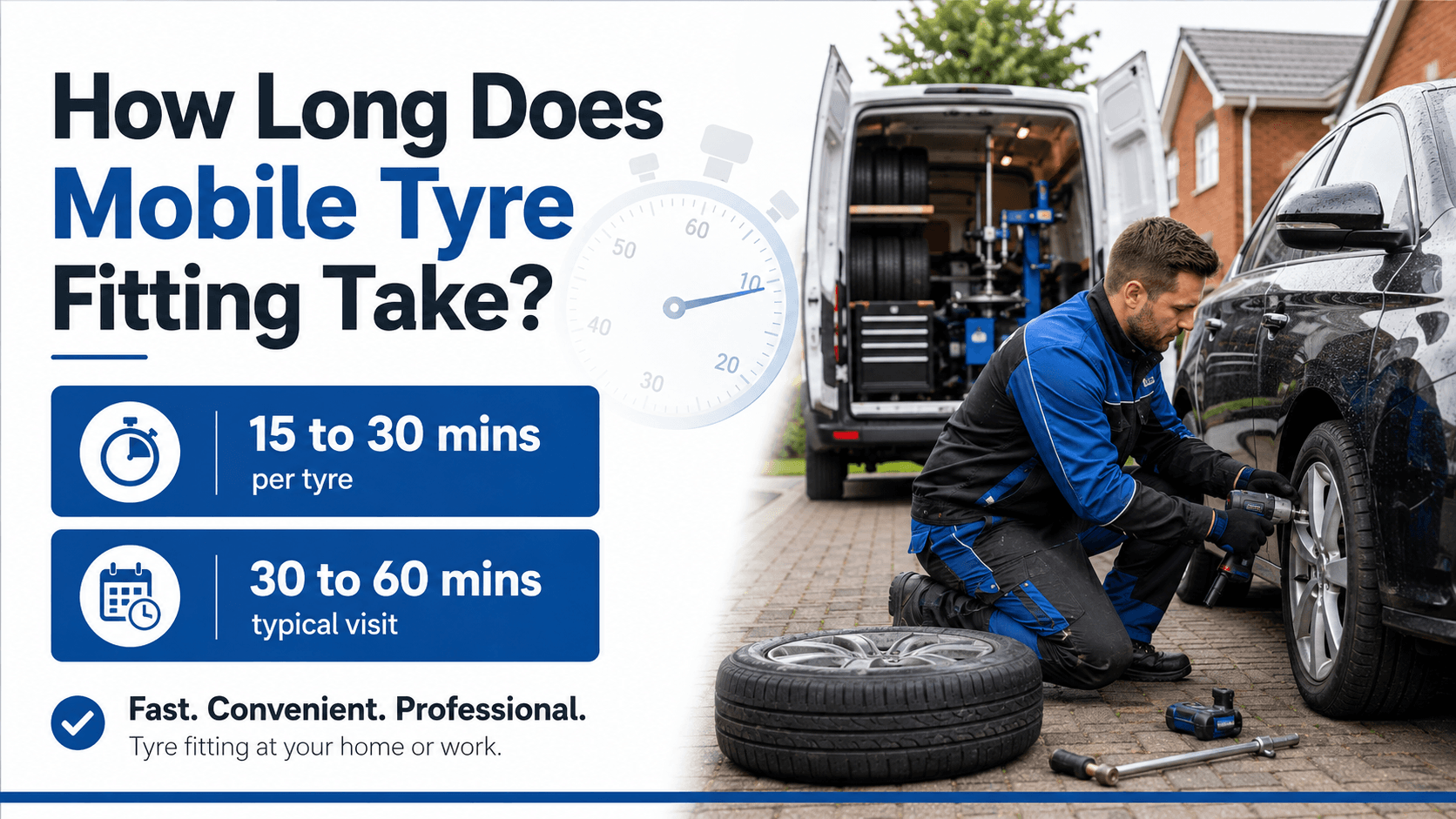
Mobile tyre fitting works by sending a trained tyre technician in a fully equipped van to your home, workplace, or another safe location. The technician checks the vehicle, removes the wheel, fits the new tyre, balances the wheel, checks pressure and wheel-nut torque, then takes the old tyre away for responsible disposal.
Drivers use mobile tyre fitting when garage travel wastes time, tyre damage makes driving unsafe, or workplace parking gives better access than a busy tyre centre. The guide explains the UK mobile tyre fitting process from booking to final checks, with clear limits around roadside safety, puncture repairs, TPMS, wheel balancing, and garage-only work.
What is mobile tyre fitting?
Mobile tyre fitting is an on-site tyre replacement service where a tyre technician travels to the customer in a mobile fitting van. The van carries fitting equipment, jacks, a compressor, a wheel balancer, valves, and safety tools. The technician fits tyres at home, work, or another safe place, so the driver avoids a garage visit.
Mobile tyre fitting connects the tyre shop process with the customer’s chosen location. The customer books a tyre, selects a time slot, and provides a postcode or exact address. The technician then brings the tyre and equipment to the vehicle.
The service suits drivers who need scheduled tyre replacement, same-day fitting, or support after a flat tyre. The next section compares the mobile service with a normal garage visit.
How is mobile tyre fitting different from garage tyre fitting?
Mobile tyre fitting sends the technician to the vehicle, while garage tyre fitting sends the driver to the workshop. The mobile model reduces travel time, waiting-room time, and vehicle downtime. Garage fitting still helps when the vehicle needs wheel alignment, major wheel repair, or wider mechanical diagnosis.
Service Attribute Mobile Tyre Fitting Garage Tyre Fitting Location Home, work, fleet yard, safe car park, or safe roadside area Garage, autocentre, or tyre shop Customer action Customer books a slot and prepares vehicle access Customer drives or transports the vehicle to the garage Main advantage Convenience and reduced disruption Wider workshop support and alignment equipment
Where can mobile tyre fitting take place?
Mobile tyre fitting can take place where the technician has safe access to the vehicle. Common locations include a driveway, workplace car park, office yard, fleet depot, and suitable private parking area. Roadside fitting depends on traffic risk, surface condition, visibility, and technician safety assessment.
Home driveway with a flat surface and clear access
Workplace parking with permission and enough working space
Fleet yard with controlled vehicle movement
Safe car park away from moving traffic
Roadside location only when the technician confirms safe working conditions
How do you book mobile tyre fitting online or by phone?
A driver books mobile tyre fitting by providing vehicle details, tyre size, location, contact details, and a preferred appointment slot. Most services use vehicle registration lookup, tyre-size search, postcode availability, and online payment. Phone booking helps when the tyre size, vehicle position, locking wheel nut key, or emergency location needs human confirmation.
The booking process gives the tyre provider the data required to send the correct tyre and equipment. The customer should check the tyre sidewall, registration number, and parking location before confirming the order. Accurate information reduces failed appointments and wrong-tyre delays.
Enter the vehicle registration number or tyre size.
Enter the fitting postcode or exact location.
Select the tyre brand, size, load index, and speed rating.
Choose mobile fitting as the appointment type.
Select an available date and time slot.
Confirm contact details, payment method, and access notes.
Keep the vehicle keys and locking wheel nut key ready.
Drivers who need direct help can use the mobile tyre fitting service at your location page after they understand the booking flow. The next checks cover the details needed before booking.
What details do you need before booking?
Booking details connect the vehicle, tyre, fitter, and appointment location. The tyre provider needs enough information to identify the correct tyre and confirm safe attendance. Missing tyre size, incomplete location details, or a missing locking wheel nut key can delay the fitting.
Booking Detail Why The Fitter Needs It Where The Driver Finds It Vehicle registration Provider matches tyre options to the vehicle record Number plate or V5C record Tyre size Provider confirms width, profile, rim size, load index, and speed rating Tyre sidewall or vehicle handbook Postcode and address Provider checks coverage, travel time, and fitting location Home, workplace, car park, or roadside pin Locking wheel nut key Technician needs the key before removing protected wheel nuts Glove box, boot kit, centre console, or tool bag Contact number Technician sends arrival updates and access questions Customer mobile phone
How do you choose the right tyre size?
The right tyre size matches the vehicle, wheel rim, load requirement, and speed rating. The tyre sidewall usually shows a format such as 205/55 R16, followed by a load index and speed rating. Vehicle registration lookup helps, but the driver should still compare the chosen size with the tyre fitted to the vehicle.
A van or loaded commercial vehicle may require a load-rated tyre rather than a standard car tyre. The booking journey should check the sidewall code before the fitter attends the appointment.
What happens before the mobile tyre fitter arrives?
Before the mobile tyre fitter arrives, the customer receives appointment confirmation, prepares the vehicle, keeps the keys ready, and confirms safe access. Many providers send text or email updates with an arrival window. The customer should park on stable ground, leave enough working space, and keep the locking wheel nut key available.
Pre-arrival preparation controls the success of the appointment. A technician can work faster when the vehicle has clear access, safe ground, and the right tools available. The driver should move the vehicle before the appointment when the space looks too tight.
Workplace fittings may need permission from a facilities manager or site supervisor. Fleet yards may need the vehicle parked away from active loading bays, moving forklifts, or customer traffic.
How do SMS, email, ETA, and tracking updates work?
Appointment updates give the customer a narrower arrival expectation. A provider may send an email confirmation, text message, arrival window, or real-time tracking link. The technician may call when access instructions, parking controls, or vehicle location need confirmation.
Tracking updates reduce missed appointments and help drivers keep the vehicle accessible. The next checklist explains the items that the customer should prepare.
What should you prepare at home, work, or roadside?
Preparation items give the technician access to the vehicle and wheel assembly. The customer should prepare keys, wheel nut key, safe parking, and enough room before the technician arrives. Roadside preparation must prioritise driver safety over appointment speed.
Preparation Item Required Action Reason Vehicle keys Keep keys available for the technician Technician may need to release steering lock or move the vehicle Locking wheel nut key Place the key inside the vehicle or hand it to the fitter Protected wheel nuts cannot be removed without the correct key or removal service Parking space Leave enough room beside the wheel being fitted Jacks, tools, and tyre equipment need working space Surface condition Park on stable, level ground where possible Safe lifting requires stable vehicle support Roadside safety Move away from traffic and use hazard lights when safe Live traffic creates risk for the driver and technician
A missing wheel nut key can require locking wheel nut removal before tyre fitting. The technician will confirm the safest next step when the key or wheel nut is damaged.
What happens when the mobile tyre technician arrives?
When the mobile tyre technician arrives, the technician confirms the vehicle, tyre size, work location, and customer details. The technician checks the working area before lifting the vehicle. The tyre condition, wheel rim, valve, wheel nuts, and visible damage are inspected before the old tyre is removed and the new tyre is fitted.
Technician arrival starts with identity, vehicle, and job confirmation. The fitter should match the ordered tyre against the vehicle and customer booking before tools leave the van. This check prevents wrong-tyre fitting and avoids wasted fitting time.
In our mobile fitting workflow review, the first two minutes belong to site-risk assessment rather than tyre removal. The technician should reject unsafe positioning before any wheel nut is loosened.
How does the technician check the vehicle and working area?
The technician checks ground stability, traffic exposure, working space, vehicle position, and access before lifting the vehicle. The mobile fitting van should park where equipment can move safely between the van and vehicle. Poor lighting, steep slopes, loose gravel, or live traffic can stop the job.
Flat or stable surface for safe lifting
Enough side clearance around the affected wheel
No active traffic lane beside the technician
Safe access from the mobile fitting van to the vehicle
Visible wheel nuts and available locking wheel nut key
How does the technician inspect tyre condition before fitting?
The technician inspects tyre condition to decide whether fitting, repair, or further advice applies. The tyre inspection may include tread depth, sidewall condition, puncture location, valve condition, rim damage, bead damage, and uneven wear. GOV.UK vehicle safety guidance states that cars and light vans need 1.6mm tread across the central three-quarters around the tyre.
The GOV.UK vehicle safety guidance and MOT inspection manual provide the official UK source context for tread, tyre condition, valves, wheels, suspension, and TPMS inspection. The fitting process begins after the vehicle passes the site and tyre checks.
How does the tyre fitting process work step by step?
The tyre fitting process starts with vehicle positioning and wheel-nut loosening, then continues through lifting, wheel removal, old tyre demounting, new tyre mounting, valve replacement, inflation, wheel balancing, wheel refitting, torque checking, pressure checking, and old tyre collection. A mobile fitting van carries the main equipment needed for this workshop-style process.
The tyre fitting process follows a fixed sequence because each step depends on the previous step. The technician cannot balance the wheel before the new tyre is mounted, and the technician cannot complete torque checks before the wheel is refitted. A clean sequence protects the wheel, tyre, and vehicle.
Step Technician Action Purpose
1. Confirm job Match vehicle, tyre size, location, and customer booking Prevent wrong-tyre fitting
2. Assess location Check ground, traffic, space, and visibility Confirm safe working conditions
3. Loosen wheel nuts Loosen nuts before lifting the vehicle Prepare wheel removal safely
4. Lift vehicle Use suitable jack and support method Raise the wheel for removal
5. Remove wheel Take the wheel assembly off the vehicle Move wheel to fitting equipment
6. Remove old tyre Break the bead and demount the tyre from the rim Prepare rim for new tyre
7. Fit new tyre Mount new tyre and seat the bead correctly Install tyre on the rim
8. Balance wheel Use a wheel balancer and balance weights Reduce vibration and uneven wear
9. Refit wheel Return wheel to vehicle and tighten wheel nuts Secure the wheel assembly
10. Complete checks Check torque, pressure, and visible fitment Confirm safe completion
A deeper mobile tyre fitting van equipment guide can support readers who need more detail on jacks, tyre changers, balancers, compressors, and torque tools.
How are the wheel and old tyre removed?
The technician loosens the wheel nuts before lifting the vehicle because the wheel needs resistance during loosening. The technician then lifts the vehicle at a suitable jacking point, removes the wheel, and transfers the wheel assembly to the fitting equipment. The old tyre is demounted from the rim after the bead is broken.
The technician checks the rim for visible damage before the new tyre is fitted. Rim damage can affect bead seating, air retention, and driving safety.
How is the new tyre fitted to the rim?
The technician mounts the new tyre onto the rim using tyre fitting equipment inside or beside the mobile van. Correct mounting protects the bead, rim edge, valve area, and tyre sidewall. The technician checks the tyre direction when directional or asymmetric tyre markings apply.
The new tyre must sit evenly on the rim before inflation and balancing. Uneven seating can cause air loss, vibration, or fitting failure.
How are valve replacement, inflation, and pressure checks completed?
The technician replaces the standard rubber valve during many tyre fitting appointments because the valve helps maintain air pressure. Vehicles with TPMS may need compatible valve service, sensor handling, or a pressure warning check. The technician inflates the tyre to the vehicle manufacturer’s recommended pressure after the tyre sits correctly on the rim.
A dedicated TPMS valve service for tyre pressure warning lights helps when the warning light remains active after fitting. The next section explains why balancing matters before the wheel returns to the vehicle.
Why is wheel balancing included in mobile tyre fitting?
Wheel balancing is included in mobile tyre fitting because a newly fitted tyre can create uneven weight distribution around the wheel assembly. A wheel balancer identifies heavy and light points, then the technician adds small balance weights. Correct balancing reduces steering vibration, uneven tyre wear, suspension strain, and poor ride quality after fitting.
Wheel balancing protects the driving result after the tyre is fitted. A new tyre can sit correctly on the rim but still rotate with uneven weight distribution. The balancing machine measures that imbalance before the technician refits the wheel.
Drivers often confuse wheel balancing with wheel alignment. Balancing treats the wheel assembly, while alignment treats wheel angles and steering geometry.
How does wheel balancing prevent vibration and uneven wear?
Wheel balancing prevents vibration by correcting weight differences around the rotating wheel. The technician spins the wheel on a balancing machine and adds weights where the machine indicates. Balanced wheels help the tyre roll smoothly, which can reduce steering shake, uneven tread wear, and unnecessary stress on suspension parts.
Drivers who notice vibration after fitting should request a recheck. The mobile wheel balancing for smoother driving page can capture that specific service need.
What is the difference between wheel balancing and wheel alignment?
Wheel balancing and wheel alignment solve different problems. Mobile tyre fitting commonly includes balancing because the mobile van can carry a balancer. Wheel alignment usually requires fixed workshop equipment that measures camber, caster, and toe angles.
Service Main Purpose Typical Equipment Wheel balancing Corrects uneven weight around the wheel and tyre assembly Wheel balancing machine and balance weights Wheel alignment Corrects wheel angles and steering geometry Alignment ramp and geometry measurement system Mobile tyre fitting Fits new tyre and balances the wheel before refitting Mobile fitting van with tyre changer and balancer
What is included in a mobile tyre fitting appointment?
A mobile tyre fitting appointment usually includes technician travel, tyre fitting, wheel removal, old tyre removal from the rim, new tyre mounting, wheel balancing, valve replacement where applicable, tyre inflation, pressure checks, wheel refitting, torque checks, and old tyre collection. Exact inclusions depend on the provider, tyre type, vehicle, and appointment terms.
Service inclusions explain the real value behind the mobile fitting fee. A customer should check whether balancing, valves, disposal, call-out, VAT, and emergency attendance appear in the quote before booking. Transparent pricing reduces appointment-day confusion.
Included Entity Service Attribute Customer Value Technician travel Fitter attends the chosen safe location Customer avoids garage travel Tyre fitting New tyre mounts onto the wheel rim Vehicle receives replacement tyre on-site Wheel balancing Technician balances the wheel before refitting Driver gets smoother road feel Valve replacement Standard rubber valve may be replaced during fitting Tyre pressure retention improves Pressure check Technician inflates tyre to recommended pressure Vehicle leaves with correct tyre pressure Torque check Wheel nuts receive correct tightening procedure Wheel refitting receives final safety check Old tyre disposal Technician takes away the removed tyre Customer avoids waste tyre handling
Does mobile tyre fitting include tyre disposal?
Mobile tyre fitting often includes old tyre collection, but the customer should confirm the disposal term before booking. Waste tyres require responsible handling because they cannot be treated like normal household waste. The provider should remove the old tyre and send it through an appropriate waste or recycling route.
A separate responsible old tyre disposal after mobile fitting guide can explain the environmental handling route in more detail.
Does mobile tyre fitting include valves, TPMS checks, and pressure checks?
Mobile tyre fitting commonly includes a standard valve replacement and a pressure check. TPMS-equipped vehicles may need extra sensor care because the sensor, valve stem, warning light, and vehicle system can interact. The MOT inspection manual includes TPMS as part of the official vehicle inspection context for relevant passenger vehicles.
The technician should tell the customer when a TPMS sensor fault needs a separate diagnostic or sensor replacement. This boundary keeps the mobile tyre fitting service clear and accurate.
Can mobile tyre fitters repair punctures or do they replace tyres?
Mobile tyre fitters can repair some punctures, but they must replace tyres when the damage sits outside the repairable tread area, affects the sidewall, exposes cords, causes a bulge, damages the rim, or leaves the tyre unsafe. TyreSafe explains that proper puncture repairs need specialist assessment and must follow British Standard AU 159.
Puncture repair decisions depend on damage location, tyre condition, and internal inspection. A small nail in the central tread area may be repairable, while sidewall damage normally requires replacement. The technician should inspect the tyre rather than promise a repair from a photo alone.
The TyreSafe puncture repair guidance provides the repair-zone source context. Drivers can also book mobile puncture repair for repairable tyre damage when the tyre appears suitable for assessment.
When can a puncture usually be repaired?
A puncture can usually be repaired when the damage sits inside the central repairable tread area, the tyre has not been driven flat, and the internal structure remains safe. British Standard AU 159 governs professional tyre repair practice in the UK repair context. The technician must inspect the tyre before confirming the repair.
Puncture Attribute Likely Outcome Reason Central tread puncture Possible repair after inspection Repair area may support a compliant repair Sidewall puncture Replacement usually required Sidewall flex creates repair failure risk Run-flat driven deflated Replacement often required Internal damage may not be visible externally Repeated or overlapping repair area Replacement may be required Repair integrity may be compromised
When does tyre damage usually require replacement?
Tyre damage usually requires replacement when the tyre has sidewall damage, exposed ply or cord, a visible bulge, severe cracking, unsafe tread depth, bead damage, or a damaged rim contact area. GOV.UK safety guidance gives the legal tread context for cars and light vans, and MOT guidance covers tyre condition defects.
The technician should advise replacement when a repair would compromise safety. That decision protects the driver, passengers, and other road users.
Can mobile tyre fitting be done safely at home, work, or roadside?
Mobile tyre fitting can be done safely at home, work, or roadside only when the technician has stable ground, clear access, enough working space, and no live-traffic risk. Home and workplace fitting are usually easier to control. Roadside fitting needs stricter safety assessment, especially near motorways, hard shoulders, fast roads, or poor visibility.
Safe mobile fitting depends on the location before the tyre. A fully equipped van cannot remove traffic risk, unstable ground, or poor access. The technician should refuse, move, or rearrange work when the location creates unacceptable danger.
National Highways hard-shoulder guidance says drivers should use the hard shoulder only for an emergency when the vehicle cannot reach a safer exit or service area. The National Highways hard shoulder guidance supports this roadside limitation.
What makes a location safe for mobile tyre fitting?
A safe location gives the technician a stable surface, controlled traffic environment, visible vehicle position, and enough room around the wheel. A flat driveway, quiet workplace bay, or controlled fleet yard usually gives better conditions than a live roadside. The technician still makes the final site decision.
Stable surface under the vehicle and jack
Clear space beside the wheel being removed
Controlled traffic movement around the work area
Safe route between mobile van and vehicle
Enough lighting for wheel, nut, valve, and tread checks
When can mobile fitting not be done safely?
Mobile fitting cannot safely proceed when the work area exposes the technician or driver to traffic, unstable ground, or blocked access. A safe service decision may involve moving the vehicle, calling roadside recovery, or rearranging the appointment to a controlled location.
Location Condition Risk Safer Action Live motorway lane Traffic impact risk Leave vehicle area and contact emergency or recovery support Hard shoulder beside fast traffic Limited protection for driver and technician Use official motorway safety guidance and move to a safer place if possible Steep slope Unsafe lifting and vehicle movement risk Move vehicle to level ground before fitting Loose gravel or soft verge Jack instability and vehicle support risk Use a firmer surface or rearrange fitting Tight multi-storey space Insufficient van and equipment access Move vehicle to open parking space Severe weather or poor visibility Reduced control and visibility Wait, move, or rebook based on technician assessment
A UK tyre safety checks before replacement guide should support legal tread, pressure, sidewall, and dangerous-condition searches.
Does mobile tyre fitting cost more than garage fitting?
Mobile tyre fitting can cost more than garage fitting when the provider charges for travel, emergency attendance, distance, or a narrow time slot. The final price depends on tyre size, tyre brand, number of tyres, fitting location, call-out terms, balancing, valve replacement, disposal, and urgency. A clear quote should show all major charges upfront.
Cost comparison depends on what the quote includes. A garage price may look lower until travel time, waiting time, fuel, and lost work time enter the decision. A mobile quote may offer stronger value when the driver cannot safely drive or cannot lose half a day.
What affects the mobile tyre fitting cost?
Cost factors connect tyre specification, technician travel, appointment timing, and service inclusions. Larger tyres, performance tyres, emergency call-outs, and remote locations can increase the price. Multiple tyres may reduce per-tyre fitting disruption because the technician attends once.
Cost Factor Why Cost Changes Customer Check Tyre size Larger or specialist sizes can cost more Check sidewall before ordering Tyre brand Budget, mid-range, and premium tyres have different prices Compare by size and rating Number of tyres More tyres increase total parts and labour Ask for total fitted price Travel distance Provider may charge outside a standard radius Confirm postcode coverage Urgency Same-day or emergency jobs may cost more Compare scheduled and urgent slots
What charges should be included or shown upfront?
A trustworthy quote should show the tyre price, fitting fee, balancing, valve replacement, old tyre disposal, call-out fee, VAT position, and emergency surcharge where relevant. Hidden charges create distrust and reduce conversion. The customer should ask for a full fitted price rather than a tyre-only price.
Readers who need pricing detail can use the mobile tyre fitting cost factors explained guide before booking.
When should you use emergency mobile tyre fitting?
Drivers should use emergency mobile tyre fitting when a flat tyre, blowout, sidewall damage, illegal tread, or puncture leaves the vehicle unsafe to drive. Emergency fitting helps when the vehicle can be reached safely by a technician. Motorway, live-lane, or hard-shoulder situations require safety-first decisions before any tyre service is arranged.
Emergency tyre fitting solves a mobility problem, not every roadside safety problem. A stranded driver should first move away from danger, then request help. The tyre appointment comes after the driver, passengers, and vehicle position become safe enough to assess.
The emergency mobile tyre fitting for flat tyres page should receive internal traffic from this section because the user has clear urgent intent.
What should you do after a flat tyre or blowout?
A driver should control the vehicle, avoid sudden steering, move to a safer place where possible, switch on hazard lights, and exit away from traffic when safe. The driver should not attempt wheel changing in a live lane. National Highways guidance should shape motorway and hard-shoulder decisions.
Keep control of the vehicle and reduce speed safely.
Move away from live traffic where possible.
Switch on hazard lights when safe.
Move passengers away from traffic when safe.
Call emergency support or a mobile tyre fitter after reaching a safer position.
What information should you give an emergency mobile tyre fitter?
An emergency mobile tyre fitter needs exact location, vehicle registration, tyre size, tyre damage type, wheel nut key status, and safety conditions around the vehicle. A motorway marker, postcode, what3words reference, car park name, or business address can reduce dispatch confusion. The customer should explain whether the vehicle sits on a live road, hard shoulder, or private parking area.
Emergency Detail Example Why The Fitter Needs It Exact location Postcode, pin, road name, or motorway marker Technician needs accurate dispatch information Vehicle details Registration, make, model, and tyre size Provider needs the right tyre and equipment Damage description Flat tyre, blowout, sidewall cut, or puncture Technician assesses repair or replacement likelihood Safety position Driveway, car park, verge, or hard shoulder Provider checks whether attendance can happen safely
Why choose mobile tyre fitting instead of visiting a garage?
Drivers choose mobile tyre fitting instead of visiting a garage because the service saves travel time, reduces waiting, supports home or workplace appointments, and helps when a damaged tyre makes driving unsafe. Garage fitting remains better for wheel alignment, major wheel damage, suspension diagnosis, or locations where mobile work cannot be completed safely.
Mobile tyre fitting works best when the driver needs tyre replacement without disrupting the day. The fitter brings the core tyre fitting workflow to the vehicle. The customer keeps control of time, location, and appointment access.
How does mobile tyre fitting save time?
Mobile tyre fitting saves time by removing the drive to a tyre centre, garage check-in, waiting-room delay, and return journey. A home or workplace fitting lets the customer continue normal tasks while the technician works outside. That convenience creates the commercial bridge between an informational guide and a booking page.
When is garage fitting still the better option?
Garage fitting remains the better option when the vehicle needs wheel alignment, suspension checks, major rim damage inspection, complex diagnostics, or workshop-only equipment. Mobile fitting also becomes unsuitable when the location has unsafe ground, tight access, poor visibility, or live-traffic exposure. A clear boundary protects customer expectations.
Decision Factor Choose Mobile Fitting Choose Garage Fitting Convenience Driver wants fitting at home or work Driver can visit a workshop easily Vehicle condition Vehicle needs tyre replacement only Vehicle needs diagnosis beyond tyres Wheel service Wheel balancing is needed after fitting Wheel alignment or rim repair is needed Location safety Safe flat space is available Location cannot support safe mobile work
Drivers comparing both routes can read the mobile tyre fitting versus garage tyre fitting comparison before making a booking decision.
Check mobile tyre fitting availability by postcode before choosing a garage visit. A mobile technician can fit tyres at home, work, or another safe location when access and tyre stock allow. Book mobile tyre fitting at home, work, or another safe location.
What else do drivers ask about mobile tyre fitting?
Drivers ask about mobile tyre fitting time, safety, cost, wheel balancing, old tyre disposal, home fitting, workplace fitting, roadside attendance, wet weather, run-flat tyres, and customer presence. The most useful answers explain the direct service outcome first, then add the limitation that affects booking, safety, or technician attendance.
How long does mobile tyre fitting take?
Mobile tyre fitting usually takes 30 to 60 minutes for a standard appointment. A single tyre can take less time when access is simple, the locking wheel nut key is ready, and balancing runs smoothly. Four tyres, TPMS issues, damaged wheel nuts, poor access, or roadside safety checks can extend the appointment.
Does mobile tyre fitting include wheel balancing?
Mobile tyre fitting usually includes wheel balancing when a new tyre is fitted. The technician places the wheel on a balancing machine, measures imbalance, and adds balance weights where needed. The balancing step reduces steering vibration, uneven tyre wear, and poor ride quality after the new tyre is installed.
Do mobile tyre fitters dispose of old tyres?
Mobile tyre fitters often take old tyres away after fitting. The customer should confirm disposal terms before booking because providers can structure quotes differently. Waste tyres need responsible handling, so the removed tyre should follow an appropriate waste or recycling route rather than household disposal.
Can tyres be fitted at home?
Tyres can be fitted at home when the vehicle has safe access and a suitable surface. A driveway or private parking bay usually works when the technician has enough room around the wheel. Steep slopes, loose gravel, blocked access, or unsafe vehicle positioning can stop or delay the appointment.
Can mobile tyre fitting be done at work?
Mobile tyre fitting can be done at work when the site allows safe vehicle access. The driver should confirm parking permission, keep keys available, and leave enough room for the technician and mobile van equipment. Fleet yards and office car parks work best when traffic movement is controlled.
Can mobile tyre fitters come roadside?
Mobile tyre fitters can come roadside only when the location is safe for attendance. A quiet car park, side road, or safe lay-by may work. A live lane, dangerous hard shoulder, poor visibility, or fast-road position may require emergency or recovery support before tyre fitting can happen.
Is mobile tyre fitting safe?
Mobile tyre fitting is safe when a trained technician works in a safe location with suitable equipment. Safety depends on stable ground, traffic control, clear access, correct lifting, proper wheel balancing, tyre pressure checks, and torque checks. The technician should refuse or rearrange work when the location creates unacceptable risk.
Does mobile tyre fitting cost more?
Mobile tyre fitting can cost more when travel, emergency attendance, or narrow time slots are included. The total fitted price depends on tyre size, tyre brand, number of tyres, distance, call-out terms, balancing, valve replacement, and disposal. A clear quote should show the main charges before booking.
What equipment do mobile tyre fitters use?
Mobile tyre fitters use a van equipped with tyre fitting and wheel service tools. Common equipment includes a jack, tyre changer, wheel balancer, air compressor, pressure gauge, torque wrench, valves, balance weights, and safety equipment. The equipment lets the technician complete workshop-style tyre fitting at a suitable location.
Do I need to be present for mobile tyre fitting?
You may need to be present or contactable for mobile tyre fitting. The technician may need vehicle keys, parking instructions, access permission, and the locking wheel nut key. Some providers allow unattended work when arrangements are agreed before the appointment and the vehicle can be accessed safely.
Can mobile tyre fitting be done in rain?
Mobile tyre fitting can sometimes be done in rain when conditions remain safe. The technician must assess ground stability, visibility, traffic risk, equipment safety, and working space before starting. Heavy rain, standing water, poor visibility, or unsafe roadside conditions can delay, move, or rearrange the fitting.
Can mobile tyre fitters fit run-flat tyres?
Some mobile tyre fitters can fit run-flat tyres when the vehicle, tyre, and equipment are compatible. Run-flat tyres may need specialist handling because sidewalls are reinforced. A tyre that has been driven deflated may need replacement rather than repair, so the technician should inspect the tyre before confirming the outcome.