
Can a puncture be repaired
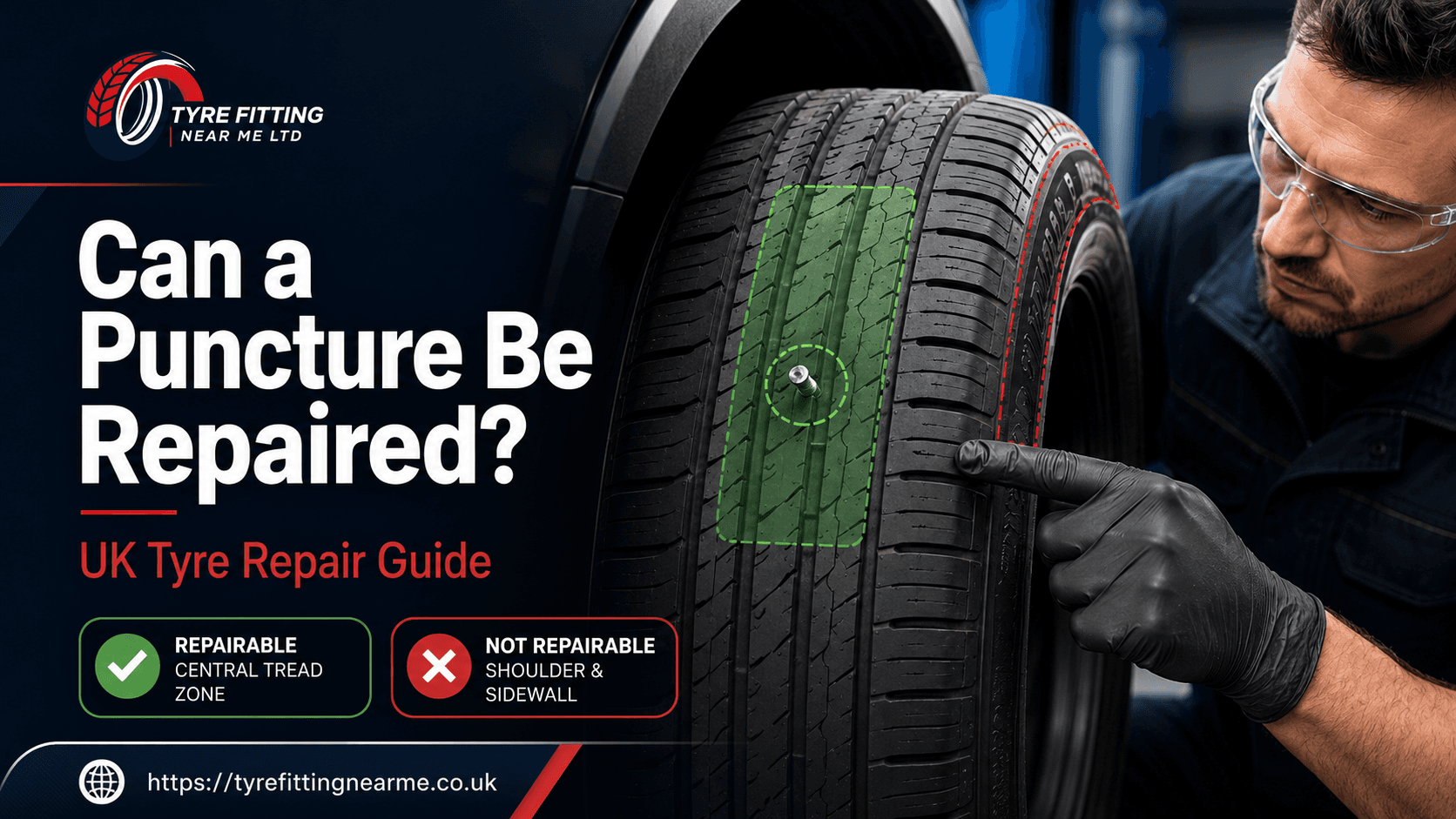
A tyre puncture can be repaired when the damage sits in the central tread area, the hole is usually 6mm or smaller, and the tyre has safe tread, no sidewall damage, and no hidden internal damage. A tyre technician must inspect the tyre before any permanent repair.
Can a puncture be repaired on a car tyre?
A car tyre puncture can be repaired when the damage sits inside the central tread repair area, the hole is small enough for a safe repair, and the tyre has no unsafe structural damage. British Standard AU159 gives the repair framework, and TyreSafe says permanent repairs require tyre removal for internal and external inspection.
What makes a tyre puncture repairable?
A repairable tyre puncture has a controlled damage point inside the central tread area. The technician checks the hole size, tread depth, casing condition, sidewall condition, previous repairs, valve condition, bead seal, and inner liner before approving repair.
The puncture sits in the central tread repair area.
The damaged hole is usually 6mm or smaller.
The tyre keeps legal tread depth across the required tread area.
The sidewall shows no bulges, cuts, exposed cords, or crushing.
The inner liner shows no hidden damage after tyre removal.
The tyre has no unsafe previous repair near the same damage zone.
What makes a tyre puncture unsafe to repair?
An unsafe tyre puncture affects the tyre structure, not just the tread surface. A technician should reject repair when the damage reaches the shoulder, sidewall, bead, casing, inner liner, or any area weakened by driving while flat.
Repair factor Repairable condition Replace condition Puncture location Central tread repair area Sidewall, shoulder, or outer edge damage Puncture size Small round hole, usually 6mm or smaller Large hole, split, cut, tear, or gouge Tyre condition Safe tread, sound casing, clean inner liner Bulges, cords, cracking, casing damage, or low tread
How do I know where the puncture is on the tyre?
The puncture location tells the technician whether the repair can protect tyre strength, heat control, and road contact. A tread puncture may be repairable because the tread receives a controlled repair unit. A shoulder or sidewall puncture usually needs replacement because the sidewall flexes, carries load, and cannot hold a safe patch under repeated movement.
Can a puncture in the central tread be repaired?
A central tread puncture can usually be repaired when the tyre condition and hole size also pass inspection. The central tread area gives the repair material a stable contact zone, while the tyre casing still needs internal checking before the technician confirms repair.
Why can’t sidewall or shoulder punctures be repaired?
Sidewall and shoulder punctures usually cannot be repaired because those zones flex under load during driving. A patch in that moving zone can detach, and sidewall preparation can weaken the tyre structure. A tyre with sidewall damage should move toward replacement rather than repair.
Tyre area Repairable? Why it matters Central tread Usually possible The tread gives the repair unit a stable working area. Shoulder Usually not possible The shoulder carries flex between tread and sidewall. Sidewall No The sidewall flexes heavily and supports vehicle load.
What size puncture can be repaired?
A tyre puncture can usually be repaired when the damaged area is small, round, clean, and suitable for a recognised repair unit. The common passenger-car threshold across UK repair guidance is 6mm for minor tread damage. A larger hole, jagged split, sidewall tear, or long cut needs replacement because the tyre structure cannot be restored safely.
Can a nail or screw puncture be repaired?
A nail or screw puncture can often be repaired when the object enters the central tread and leaves a small, clean hole. The technician still needs to remove the tyre from the wheel because hidden inner liner damage can turn a simple nail puncture into a replacement case.
What damage is too large for tyre repair?
Large tyre damage needs replacement because a repair unit cannot restore casing strength across an irregular wound. A technician should reject repair when the tyre has a long cut, split, gouge, exposed cord, sidewall tear, shoulder damage, or multiple unsafe punctures.
Damage type Usually repairable? Reason Small nail hole in tread Yes, after inspection The hole may accept a safe internal repair unit. Screw hole near shoulder No The damage sits too close to the flexible shoulder zone. Cut or split in rubber No The tyre casing may have structural damage.
What tyre condition allows a puncture repair?
A tyre condition allows puncture repair when the tread depth, casing, sidewall, bead, and inner liner remain safe after inspection. GOV.UK states that cars, light vans, and light trailers need 1.6mm tread depth across the middle three-quarters and around the entire tyre. Cuts, bulges, and unsafe deterioration change the decision toward replacement.
Does tread depth affect puncture repair?
Tread depth affects puncture repair because a tyre near the legal limit may not justify repair or may fail a safety inspection. GOV.UK vehicle safety guidance gives 1.6mm as the tread depth requirement for cars, light vans, and light trailers.
Can a tyre be repaired after driving flat?
A tyre can become unrepairable after driving flat because the rim can crush the sidewall and damage the inner liner. A technician should inspect the inside of the tyre for dusting, mottling, cords, liner splits, and casing separation before approving repair.
Can cracked, bulged, or worn tyres be repaired?
Cracked, bulged, or heavily worn tyres usually need replacement because the puncture no longer represents the only safety issue. GOV.UK MOT guidance says tyre inspections check condition, security, size, type, and tread depth, so repairability depends on the whole tyre, not the hole alone.
Tyre condition Repair impact Recommended action Safe tread and clean casing Repair may be possible Request professional puncture inspection. Low tread depth Repair may fail safety judgement Choose replacement instead of repair. Bulge, crack, or exposed cord Repair should be rejected Replace the damaged tyre. Driven while flat Hidden internal damage may exist Remove tyre for internal inspection.
How can I tell if it is a puncture, valve leak, bead leak, or rim issue?
A pressure-loss problem can come from a tread puncture, valve leak, bead leak, rim corrosion, cracked wheel, or TPMS fault. GOV.UK says vehicles first used on or after 1 January 2012 are checked during MOT for the TPMS malfunction indicator lamp. A technician should diagnose the source before selling repair or replacement.
What are the signs of a slow puncture?
A slow puncture usually causes repeated air top-ups, gradual visible deflation, a tyre pressure warning, mild pulling, steering vibration, or hissing near the tread. A driver may notice the problem after the car has parked overnight or after several short journeys.
Can a tyre valve leak be repaired?
A tyre valve leak can often be repaired by replacing the valve stem or valve core when the tyre itself remains safe. A technician should inspect the valve, dust cap, wheel seat, and tyre pressure behaviour before treating the issue as a tread puncture.
Can bead or rim leaks be fixed by a mobile tyre service?
A mobile tyre service can assess bead leaks and rim-related pressure loss when the vehicle sits in a safe working location. The technician may reseal the bead, replace the valve, identify rim corrosion, or recommend wheel repair when the rim prevents an airtight seal.
Symptom Likely cause Next step Air loss after a visible nail Tread puncture Book puncture inspection and possible repair. Air loss around valve Valve leak Request valve inspection and valve replacement. Air loss after pothole impact Bead leak or rim damage Request bead, rim, and wheel inspection. TPMS light with no visible damage Low pressure, puncture, valve fault, or sensor issue Check pressure and request technician diagnosis.
Drivers who see a pressure warning before visible tyre damage should read the TPMS tyre pressure warning light causes guide before assuming the tyre has a repairable puncture.
What should I do if my tyre is punctured while driving?
A driver with a punctured tyre should reduce speed smoothly, avoid harsh steering, find a safe stopping place, and keep away from live traffic. National Highways advises drivers on motorways to go left, move into the left lane, and use an emergency area, lay-by, or hard shoulder when possible.
Can I drive with a punctured tyre?
A driver should not continue normal driving with a punctured tyre because pressure loss can damage the sidewall, reduce handling, and create a replacement case. A slow leak may allow a short, careful journey to a safe repair location, but a flat tyre needs recovery or mobile help.
What should I do on a motorway or live lane?
A driver on a motorway should prioritise personal safety over tyre repair. National Highways says drivers should leave space to exit from the left side, keep seatbelts on if staying in the vehicle is safer, and get behind a safety barrier when conditions allow. Mobile repair should not happen in a live lane.
Should I use a spare wheel or repair kit?
A spare wheel or repair kit can help only when the vehicle sits in a safe location away from moving traffic. A repair kit gives temporary mobility, not a permanent repair, so a technician must inspect the tyre as soon as possible.
Hold the steering wheel firmly and reduce speed smoothly.
Move left when traffic conditions make the manoeuvre safe.
Stop in a safe place away from moving traffic.
Switch on hazard warning lights and keep passengers protected.
Call breakdown support or emergency tyre fitting for flat tyres when roadside work would be unsafe.
Can I repair a puncture myself?
A driver can use a tyre repair kit only as a temporary mobility measure when the vehicle is parked safely and the tyre damage appears minor. A DIY kit cannot confirm inner liner damage, sidewall crushing, casing separation, or bead problems. TyreSafe says permanent repairs require removal from the wheel and inspection inside and outside.
Are tyre repair kits permanent?
Tyre repair kits are not permanent repairs because sealant and inflation only help the vehicle reach professional help. The tyre still needs inspection, cleaning, and a recognised repair method when the damage qualifies for safe repair.
How do tyre sealants work?
Tyre sealants work by coating the inner tyre surface and temporarily slowing air loss through a small hole. Pre-puncture sealant sits inside the tyre before damage happens, while post-puncture sealant enters the tyre after pressure loss begins.
When should a professional inspect the tyre?
A professional should inspect the tyre after any puncture, pressure warning, sealant use, flat-driving incident, valve leak, rim impact, or visible sidewall damage. The inspection separates repairable tread damage from unsafe structural damage.
Option Temporary or permanent Safe limitation Tyre sealant kit Temporary Use only to reach safe professional help. Spare wheel Temporary or limited-use depending on wheel type Follow vehicle handbook speed and distance limits. Professional internal repair Permanent when approved Requires tyre removal and internal inspection.
How does a professional tyre puncture repair work?
A professional tyre puncture repair starts with external inspection, wheel removal, tyre removal, internal inspection, damage preparation, repair unit fitting, inflation, leak testing, and wheel refitting. The method protects the inner liner and tread channel when the puncture qualifies for repair. A mobile technician follows the same safety decision before approving repair at home or work.
Why must the tyre be removed from the wheel?
The tyre must be removed from the wheel because external inspection cannot reveal all inner liner or casing damage. TyreSafe states that permanent repairs require internal and external inspection to detect hidden damage that could cause serious tyre failure.
What is a plug, patch, or mushroom repair?
A plug, patch, or mushroom repair describes how the repair unit seals the puncture channel and inner liner. A professional repair usually uses a combined repair unit that fills the injury path and seals the inside surface after proper preparation.
How long does tyre puncture repair take?
A straightforward puncture repair often takes around 30 to 45 minutes after the technician reaches the vehicle. The timeframe can increase when locking wheel nuts, seized valves, rim corrosion, TPMS issues, or replacement tyre fitting enter the job.
The technician confirms the vehicle sits in a safe working position.
The technician inspects the visible puncture, sidewall, tread, valve, and rim.
The technician removes the wheel and separates the tyre from the rim.
The technician checks the inner liner, casing, bead, and injury path.
The technician prepares the puncture channel and fits the approved repair unit.
The technician inflates the tyre, checks for leaks, balances when required, and refits the wheel.
A wheel with a damaged lock nut may need locking wheel nut removal for tyre repair before the technician can complete the inspection.
Can run-flat tyres be repaired after a puncture?
A run-flat tyre usually needs replacement after a puncture because reinforced sidewalls can hide damage caused during low-pressure driving. The tyre may look controlled from outside while the casing has suffered internal stress. A technician should follow the tyre manufacturer, vehicle handbook, and repair policy before giving any repair approval.
Why are run-flat tyres harder to assess?
Run-flat tyres are harder to assess because reinforced sidewalls support the vehicle after pressure loss. That support can mask whether the tyre has been driven too far, driven too fast, overheated, or internally weakened during the puncture event.
When should a run-flat tyre be replaced?
A run-flat tyre should be replaced when the vehicle handbook, tyre manufacturer, or technician assessment rejects repair. Replacement becomes more likely when the tyre has unknown driving distance, visible sidewall damage, low tread, casing damage, or a pressure-loss history.
Tyre type Repair assessment difference Common outcome Standard tyre Damage signs usually show through pressure loss and visible deflation. Repair may be possible after internal inspection. Run-flat tyre Reinforced sidewalls can hide low-pressure driving damage. Replacement is often recommended after puncture. Unknown run-flat history Distance and speed after puncture cannot be proven. Replacement protects safety and compliance.
Drivers using run-flat tyres should read the run-flat tyre puncture repair limits guide before approving any repair.
How much does tyre puncture repair cost in the UK?
Tyre puncture repair cost in the UK depends on the repair type, mobile call-out, location, time of day, tyre size, valve condition, and whether replacement becomes necessary. A basic garage repair commonly costs less than mobile emergency help because the technician does not travel to the vehicle. A confirmed quote should follow inspection.
How much does basic puncture repair cost?
Basic puncture repair commonly costs around £20 to £40 at many UK tyre centres when the damage qualifies for repair. The price can change when sealant cleaning, valve work, TPMS handling, or wheel balancing becomes necessary.
How much does mobile puncture repair cost?
Mobile puncture repair commonly costs more than a garage repair because the service includes technician travel, vehicle location, appointment urgency, and equipment setup. Evening, roadside, or emergency work can increase the final price.
Is puncture repair cheaper than tyre replacement?
Puncture repair is usually cheaper than tyre replacement when the tyre qualifies for a safe permanent repair. Replacement becomes better value when the tyre has low tread, sidewall damage, run-flat uncertainty, aged rubber, or hidden internal damage.
Service type Typical cost range Best for Basic puncture repair Around £20 to £40 Repairable tread punctures at a garage. Mobile puncture repair Often higher than garage repair Safe home, workplace, or private-location repairs. Tyre replacement Varies by tyre size and brand Sidewall damage, large punctures, worn tyres, or run-flat cases.
When should I repair the tyre and when should I replace it?
A driver should repair the tyre only when a technician confirms a small central-tread puncture, safe tread depth, sound casing, clean inner liner, and no sidewall or shoulder damage. A driver should replace the tyre when damage affects structure, location, condition, or repair safety. The repair-or-replace decision protects both cost and road safety.
What repair-or-replace decision tree should I follow?
Find the damage location on the tyre surface.
Choose replacement when damage sits on the sidewall or shoulder.
Check whether the puncture is small, round, and clean.
Choose replacement when the damage is a split, tear, cut, or large hole.
Check tread depth, sidewall condition, cracking, bulges, and cords.
Ask a technician to remove the tyre and inspect the inner liner.
Approve repair only when every safety condition passes inspection.
Which tyre damage always needs replacement?
Tyre damage needs replacement when the puncture sits on the sidewall, shoulder, bead, or casing. Replacement also becomes necessary when the tyre has a large hole, long cut, exposed cord, bulge, cracking, low tread, unsafe previous repair, or internal damage from flat driving.
When is mobile tyre replacement the better option?
Mobile tyre replacement becomes the better option when the vehicle cannot safely travel, the tyre fails repair criteria, or the damage prevents safe inflation. Drivers can use mobile tyre fitting for punctured tyres when the vehicle sits at home, work, or another safe location.
Situation Repair possible? Recommended action Nail in central tread Possible after inspection Book puncture repair inspection. Screw near sidewall No Book tyre replacement. Tyre driven flat Uncertain Request internal inspection before any repair. Worn tyre near legal limit Usually poor value Replace the tyre and check matching axle tyre condition. New tyre with small tread puncture Often possible Use professional repair when inspection passes.
Drivers replacing a punctured tyre should consider wheel balancing after tyre replacement when vibration, uneven wear, or wheel removal affects driving comfort.
Need mobile puncture repair today?
A mobile tyre technician can inspect the puncture, confirm repairability, and repair or replace the tyre at a safe home or workplace location. Book mobile puncture repair now and get the right repair-or-replacement decision before driving further.
What do drivers ask about puncture repair?
Drivers usually ask whether the tyre can be repaired, whether the repair will last, whether driving remains safe, and whether mobile help can fix the issue without a garage visit. Clear answers depend on damage location, hole size, tread depth, sidewall condition, internal inspection, tyre type, and driving history after pressure loss.
Can a puncture be repaired?
A puncture can be repaired when the damage sits in the central tread area, the hole is small enough, and the tyre has no unsafe structural damage. A technician must inspect the inside and outside of the tyre before approving a permanent repair. Sidewall damage, shoulder damage, low tread, and hidden casing damage usually mean replacement.
Can a nail in my tyre be repaired?
A nail in a tyre can be repaired when the nail enters the central tread and leaves a small, clean puncture channel. The repair decision still depends on tread depth, sidewall condition, inner liner condition, and previous damage. A technician should remove the tyre from the wheel before treating a nail puncture as repairable.
Can a screw puncture be repaired?
A screw puncture can be repaired when the screw sits in the repairable tread zone and the hole remains within safe repair limits. The screw angle can widen the injury path, so the technician must inspect the puncture channel carefully. A screw near the shoulder or sidewall usually makes replacement the safer action.
Can a sidewall puncture be repaired?
A sidewall puncture cannot usually be repaired because the sidewall flexes heavily and supports vehicle load during driving. A patch in that moving zone can fail, and preparation work can weaken the tyre structure. A tyre with sidewall damage should be replaced rather than treated as a minor puncture repair.
How close to the sidewall can a puncture be repaired?
A puncture close to the sidewall usually cannot be repaired because the damage may sit outside the central tread repair area. The shoulder zone forms the transition between tread and sidewall, so technicians treat edge damage cautiously. A professional inspection should decide the boundary because visual judgement from outside can be unreliable.
How long does a puncture repair last?
A puncture repair can last for the remaining safe life of the tyre when the repair follows the correct standard and the tyre remains in good condition. The repair lifespan depends on tread depth, driving pressure, tyre age, load, repair quality, and future impacts. A repaired tyre still needs regular pressure and condition checks.
Can I drive after a puncture repair?
A driver can drive after a puncture repair when the technician confirms the tyre has passed inspection, inflation, leak testing, and refitting checks. The driver should monitor tyre pressure during the next journeys because pressure loss can reveal valve, bead, rim, or repair issues. Repeated pressure loss needs another inspection.
Does MOT accept repaired tyres?
An MOT can accept a repaired tyre when the tyre still meets safety requirements for condition, tread depth, size, type, and visible damage checks. GOV.UK says MOT tyre checks include condition, security, tyre size and type, and tread depth. A poor repair, exposed cord, bulge, cut, or low tread can still fail inspection.D
Can a slow puncture be repaired?
A slow puncture can be repaired when the air loss comes from a repairable tread puncture and the tyre passes inspection. Slow air loss can also come from a valve leak, bead leak, rim corrosion, or TPMS issue. A technician should diagnose the actual cause before recommending repair, replacement, valve work, or rim attention.
Can mobile tyre fitters repair punctures?
Mobile tyre fitters can repair punctures when the vehicle sits in a safe working location and the tyre passes repair criteria. The technician can inspect the tyre, remove the wheel, check the inner liner, and complete a repair when safe. Live lanes, unsafe roadsides, and hard-shoulder situations need safety-first recovery or emergency support.