
Part-worn vs new tyres
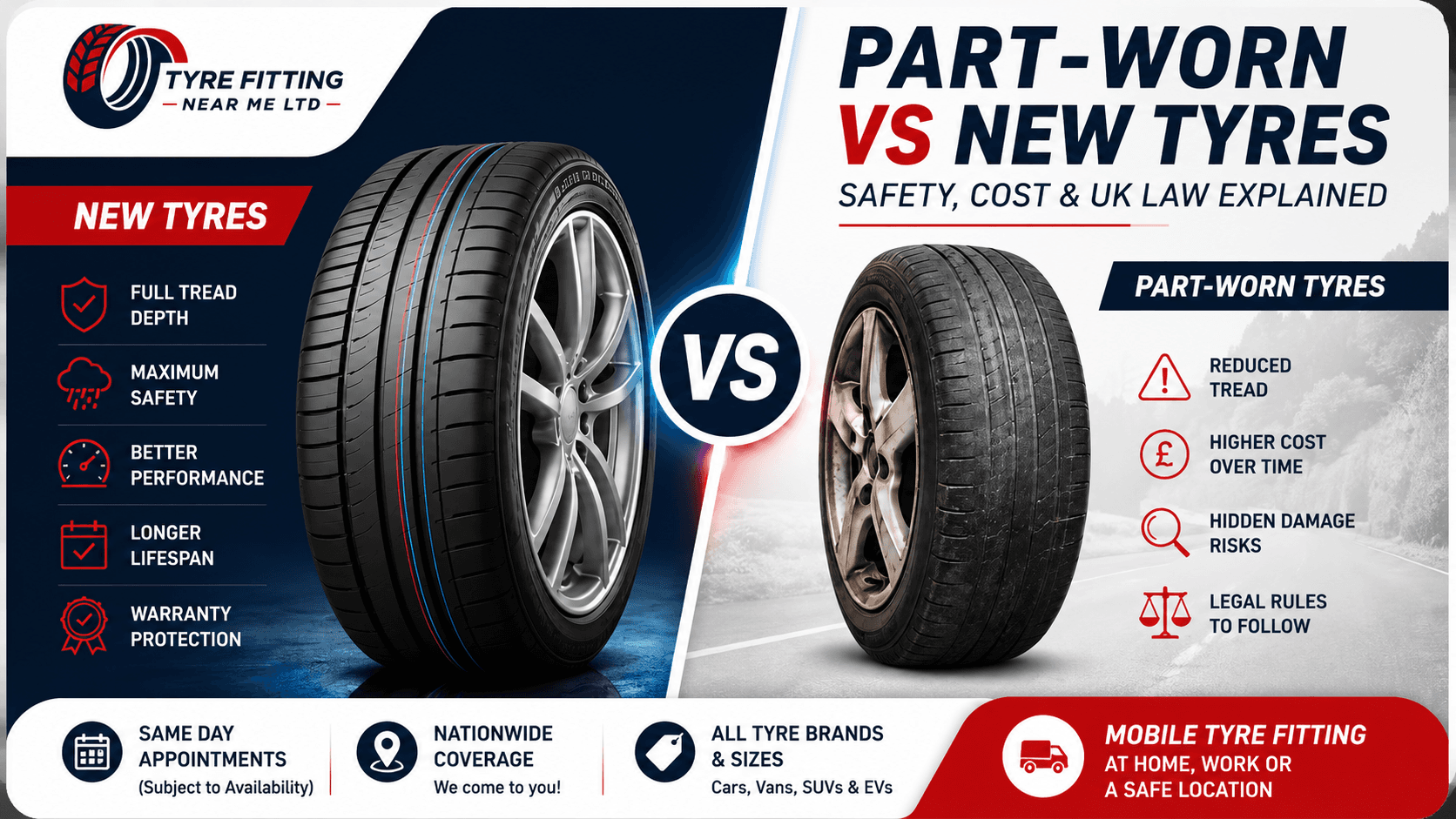
New tyres usually provide the safer and more predictable choice because they include full tread depth, an unused structure and a known purchase history. Legal part-worn tyres can remain roadworthy, but their age, previous loading, repair history and internal condition may remain uncertain. Buyers should compare usable tread, tyre compatibility, inspection evidence and total fitted cost before choosing.
UK motorists commonly compare part-worn and new tyres after punctures, MOT advisories or unexpected replacement costs. A reliable decision requires more than comparing two purchase prices. Tyre condition affects wet braking, remaining service life and structural reliability, while vehicle specifications determine whether any replacement tyre fits safely. The following comparison covers UK law, safety, value, inspection, compatibility and mobile fitting.
What Are Part-Worn Tyres?
A part-worn tyre is a tyre that has previously been fitted to another vehicle and is offered for sale again. A lawful seller must inspect its structure, verify sufficient tread, complete the required inflation test and apply the prescribed marking. A new tyre has no previous road use, so the buyer receives full starting tread and a known service history.
What Is the Difference Between a Used Tyre and a Legal Part-Worn Tyre?
A used tyre describes any tyre with previous service, while a legal part-worn tyre describes a used tyre that meets specific UK resale requirements. A tyre removed from a second-hand car remains used, but a dealer must satisfy inspection, tread and marking rules before selling that tyre separately as part-worn.
DVSA guidance states that sellers may legally supply and fit compliant part-worn tyres. The same guidance requires buyers and operators to examine structural integrity, original grooves, exposed cords, bulges, repairs and legal markings. A casual description such as “used tyre” does not prove that a seller completed those checks.
Tyre category Previous use Compliance evidence Purchase history New tyre No previous road use Manufacturer markings and product specification Known from initial purchase Legal part-worn tyre Previously fitted Required tread, inspection, inflation test and marking Previous service history may remain incomplete Unverified used tyre Previously fitted No confirmed resale compliance Source and condition may remain unknown
How Much Tread Do New and Part-Worn Tyres Usually Have?
New passenger-car tyres commonly start with approximately 7 mm to 9 mm of tread, although the exact depth varies by tyre model and manufacturer. A legally sold part-worn tyre must retain at least 2 mm across the full tread breadth and around the entire circumference under DVSA resale guidance.
Usable tread measures the depth available before the selected replacement threshold. A new tyre with 8 mm provides 6.4 mm before the 1.6 mm legal road-use limit, while a part-worn tyre with 4 mm provides 2.4 mm. The initial measurement therefore controls both remaining lifespan and value calculations.
Comparison point New tyre example Part-worn example Tread at purchase 8 mm 4 mm Legal road-use minimum 1.6 mm 1.6 mm Usable tread to legal minimum 6.4 mm 2.4 mm Previous road use None Variable
Are Part-Worn Tyres Legal in the UK?
Part-worn tyres are legal to sell and fit in the UK when they satisfy applicable condition, tread, inspection and marking requirements. A compliant tyre must retain at least 2 mm of tread for resale, show no disqualifying structural defects, pass an inflation test and carry the required PART-WORN marking. Road-use legality remains a separate requirement.
What Markings Must a Legal Part-Worn Tyre Have?
A non-retreaded part-worn tyre must display the relevant approval mark and a permanent, legible “PART-WORN” marking. DVSA guidance specifies uppercase lettering at least 4 mm high. The marking indicates resale compliance, but the marking cannot replace a buyer’s condition check or a professional internal inspection.
The tyre must show the relevant approval marking.
The sidewall must display “PART-WORN” in uppercase letters.
The lettering must measure at least 4 mm high.
The marking must remain permanent and legible.
The tyre must retain its original grooves around the circumference.
DVSA Market Surveillance Unit exercises found that 85% of purchased part-worn tyres lacked correct markings, although every sampled tyre met the minimum tread requirement. The finding shows why tread depth alone cannot establish full resale compliance.
What Inspection and Inflation Tests Are Required Before Sale?
A seller must inspect a part-worn tyre for structural defects before sale. DVSA guidance prohibits exposed ply or cords, structural bulges, disqualifying cuts and unsuitable penetration repairs. The tyre must also withstand its highest designed operating pressure during an inflation test without displaying the specified external defects.
An inflation test checks the pressurised casing for visible deformation or failure. The test does not reveal every historical impact, heat cycle, storage condition or concealed repair weakness. A competent fitter should therefore combine pressure testing with external examination, internal casing inspection and specification verification.
Inspect the tread surface for cuts and penetrations.
Inspect both sidewalls for bulges, cracking and deformation.
Inspect the inner liner, carcass and bead area.
Confirm that no ply or cord remains exposed.
Check that any penetration repair follows the relevant standard.
Complete the required inflation test before sale.
What Is the Difference Between the Sale Tread and Road-Use Tread Limits?
The part-worn sale threshold and the road-use threshold control different activities. DVSA resale guidance requires at least 2 mm across the full tread breadth and circumference before sale. The MOT inspection manual requires at least 1.6 mm within the central three-quarters and around the entire circumference for most cars and light vans.
Threshold Measurement Purpose Part-worn resale requirement At least 2 mm across the full breadth and circumference Controls legal resale as a part-worn tyre Road-use legal minimum At least 1.6 mm across the central three-quarters and circumference Controls roadworthiness for most cars and light vans Personal replacement threshold Chosen above the legal minimum Supports the driver’s wet-weather and risk preferences
Are Part-Worn Tyres Safe?
A compliant part-worn tyre can remain roadworthy, but its safety depends on condition, age, previous treatment, repair quality and correct fitment. A visual check cannot always reveal internal carcass damage or previous underinflation. New tyres remove most history uncertainty and normally provide deeper tread, which supports stronger wet-weather performance and a longer predictable service life.
Can Part-Worn Tyres Have Hidden Internal Damage?
Part-worn tyres can contain internal damage that an external inspection cannot reveal. Kerb impacts, potholes, collision forces, prolonged underinflation and overloaded driving can damage belts, beads, inner liners or carcass structures. A tyre may retain an acceptable outer appearance while internal separation or deformation weakens its load-bearing structure.
Auto Express documented that limitation during a 2025 mystery-shopping investigation. Professional inspection found one purchased pair in nearly new condition, while another pair showed age-related delamination and carcass breakdown that a casual buyer could easily miss.
A qualified fitter should remove the tyre from the wheel when a full internal assessment becomes necessary. Surface appearance, pressure retention and tread depth provide useful evidence, but no single check proves the complete history of a previously used casing.
How Does Tyre Age Affect Safety When the Tread Looks Good?
Tyre age affects rubber flexibility, bonding and structural condition even when the tread remains deep. Heat, sunlight, moisture, storage position, pressure history and road use influence degradation rates. A manufacture date therefore provides one condition indicator rather than a universal expiry date for ordinary passenger-car tyres.
A four-digit date code identifies the manufacturing week and year. A code reading 3524 identifies production during week 35 of 2024. The updated MOT manual applies specific ten-year age restrictions to buses, coaches and certain minibus positions, but it does not create the same automatic age failure for ordinary passenger cars.
A buyer should combine the date code with cracking, hardness, deformation, storage evidence and professional judgement. Deep tread cannot cancel age-related carcass deterioration, so the inspection must connect age with physical condition.
What Happens to Wet Grip and Braking as Tread Wears?
Reduced tread limits the channels that remove water from the contact patch. Lower water evacuation can increase aquaplaning exposure and reduce braking control on wet surfaces. Tyre compound, tread design, temperature, pressure and road texture also influence the final stopping distance.
Auto Express compared identical Ford Pumas on Continental SportContact 7 tyres at UTAC Millbrook. The new-tyre car stopped from 70 mph in 60.7 metres, while the car using tyres shaved to 1.6 mm required 75.6 metres. The 14.9-metre difference equalled roughly three and a half car lengths in the reported test.
Wet braking test New tread result Worn tread result 70 mph to stop 60.7 metres 75.6 metres 60 mph to stop 42.6 metres More than 55.1 metres Reported handling Greater control Reduced grip and greater understeer
The controlled comparison measured worn and new versions of the same premium tyre rather than every part-worn and budget tyre combination. The evidence still demonstrates that remaining tread changes wet performance, which makes tread depth a safety and value attribute.
Which Is Cheaper Over Time: Part-Worn or New Tyres?
Part-worn tyres usually cost less at purchase, but new tyres can cost less per usable millimetre because they provide more remaining tread and require fewer replacement fittings. A fair comparison should include tyre price, usable tread, balancing, valves, disposal and expected replacement frequency. Lower checkout cost does not automatically produce lower ownership cost.
How Do You Calculate Cost per Usable Millimetre of Tread?
Cost per usable millimetre divides the tyre price by the tread available before the chosen replacement threshold. The formula compares remaining material rather than headline price. Drivers should use the same replacement threshold for both tyres so the calculation preserves a fair basis.
Formula: tyre purchase price ÷ (tread at purchase − replacement threshold).
Illustrative input New tyre Part-worn tyre Purchase price £70 £35 Tread at purchase 8 mm 4 mm Selected replacement threshold 2 mm 2 mm Usable tread 6 mm 2 mm Cost per usable millimetre £11.67 £17.50
The example shows how a tyre costing half as much can provide only one-third of the usable tread. Actual wear rates vary because pressure, alignment, suspension condition, vehicle weight, road surfaces and driving behaviour affect tread loss.
Why Can a Cheaper Part-Worn Tyre Become a False Economy?
A low-priced part-worn tyre can become a false economy when limited tread forces an early replacement. Each replacement may create another fitting charge, balancing charge, valve cost and disposal fee. Repeated workshop visits also add time and vehicle downtime.
A mismatched wear pattern can create another cost. A tyre removed from one vehicle may carry shoulder wear or tread deformation caused by the previous vehicle’s alignment and suspension geometry. The new vehicle may then produce noise, vibration or accelerated wear after fitting.
A new tyre creates a longer and more measurable ownership period. The known starting condition allows the driver to monitor pressure, rotation, alignment and wear from the first mile, which improves cost forecasting.
What Costs Should Be Included Beyond the Tyre Price?
A whole-job comparison should include every charge required to place the vehicle safely back on the road. Retailers may bundle some services, so drivers should compare written fitted quotes rather than isolated product prices.
Tyre purchase price
Mobile call-out or workshop fitting
Replacement valve or TPMS service kit
Old tyre disposal
Repeat fitting caused by shorter remaining life
Vehicle downtime and travel
Warranty or accidental-damage coverage
Are Budget New Tyres Better Than Premium Part-Worn Tyres?
A suitable budget new tyre often provides a safer buying decision than an unknown premium part-worn tyre because the new product offers an unused casing, full tread and traceable specifications. A verified premium part-worn tyre may outperform some budget products in selected tests, but brand reputation cannot prove its age, repair history, remaining structure or previous treatment.
Is Tyre Condition More Important Than the Brand Name?
Tyre condition can outweigh brand reputation when a previously used tyre carries unknown damage or limited tread. A premium model may use an advanced compound and tread design, but previous underinflation, impact damage or poor repairs can compromise the original engineering.
A budget new tyre still requires careful selection. The driver must verify tyre size, load index, speed rating, wet-grip label, vehicle suitability and manufacturer credentials. A new product label cannot compensate for an incorrect specification.
A rational comparison therefore evaluates model performance and present condition separately. The buyer should never treat a premium sidewall name as evidence of structural integrity.
How Do Wet Grip, Noise, Warranty and Remaining Life Compare?
Decision attribute Budget new tyre Premium part-worn tyre Casing history Unused and traceable from purchase Previous use may remain incomplete Starting tread Full model-specific tread Remaining depth varies Wet performance Shown through current product rating and tests Original capability reduced by wear and age Road noise Declared label value where applicable Wear pattern may alter noise Warranty Manufacturer or retailer coverage may apply Coverage depends on the seller Remaining life Normally longer and easier to track Depends on tread, age and condition Purchase risk Model-quality uncertainty Model quality plus history uncertainty
A buyer should compare named tyre models rather than broad “budget” and “premium” labels. Independent wet-braking tests, product labels, warranty terms and correct vehicle specifications provide stronger evidence than price tier alone.
Which Option Suits Urban, Motorway and Performance Driving?
Driving context Preferred starting point Decision reason Low-speed urban use Suitable new budget or mid-range tyre Known condition and predictable daily service Regular motorway use New mid-range or premium tyre Higher-speed heat, wet braking and reliability demands Performance driving New approved performance tyre Vehicle dynamics require matched capability and condition Short-term emergency use Professionally verified replacement Correct fitment and roadworthiness control immediate risk
How Should You Inspect a Part-Worn Tyre Before Buying?
A buyer should inspect a part-worn tyre through a structured process covering specification, tread, sidewalls, casing, repairs, age, markings and seller evidence. A professional should remove the tyre for internal examination when condition remains uncertain. A visual buyer check can identify clear rejection signs, but it cannot certify every concealed structural defect.
How Do You Check Tread Depth, Uneven Wear and Sidewall Damage?
Confirm the tyre size. Match the width, profile and rim diameter against the vehicle handbook or approved fitment data.
Measure several tread points. Check the inner, centre and outer tread at multiple positions around the circumference.
Compare shoulder wear. Reject unexplained severe inner-edge, outer-edge or patchy wear.
Inspect every visible groove. Look for embedded objects, cuts, tearing and exposed material.
Examine both sidewalls. Search for bulges, deep scrapes, cracking, distortion and previous impact marks.
Inspect the bead area. Check the mounting edge for tearing, deformation and fitting damage.
Request internal inspection. Ask the fitter to examine the inner liner, carcass and repair locations before installation.
The MOT manual classifies exposed cords, structural bulges, lifting tread and certain deep cuts as major or dangerous defects. The same manual requires correct tread depth and proper tyre seating on the wheel rim.
A dedicated guide explaining how to measure tyre tread depth across the tyre can support monthly maintenance after fitting. Tread measurement should lead directly into age and repair verification.
How Do You Read the Tyre Date Code and Check Repair History?
Locate the date-code panel. Search the sidewall near the DOT marking or moulded identification area.
Read the four digits. Interpret the first pair as the manufacturing week and the second pair as the year.
Inspect both sidewalls. Some tyres display the complete code on only one side.
Ask about previous punctures. Request the number, position and repair method for every known penetration.
Inspect the inner liner. Check whether each repair uses a suitable permanent method in an allowed area.
Reject doubtful repairs. Avoid exposed cords, sidewall penetrations, insecure plugs and unexplained casing damage.
DVSA guidance requires qualifying penetration damage to follow British Standard BS AU 159. The guidance also records non-compliant string-type plugs among defects found during enforcement exercises.
A separate guide covering how to read a tyre manufacture date code can help drivers document age after purchase. Repair evidence then leads into seller verification.
What Questions Should You Ask the Tyre Seller?
What vehicle or source supplied the tyre?
What tread depth does each measurement point show?
What manufacturing date does the sidewall code show?
Has the tyre received any puncture repair?
Has a fitter inspected the internal casing?
Has the tyre passed the required inflation test?
Where does the required PART-WORN marking appear?
Does the tyre match my required size, load index and speed rating?
Does the price include fitting, balancing, valve service and disposal?
What return policy or failure guarantee does the seller provide?
A reputable seller should answer specific condition questions without replacing evidence with reassurance. A written invoice should identify the supplier, tyre specification, fitted price and applicable protection.
Which Defects Require You to Reject the Tyre?
Exposed ply, fabric or steel cords
Structural bulges, lumps or tread lifting
Deep cuts that reach structural material
Severe cracking or visible carcass deterioration
Bead tearing or deformation
Unsafe sidewall or shoulder repairs
Incorrect size, load index or speed rating
Missing required part-worn marking
Severe uneven wear
Unexplained internal damage
Any uncertainty should stop the purchase until a qualified fitter completes a proper assessment. A cheaper tyre cannot deliver value when its condition prevents safe installation.
Can You Mix New and Part-Worn Tyres on the Same Car?
Drivers can encounter legal configurations that mix tyre brands or wear levels, but every tyre must match the vehicle’s approved size, structure, load and speed requirements. Tyres on the same axle require particular attention because inconsistent construction or significant performance differences can affect braking and handling. Vehicle-manufacturer guidance should control the final fitment decision.
Should Tyres Match on the Same Axle?
Tyres on the same axle should match as closely as practical in size, structure, tread pattern, performance category and wear level. The MOT manual prohibits different tyre sizes or structures on the same axle in relevant circumstances, while manufacturer recommendations may impose stricter requirements.
Large tread-depth differences can create unequal grip and water clearance across the axle. Different wear patterns can also change noise, steering response and electronic stability-control behaviour during emergency manoeuvres.
A fitter should measure both tyres and review the vehicle handbook before replacing only one position. Drivers considering mixed brands can review mixing tyre brands and tread patterns on one axle before approving the installation.
Do Load Index, Speed Rating, Run-Flat and TPMS Requirements Matter?
Load index and speed rating determine whether a tyre can support the vehicle’s weight and operating requirements. A replacement tyre must meet the vehicle manufacturer’s approved specification, regardless of its new or part-worn condition.
Run-flat construction also changes the decision. The MOT manual states that run-flat and conventional tyres may pass in some mixed configurations, but the manual does not recommend that combination. Vehicle-handbook instructions and the fitted pressure-monitoring system should guide the replacement.
TPMS-equipped vehicles require correct pressure, compatible valves or sensors and a functioning warning system. A fitter should inspect the valve, sensor condition and dashboard warning status during replacement.
Can Part-Worn Tyres Be Used on Vans and Electric Vehicles?
Part-worn tyres can only suit vans or electric vehicles when their load capacity, dimensions, speed rating and construction meet the vehicle specification. Vans carry higher axle loads, while many electric vehicles combine greater mass with immediate torque.
A compliant resale marking cannot prove vehicle suitability. The fitter must verify the sidewall specification against approved fitment data before installation.
When Should You Choose New Tyres Instead of Part-Worn Tyres?
Drivers should choose new tyres when predictable safety, long service life, motorway performance, load capacity or warranty protection carries greater value than the lowest initial price. New tyres also suit buyers who cannot verify a used tyre’s age, repairs and internal condition. A professionally inspected part-worn tyre remains a conditional short-term option rather than an equal default.
Which Drivers Should Avoid Part-Worn Tyres?
Regular motorway drivers should favour new tyres because higher speeds increase the consequences of structural failure and reduced wet grip. High-mileage motorists also gain greater value from deeper starting tread and fewer replacement cycles.
Family-car, performance-car and commercial-vehicle drivers should prioritise known condition and correct matching. Passenger loads, vehicle weight, torque and demanding braking increase the importance of predictable tyre performance.
Drivers using run-flat systems, specialised sizes or manufacturer-matched axle sets should avoid uncertain substitutes. The safest option starts with a correct specification rather than a cheap available size.
When Could a Professionally Inspected Part-Worn Tyre Be a Short-Term Option?
A professionally inspected part-worn tyre may serve a short-term need when the tyre retains substantial even tread, carries the required marking, passes structural checks and exactly matches the vehicle specification. The seller should also provide clear evidence about testing, repairs and fitted cost.
A temporary use case might involve a low-mileage vehicle approaching planned disposal or a matching replacement with verified provenance. The driver must still maintain legal tread, correct pressure and ongoing condition checks.
A short-term option should never justify an unsafe roadside repair or an incompatible fitment. Professional verification must connect the available tyre with the actual vehicle and journey.
What Is the Safest Choice When Your Budget Is Limited?
A budget-limited driver should compare fitted prices for suitable new budget and mid-range tyres before considering a part-worn alternative. New tyres provide full tread and remove previous-use uncertainty.
A written quote should include the tyre model, wet-grip rating, fitting, balancing, valve service and disposal. The lowest complete quote often provides a clearer decision than the lowest tyre-only price.
How Can Mobile Tyre Fitting Resolve the Replacement at Home or Work?
Mobile tyre fitting can supply and install a correctly specified new tyre at a home, workplace or other safe location. A trained fitter can verify tyre size, load rating, speed rating, pressure and visible wheel condition before fitting. Mobile service removes the need to drive on a damaged tyre, but the operating location must protect the customer and technician.
What Can a Mobile Tyre Fitter Check Before Installation?
A mobile fitter can confirm the registration details, tyre dimensions and manufacturer specification before travelling. The technician can then inspect the damaged tyre, wheel, valve, tread pattern and TPMS status at the vehicle.
Approved tyre size
Required load index
Required speed rating
Run-flat or conventional construction
TPMS valve and warning status
Wheel and rim condition
Remaining tread on the opposite tyre
Axle matching requirements
Correct inflation pressure
Wheel-nut torque requirement
Drivers can review how mobile tyre fitting works from booking to balancing before arranging attendance. The verification process then supports a correct installation.
Can New Tyres Be Fitted and Balanced at Your Location?
A properly equipped mobile unit can fit and balance new tyres at homes, workplaces and safe off-road locations. The technician normally uses a tyre-changing machine, wheel balancer, approved lifting equipment, calibrated torque wrench and inflation equipment.
Service capability depends on tyre size, wheel type, vehicle access and local stock. Drivers comparing service models can review a mobile tyre fitting versus garage fitting comparison and the expected mobile tyre fitting time for one or more tyres.
When Is Roadside Tyre Work Unsafe or Inappropriate?
Roadside tyre work becomes unsafe when traffic, road position, visibility, ground stability or vehicle access exposes the driver or fitter to danger. National Highways tells motorists not to attempt repairs after stopping on a motorway hard shoulder or emergency area. Drivers should move left, reach safety and contact assistance.
A live motorway lane never provides a suitable mobile-fitting location. Emergency services or traffic officers may need to secure the scene before recovery or repair can proceed.
Need a Safe Replacement Tyre Fitted at Your Location?
Request a correctly sized new tyre for fitting at your home, workplace or another safe location. Our mobile tyre fitting service at home or work can confirm availability, tyre specification and the complete fitted price before dispatch.
Get a Mobile Tyre Fitting Quote
What Else Do Drivers Ask About Part-Worn and New Tyres?
Drivers commonly ask about legality, lifespan, motorway use, pressure testing, warranties and mixed fitments after comparing new and part-worn tyres. Each answer below resolves one specific purchase concern without replacing a professional inspection. Vehicle specifications, tyre condition and seller evidence should control every final decision.
Are Part-Worn Tyres Illegal?
No, compliant part-worn tyres are legal to sell and fit in the UK. The tyre must meet applicable tread, structural-condition, inflation-test and marking requirements. DVSA guidance requires at least 2 mm of tread for resale and a permanent PART-WORN marking on qualifying non-retreaded tyres. A legal sale does not guarantee suitability for every vehicle, so a fitter must still verify condition and specification.
How Long Can a Part-Worn Tyre Last?
A part-worn tyre can last from a short period to several years because remaining tread, annual mileage, pressure, alignment and driving style control wear. A tyre bought with 4 mm provides much less usable tread than a new tyre starting near 8 mm. Age or uneven wear can also shorten service life before the tread reaches the legal limit.
Is a 4 mm Part-Worn Tyre Worth Buying?
A 4 mm part-worn tyre only offers value when its price, age, condition and fitted cost compare favourably with a suitable new tyre. A 4 mm tyre provides 2.4 mm before the 1.6 mm legal minimum, while an 8 mm new tyre provides 6.4 mm. The buyer should calculate cost per usable millimetre and verify internal condition before purchasing.
Are Part-Worn Tyres Safe for Motorway Driving?
A verified part-worn tyre may remain roadworthy on a motorway, but unknown history and reduced tread create greater purchase uncertainty. Regular motorway speeds increase heat and magnify the consequences of pressure loss, structural failure or poor wet grip. New matched tyres normally provide a more predictable choice for frequent motorway travel, especially when the used tyre lacks documented inspection evidence.
Can a Pressure Test Detect Every Tyre Defect?
No, an inflation test cannot detect every tyre defect or reconstruct the tyre’s complete service history. The test can expose certain visible problems while the casing carries pressure, but concealed impact damage, ageing, poor storage and some repair weaknesses may require internal examination. A reliable assessment combines inflation testing, external inspection, internal inspection, tread measurement, date-code review and repair verification.
Is a New Budget Tyre Safer Than a Used Premium Tyre?
A suitable new budget tyre usually presents less history uncertainty than an unknown used premium tyre. The new tyre provides an unused casing, full tread and traceable specifications, while the premium part-worn tyre may retain stronger original engineering but reduced tread or hidden damage. Buyers should compare named models, wet-grip evidence, vehicle compatibility, age, repairs and warranty rather than relying on price tier.
Can One Part-Worn Tyre Be Fitted With Three New Tyres?
One part-worn tyre may create an unsuitable mismatch when its tread depth, construction or performance differs from the tyre on the same axle. The replacement must meet the approved size, load index and speed rating, while the axle pair should match as closely as practical. A fitter should measure the opposite tyre and follow the vehicle manufacturer’s guidance before approving a single replacement.
Do New Tyres Come With a Warranty?
Many new tyres include manufacturer defect coverage, while some retailers provide separate workmanship or accidental-damage protection. Warranty duration, exclusions and claim procedures vary by brand and seller. Part-worn tyre protection usually depends on the individual dealer and may offer narrower remedies. Buyers should request written terms covering manufacturing faults, fitting work, road damage, returns and evidence required for a claim.
Can Mobile Tyre Fitters Supply New Tyres the Same Day?
Mobile tyre fitters can often supply new tyres on the same day when the required size, load rating and speed rating remain available locally. Specialist run-flat, commercial, performance or uncommon sizes may require additional sourcing time. The customer should provide the registration number, full sidewall size, current location and tyre position so the service can confirm stock and the fitted price.