How to find your tyre size
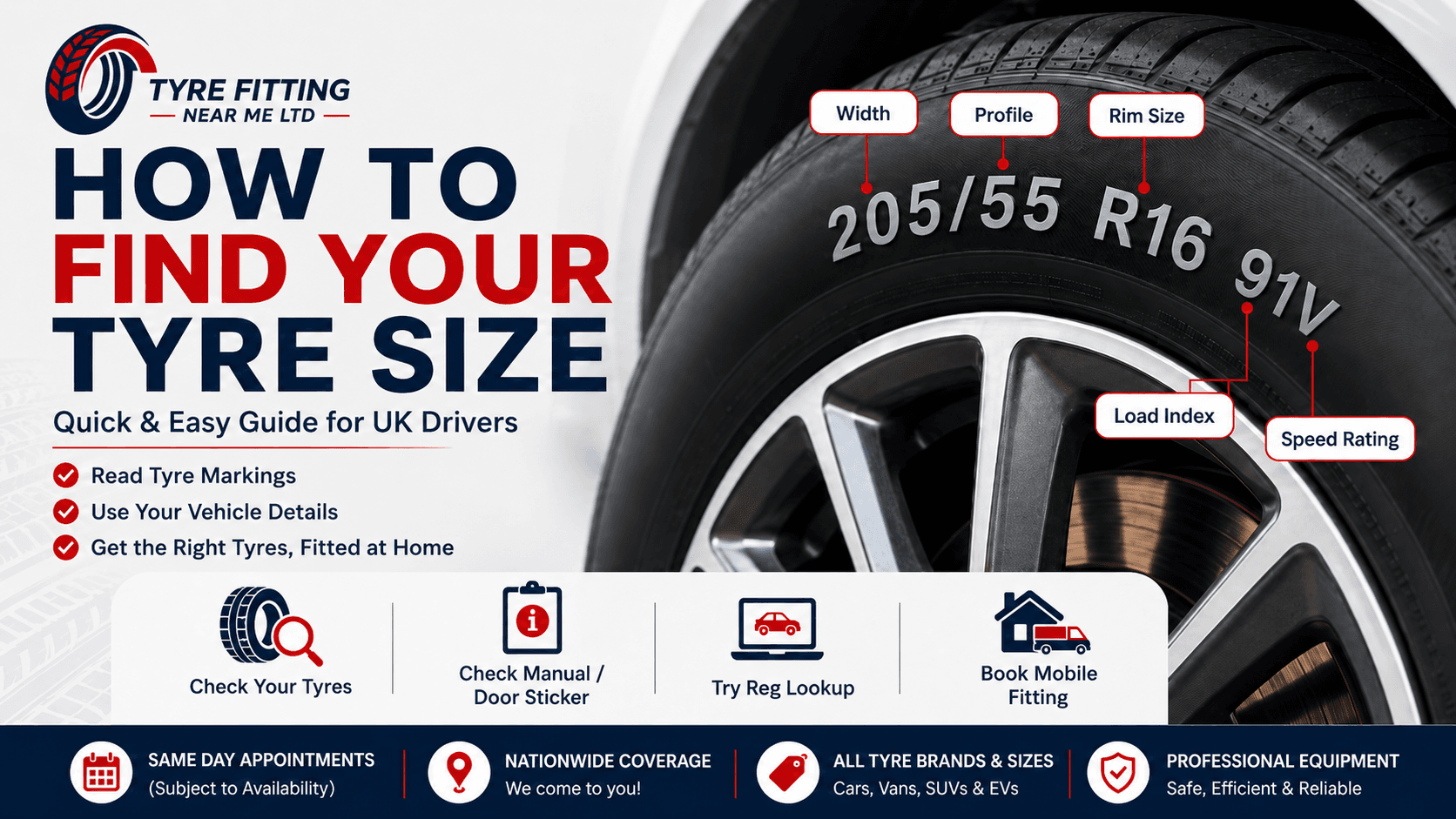
If you need mobile tyre fitting at home, work, or roadside, finding the correct tyre size is one of the first things to check before booking. You can find your tyre size on the sidewall of your current tyre. Look for a code like 205/55 R16 91V. This code tells the mobile tyre fitter the tyre width, profile, rim size, load index, and speed rating so the correct replacement tyre can be brought to your location.
How do you find your tyre size before booking mobile tyre fitting?
You can find your tyre size quickly by checking the tyre sidewall first, then confirming the same size against your vehicle handbook, door sticker, fuel flap, or registration lookup. A tyre code such as 205/55 R16 91V gives the main fitment details a mobile tyre fitter needs before travelling to you.
How do you check the tyre sidewall?
Park the vehicle safely on level ground.
Turn the steering wheel outward if checking a front tyre.
Look around the outer tyre sidewall.
Find a code similar to 205/55 R16 91V.
Take a clear photo and send it when booking your mobile tyre fitting service.
The tyre sidewall gives the fastest visible tyre size source. Sending a clear photo helps the fitter confirm the tyre before bringing replacement stock to your home, workplace, or roadside location.
How do you check your vehicle handbook or door sticker?
Your vehicle handbook lists manufacturer-approved tyre sizes for the vehicle model, trim, and wheel option. The door sticker normally sits inside the driver door opening, while some vehicles place tyre information inside the fuel flap, glove box, or under the bonnet.
These sources help confirm the fitted tyre size before a mobile tyre fitting appointment is arranged.
How do you use registration lookup safely?
A registration lookup can match your number plate with common tyre sizes for your vehicle. The lookup may show more than one size when the car has different wheel options, aftermarket wheels, or different front and rear tyres.
For mobile tyre fitting, use registration lookup as a starting point and confirm the result against the tyre sidewall before booking.
What does a tyre size like 205/55 R16 91V mean?
A tyre size like 205/55 R16 91V identifies the tyre width, sidewall profile, radial construction, rim diameter, load index, and speed rating. Each part helps the mobile tyre fitter select a replacement tyre that matches the wheel and vehicle specification.
205 means 205mm tyre width. 55 means the sidewall height is 55% of the tyre width. R means radial construction. 16 means the tyre fits a 16-inch rim. 91 is the load index. V is the speed rating.
What does 205 mean on a tyre?
The number 205 shows the tyre section width in millimetres. Correct width helps the fitter make sure the replacement tyre matches the wheel and vehicle clearance.
What does 55 mean on a tyre?
The number 55 shows the tyre profile or aspect ratio. The sidewall height equals 55% of the tyre width. The correct profile matters because it affects overall tyre size, comfort, clearance, and rolling circumference.
What does R16 mean on a tyre?
The letter R means radial construction, and the number 16 means the tyre fits a 16-inch wheel rim. A mobile tyre fitter must know the correct rim diameter because a tyre designed for a 16-inch rim cannot be safely fitted to a different wheel size.
What do 91 and V mean on a tyre?
The number 91 shows the tyre load index, while V shows the speed rating. The replacement tyre should meet the vehicle manufacturer specification. A mobile tyre professional can verify these ratings before fitting.
Where else can you find the correct tyre size?
You can find the correct tyre size on the tyre sidewall, vehicle handbook, driver door sticker, fuel flap sticker, glove box label, or registration lookup. These sources help confirm the exact tyre specification before the mobile fitter arrives.
Where is the tyre size sticker on a car?
The tyre size sticker usually sits inside the driver door opening. Some manufacturers place the tyre placard inside the fuel filler flap, glove box, or under the bonnet.
The sticker may also show recommended tyre pressures, which can be checked during a mobile tyre fitting visit.
Where is tyre size shown in the owner’s manual?
The owner’s manual normally shows approved tyre sizes in the wheels, tyres, or maintenance section. It may list different sizes by engine, trim, wheel diameter, or load condition.
This information can help a mobile tyre fitter confirm the correct replacement when the sidewall markings are unclear.
Can a mobile tyre fitter confirm tyre size?
Yes. A mobile tyre fitter can confirm tyre size from sidewall markings, vehicle registration data, wheel diameter, tyre position, and clear tyre photos. Sending this information before the appointment reduces the chance of the wrong tyre being brought to your location.
Can you find tyre size by registration number?
You can find tyre size by registration number through an online tyre lookup tool. This is useful before booking mobile tyre fitting because it helps narrow down the likely tyre options for your vehicle.
Drivers should still check the sidewall because optional wheels, aftermarket alloys, and staggered fitments can create more than one possible size.
Why is registration lookup useful for mobile tyre fitting?
Registration lookup gives the fitter a quick starting point when preparing stock before travelling to your home, workplace, or roadside location. It can speed up booking and reduce delays.
Why should you still check the tyre sidewall?
The tyre sidewall shows the tyre currently fitted to the wheel. Registration databases can show several approved sizes for the same vehicle model, so the sidewall remains one of the most useful checks before mobile tyre replacement.
Can front and rear tyres be different sizes?
Front and rear tyres can be different sizes on vehicles with staggered fitments. Performance vehicles may use wider rear tyres for traction and handling. When booking mobile tyre fitting, tell the fitter exactly which tyre position needs attention, such as front left or rear right.
Why does tyre position matter when booking?
Tyre position matters because some vehicles use different front and rear tyre sizes. Sending the tyre position together with the tyre code helps the fitter bring the correct tyre for the wheel that needs replacement.
Why should tyres on the same axle match?
Tyres on the same axle should normally match in size, structure, and suitable rating. A mismatch can affect braking, steering, stability, and electronic safety systems. A mobile tyre professional can check the existing axle setup before fitting a replacement.
What should you do if your tyre size markings are worn or unclear?
If the tyre markings are difficult to read, check another tyre on the vehicle, inspect the door sticker, read the owner’s manual, use registration lookup, and send clear wheel photos to the mobile tyre fitter.
Drivers should not guess tyre size because the fitter needs accurate width, profile, rim size, load index, and speed rating before bringing replacement stock.
How can photos help a mobile tyre fitter confirm the size?
Send one close photo of the tyre sidewall code.
Send one full photo of the wheel and tyre.
Send the vehicle registration number.
Send the tyre position, such as front left or rear right.
Send your postcode and fitting location.
These details give the fitter enough information to check the required tyre before travelling to you.
When should you ask a tyre professional?
You should ask a tyre professional when the sidewall is unreadable, the vehicle has aftermarket wheels, the front and rear sizes differ, or registration lookup shows multiple options. A mobile fitter can help verify the tyre before arranging replacement.
Can you use a different tyre size on your car?
You should only use a different tyre size when it remains compatible with the wheel rim, vehicle clearance, load rating, speed rating, and manufacturer guidance. Changing tyre size can affect handling, braking, speedometer accuracy, suspension clearance, and TPMS operation.
If you are considering an alternative size, ask the fitter to verify compatibility before the mobile fitting appointment.
Why does wheel rim size matter?
Wheel rim size determines whether the tyre can physically fit the wheel. A 205/55 R16 tyre requires a 16-inch rim. Correct rim size is essential before any mobile tyre replacement can be completed safely.
How can changing tyre size affect safety?
Wider tyres can reduce wheel arch clearance.
Taller profiles can affect suspension clearance.
Lower load ratings can reduce safe carrying capacity.
Lower speed ratings may not meet vehicle specification.
Incorrect rolling circumference can affect braking and stability systems.
Why is the correct tyre size important for mobile tyre fitting?
The correct tyre size helps the mobile tyre fitter bring the right replacement tyre, valve, tools, and wheel balancing setup to your location. Wrong tyre information can delay fitting, create wrong-stock problems, or prevent the job from being completed during the first visit.
How does tyre size help the fitter bring the right tyre?
Tyre size tells the fitter the required width, profile, rim diameter, load index, and speed rating. The fitter uses this information to select compatible stock before travelling.
What details should you send before booking mobile tyre fitting?
Tyre size code, such as 205/55 R16 91V.
Vehicle registration number.
Tyre position, such as front left or rear right.
Postcode and fitting location.
Clear tyre sidewall photo.
Whether you have the locking wheel nut key.
Whether the TPMS warning light is on.
If your locking wheel nut key is missing or damaged, a locking wheel nut removal service may be needed before the tyre can be replaced.
What happens if the tyre size is wrong?
A wrong tyre size can stop a mobile fitting because the tyre may not match the rim, load rating, or vehicle specification. The fitter may need to source another tyre or rearrange the fitting visit.
Correct information at booking gives the best chance of completing the job in one visit.
What other mobile tyre services may be useful?
A tyre size check is often part of a wider mobile tyre service. Depending on the problem, you may also need mobile tyre repair, wheel balancing, TPMS service, run-flat tyre replacement, or 24/7 emergency tyre fitting.
If you are unsure whether the tyre can be repaired or needs replacement, read the guide on whether a puncture can be repaired. You can also compare mobile tyre fitting vs garage tyre fitting or check what you need for mobile tyre fitting before your appointment.
Need tyres fitted at home, work, or roadside? Check the sidewall code, take a clear photo, and book a mobile tyre fitting service with the correct tyre size and vehicle details.
FAQs about tyre size and mobile tyre fitting
How do I find my tyre size for mobile tyre fitting?
Check the tyre sidewall and look for a code such as 205/55 R16 91V. Send the code, vehicle registration, tyre position, postcode, and a clear tyre photo to the mobile tyre fitter before booking.
Can a mobile tyre fitter check my tyre size?
Yes. A mobile tyre fitter can use the sidewall markings, vehicle registration, wheel size, tyre position, and photos to help confirm the correct replacement tyre.
Can I find tyre size by registration?
Yes. Registration lookup can show likely tyre sizes, but you should also check the sidewall because some vehicles have different wheel options or different front and rear tyre sizes.
What if I cannot read the tyre size?
Check another tyre, the driver door sticker, fuel flap, owner’s manual, or registration lookup. You can also send clear photos to the mobile tyre fitter for confirmation.
Why does the fitter need my tyre size before arrival?
The fitter needs the tyre size to bring the correct replacement stock. Accurate information helps avoid delays, wrong-stock issues, and repeat visits.
Can front and rear tyre sizes be different?
Yes. Some vehicles use staggered fitments with different front and rear tyre sizes. Always tell the fitter which wheel needs replacement.
Can mobile tyre fitting be done at home?
Yes. Mobile tyre fitting can be carried out at home, work, roadside, or another suitable safe location. You can read more about getting tyres fitted at home.
What if I have a puncture instead of needing a new tyre?
A mobile tyre fitter can inspect the tyre and determine whether a safe repair is possible. Read the guide on repairable vs non-repairable punctures for more information.
What if I have run-flat tyres?
Tell the fitter that the vehicle uses run-flat tyres before booking. A run-flat tyre replacement service may be required depending on tyre condition and vehicle specification.
What if I need urgent tyre replacement?
If you are stranded with a flat or unsafe tyre, a 24/7 emergency tyre fitting service can bring a replacement tyre to your location, subject to tyre availability and safe access.