What do I need for mobile tyre fitting
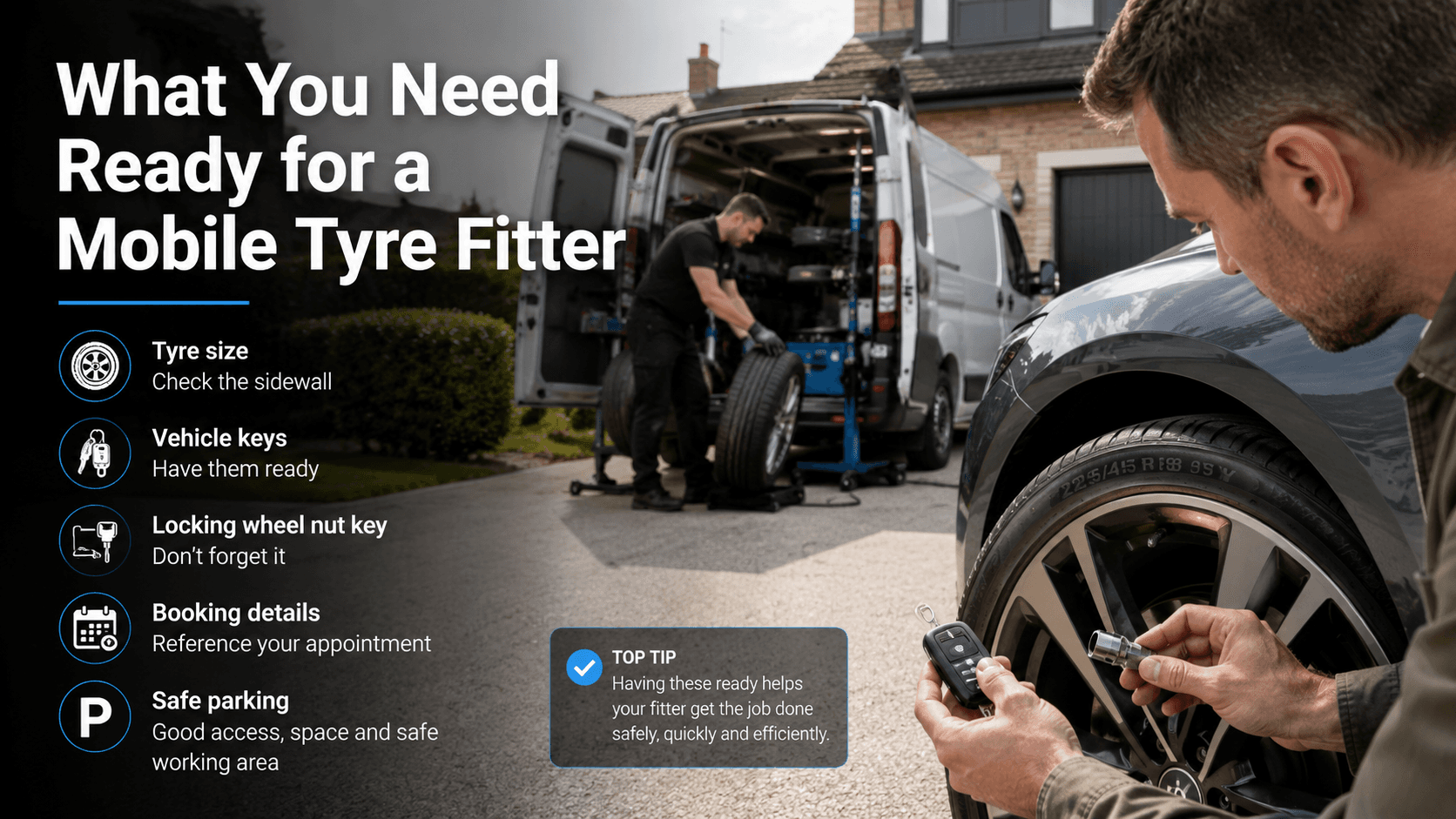
For mobile tyre fitting, you need your vehicle keys, locking wheel nut key if your wheels use one, correct tyre size or vehicle registration, appointment details, and a safe, level, accessible place for the fitter to work. The technician brings the fitting van, tools, balancing equipment, valves, and tyre-handling equipment.
Mobile tyre fitting works best when the driver prepares the vehicle and the technician can reach every wheel safely. The page explains what you should check before the appointment, what the mobile fitter brings, which locations suit the job, and when punctures, tyre damage, TPMS warnings, or roadside conditions need a different response.
What do you need ready before a mobile tyre fitter arrives?
You need five things ready before a mobile tyre fitter arrives: vehicle keys, locking wheel nut key, correct tyre details, booking confirmation, and safe vehicle access. The fitter needs these items because tyre removal, wheel balancing, valve replacement, pressure checking, and wheel refitting all depend on access, correct fitment, and a safe working space around the vehicle.
Which items should the driver have ready?
The driver should prepare the items that control vehicle access, wheel removal, tyre selection, and appointment confirmation. A missing key or wrong tyre size can delay the fitting because the technician cannot safely remove the wheel or confirm the replacement tyre matches the vehicle.
Item Why the fitter needs it What to check before arrival Vehicle keys The technician may need ignition access, steering movement, or wheel position control. Keep the keys with the person meeting the fitter. Locking wheel nut key The technician needs the key when the vehicle uses locking wheel nuts or locking wheel bolts. Check the glovebox, boot, wheel tool kit, or storage pouch. Tyre size The tyre size confirms the width, profile, rim diameter, load index, and speed rating. Read the sidewall code or confirm the vehicle registration lookup. Booking confirmation The booking confirms the appointment address, time slot, tyre choice, and contact details. Check the postcode, phone number, and tyre order before the fitter travels. Safe parking space The technician needs firm, level ground and enough working room around the wheel. Move the vehicle before arrival if the current space blocks access.
Which details should the booking already include?
The booking should include enough detail to match the tyre, find the vehicle, and allocate the right technician. A clear booking reduces wrong-tyre risk because the fitter can verify the vehicle registration, tyre size, postcode, appointment slot, and contact number before reaching the site.
Booking detail Purpose Customer action Vehicle registration The registration helps identify likely tyre fitment for the vehicle. Enter the plate exactly as shown on the vehicle. Postcode The postcode confirms mobile coverage and appointment routing. Use the postcode where the vehicle will be parked. Tyre size The size confirms the physical tyre specification. Compare the order against the sidewall code. Tyre position The position tells the fitter which wheel needs work. State front, rear, left, right, or multiple tyres. Contact number The number lets the technician confirm access or arrival time. Keep the phone switched on before the appointment.
What happens if something is missing?
A missing item can stop the appointment when the technician cannot remove the wheel, access the car, or verify the tyre. The most common failed-visit risks involve a missing locking wheel nut key, unsafe parking position, incorrect tyre size, blocked wheel access, or absent vehicle keys.
Appointment warning: A mobile fitter can usually bring tyre equipment, balancing tools, valves, and pressure gauges. The customer must usually provide access, keys, correct booking details, and the locking wheel nut key when the wheel uses one.
What does the mobile tyre fitter bring to the appointment?
The mobile tyre fitter brings a fitted service van with tyre-changing equipment, wheel balancing tools, lifting equipment, torque tools, air supply, valves, pressure gauges, and tyre-handling supplies. The customer does not need to provide fitting tools, but the customer must provide the vehicle, access, correct details, and a safe place for the technician to work.
Which tools and equipment does the technician use?
The technician uses mobile workshop equipment that performs the same core tyre replacement actions away from a garage bay. The equipment allows the fitter to remove the wheel, demount the old tyre, mount the new tyre, inflate the tyre, balance the wheel, and refit the wheel safely.
Equipment Function Customer relevance Hydraulic jack The jack lifts the vehicle at approved lifting points. The vehicle needs firm and level ground. Axle stand or support equipment The support equipment stabilises the vehicle during wheel removal. The fitter needs safe space beside the vehicle. Tyre changer The tyre changer removes and fits tyres on the wheel rim. The correct tyre size must be available. Wheel balancer The balancer reduces wheel vibration after the new tyre is fitted. The wheel should be balanced before road use. Torque wrench The torque wrench tightens wheel fixings to the correct setting. The driver should allow the technician to finish final checks. Pressure gauge The gauge checks tyre pressure after inflation. The driver should check pressure again after normal use if advised.
Which fitting tasks does the technician normally complete?
The technician normally completes the full tyre replacement sequence at the chosen location. The sequence covers wheel removal, tyre removal, new tyre fitment, valve service where required, inflation, balancing, refitting, torque checking, pressure checking, and work sign-off.
The technician confirms the vehicle and tyre order.
The technician checks wheel access and working space.
The technician lifts the vehicle at a suitable lifting point.
The technician removes the wheel and old tyre.
The technician fits the replacement tyre to the wheel rim.
The technician inflates and balances the wheel.
The technician refits the wheel and checks wheel fixing torque.
The technician checks tyre pressure and confirms completion.
Which jobs may need extra equipment or a garage?
Some tyre problems need extra equipment because mobile vans have space and safety limits. Severe wheel damage, unsafe parking, seized wheel nuts, missing locking wheel nut keys, complex TPMS faults, or suspension damage can move the job from a mobile appointment to a garage inspection.
Badly distorted wheels may need workshop inspection.
Sidewall damage usually requires tyre replacement rather than basic puncture repair.
Seized fixings may require controlled garage removal.
Complex TPMS faults may require diagnostic equipment beyond basic reset support.
Unsafe ground can stop lifting and wheel removal.
How do you choose a safe place for mobile tyre fitting?
You choose a safe place by parking the vehicle on firm, level ground with clear access around the wheel that needs work. A driveway, private parking bay, or workplace car park usually suits mobile tyre fitting when the technician can position equipment safely and avoid traffic, soft ground, steep slopes, and blocked wheel access.
What makes a driveway or car park suitable?
A suitable fitting location gives the fitter enough space to lift the vehicle, remove the wheel, and operate mobile tyre equipment. The ground should support the jack and van equipment, while the parking position should keep the technician away from moving vehicles and pedestrian hazards.
Location feature Suitable value Reason Ground surface Firm, paved, and level The jack and support equipment need stable contact. Working space Clear room around the wheel The fitter needs space for tools and wheel removal. Vehicle access Unlocked vehicle and accessible wheels The fitter may need keys, steering movement, and wheel access. Traffic exposure Low traffic or private parking The technician should not work beside moving traffic. Lighting Good visibility or technician lighting The technician needs clear sight of fixings, tyres, and tools.
Which locations can stop the fitting?
Unsafe locations can stop mobile fitting because the technician must control lifting, wheel removal, and refitting risk. A steep drive, loose gravel surface, narrow road, live traffic lane, blocked wheel, or underground car park with poor access can prevent safe mobile tyre replacement.
Location issue Risk created Better action Steep slope The vehicle can become unstable during lifting. Move the vehicle to level ground before the appointment. Loose gravel The jack may not sit securely on the surface. Use a firm paved space where available. Narrow roadside The technician may work too close to traffic. Move to a safer parking area before fitting. Blocked wheel The fitter cannot remove the wheel safely. Clear bins, kerbs, walls, or other parked vehicles. Restricted height car park The service van may not access the vehicle. Confirm height, access, and parking instructions before booking.
What should you do if the vehicle is roadside?
Roadside tyre problems need safety decisions before service decisions. National Highways tells motorway drivers to leave the carriageway at the next exit or service area where possible, avoid stopping in a live lane unless absolutely necessary, and avoid attempting repairs on the vehicle in unsafe motorway conditions.
Safety source: National Highways gives motorway breakdown guidance through a three-step method: go left, get safe, and get help. Drivers should use safe areas, keep away from traffic where possible, and call emergency help when the vehicle cannot reach a place of relative safety.
How do you find the correct tyre size before booking?
You find the correct tyre size by reading the code printed on the tyre sidewall, checking the vehicle handbook, checking the driver door placard where fitted, or using a vehicle registration lookup. The sidewall code matters because tyre width, profile, rim diameter, load index, and speed rating affect legal fitment and driving performance.
Where is tyre size shown on the sidewall?
The tyre sidewall shows the tyre size as a sequence of numbers and letters. A common example is 205/55 R16, and the DVSA MOT manual explains that the aspect ratio forms part of the tyre size marking, such as 215/55R15 with an aspect ratio of 55 percent.
Find the tyre sidewall on the outer face of the tyre.
Look for a code with width, profile, construction, and rim size.
Check the load index and speed rating after the size code.
Compare the sidewall code with the booking confirmation.
Ask the provider to verify fitment when the front and rear sizes differ.
What does a size like 205/55 R16 mean?
A tyre size code describes the tyre’s physical dimensions and construction. The fitter uses the code to match the new tyre to the wheel rim, vehicle weight, and driving requirements, especially when the vehicle uses different front and rear tyre sizes.
Code part Meaning Example value 205 Tyre width in millimetres 205 mm wide tyre 55 Aspect ratio as a percentage of tyre width 55 percent profile R Radial tyre construction Radial construction 16 Wheel rim diameter in inches 16 inch rim 91V Load index and speed rating Vehicle-specific rating
Which tyre details matter for vans, EVs and run-flats?
Vans, EVs, and run-flat vehicles need closer tyre specification checks because load, sidewall structure, and manufacturer requirements can differ from standard passenger car tyres. The booking should confirm load index, speed rating, XL marking, run-flat marking, and EV-compatible tyre options where required.
Van tyres need a suitable load index for the axle weight.
EV tyres may need load, noise, and rolling resistance checks.
Run-flat tyres need correct sidewall support and vehicle compatibility.
XL tyres indicate extra load construction where specified.
Staggered wheels may use different front and rear sizes.
Use our when the booking form asks for tyre width, profile, rim size, load index, or speed rating.
Does mobile tyre fitting include wheel balancing and valves?
Mobile tyre fitting commonly includes old tyre removal, new tyre fitting, wheel balancing, inflation, tyre pressure checking, and valve service where the booked service includes valve replacement. The exact inclusion depends on the provider, tyre type, TPMS valve type, appointment terms, and whether the vehicle needs extra diagnostic work or specialist parts.
What is normally included in a standard fitting?
A standard mobile tyre fitting appointment usually covers the core actions needed to remove a worn or damaged tyre and install a new tyre. The technician should also check that the wheel assembly is ready for road use before the vehicle leaves the fitting location.
Service item Usually included? Service note Wheel removal Yes The fitter removes the wheel after safe lifting. Old tyre removal Yes The fitter removes the old tyre from the rim. New tyre fitting Yes The fitter mounts the replacement tyre on the wheel. Wheel balancing Usually yes The fitter balances the wheel to reduce vibration. Rubber valve replacement Often yes The provider should confirm valve terms during booking. TPMS valve work Sometimes extra The sensor type may require parts or diagnostics.
Which extras may cost more?
Extra charges can apply when the service requires more time, specialist parts, difficult access, or urgent travel. The provider should confirm extras before the appointment because TPMS valves, locking wheel nut removal, emergency call-outs, and specialist tyres can change the final cost.
TPMS sensor replacement can require a sensor part and diagnostic setup.
Locking wheel nut removal can cost more when the key is missing.
Same-day fitting can carry a higher call-out charge.
Run-flat tyres can require extra handling time.
Old tyre disposal terms can vary by provider.
What should be checked before the fitter leaves?
The final check should confirm tyre pressure, wheel balance, wheel fixing torque, valve condition, warning lights, and receipt details. A trained fitter should explain any visible tyre, wheel, or TPMS issue that affects immediate road use or requires a separate inspection.
Final check Why it matters Driver action Tyre pressure Correct pressure supports braking, handling, and tyre wear. Ask for the fitted pressure if unsure. Wheel torque Correct torque supports wheel security. Follow any recheck advice from the fitter. TPMS light A warning light may show pressure or sensor issues. Ask whether reset or diagnosis is needed. Receipt and tyre details The receipt confirms the tyre brand, size, and service. Keep the document for records.
Read our wheel balancing after tyre fitting page when vibration, steering shake, or uneven tyre wear appears after replacement.
Can mobile tyre fitting repair a puncture instead of replacing a tyre?
A mobile tyre fitter may repair a puncture only after professional inspection confirms that the tyre is legally and structurally suitable for repair. TyreSafe says puncture repairs must follow British Standard BS AU 159, and permanent repair requires tyre removal from the wheel so the technician can inspect internal and external damage.
When can a puncture usually be inspected for repair?
A puncture can usually be inspected for repair when the damage sits within the central tread area and the tyre shows no unsafe structural defects. The technician must check the location, damage cause, tyre condition, tread depth, previous repairs, and internal casing before confirming a repair.
Puncture condition Repair outlook Required action Central tread puncture Possible after inspection The technician removes the tyre and checks internal damage. Slow puncture Possible after inspection The technician checks the tyre, valve, and rim seal. Unknown damage cause Unclear before inspection The fitter confirms whether repair or replacement is safer. Previous repair present Depends on repair standard The technician checks whether past repair meets requirements.
When does tyre damage usually need replacement?
Tyre replacement usually becomes necessary when the tyre has sidewall damage, exposed cords, casing damage, bead damage, splits, cracks, unsafe tread depth, underinflation damage, or repair damage outside accepted repair limits. TyreSafe states that damage close to or on the sidewall makes repair unsuitable.
Damage type Repair status Why replacement may be needed Sidewall puncture Not normally repairable The sidewall flexes and carries structural load. Bulge or lump Replacement likely The casing may have structural damage. Visible cords Replacement required The tyre structure is exposed and unsafe. Low tread depth Replacement likely The tyre may be below the legal or safe limit. Run-flat driven deflated Inspection required Internal damage may not be visible externally.
What should the article say about professional inspection?
Professional inspection should control every puncture repair decision. TyreSafe advises drivers not to treat home puncture kits as permanent repairs, and the repair standard requires internal inspection after tyre removal, so a mobile visit may still result in replacement when hidden damage appears.
Repair source: TyreSafe links professional puncture repair to British Standard BS AU 159 and states that permanent repairs require removal of the tyre from the wheel for internal and external inspection.
Use mobile puncture repair inspection when the tyre has a slow leak, nail, screw, or pressure loss but has not been confirmed as repairable.
How much does mobile tyre fitting cost?
Mobile tyre fitting cost depends on tyre size, tyre brand, fitting fee, call-out distance, appointment urgency, wheel balancing, valve type, old tyre disposal, and extra work such as TPMS service or locking wheel nut removal. The provider should give a clear quote before booking because exact prices change by vehicle, tyre specification, and location.
Which cost items affect the final price?
The final price combines product cost and service cost. The tyre usually forms the largest cost element, while mobile travel, labour, balancing, valves, disposal, and emergency appointment timing can adjust the total paid by the customer.
Cost factor Why it changes price User action Tyre size Larger or specialist sizes often cost more. Confirm the sidewall code before ordering. Tyre brand Budget, mid-range, and premium tyres use different pricing. Compare tyre options by size and driving need. Mobile fitting fee The fee covers technician travel and on-site labour. Check whether fitting appears as a separate line item. Wheel balancing Balancing uses equipment and wheel weights. Confirm whether balancing is included. TPMS valve Sensor valves can require parts and diagnostics. Tell the provider if a TPMS warning light shows. Urgent call-out Same-day travel can affect technician scheduling. Ask for the full emergency quote before booking.
How do same-day or emergency call-outs change the price?
Same-day and emergency call-outs can change the price because the provider must allocate technician time, stock availability, route planning, and travel distance quickly. A clear quote should separate the tyre price from the mobile fitting charge, emergency fee, disposal charge, and any TPMS or locking wheel nut work.
Same-day requests can depend on local stock.
Emergency attendance can depend on technician route capacity.
Remote locations can affect travel cost.
Special tyre sizes can affect stock availability.
Unsafe roadside conditions can require recovery rather than fitting.
How should price claims be written safely?
Price claims should use exact business pricing only when the provider supplies live rates. A safe article should explain cost factors without inventing prices, because tyre size, tyre brand, vehicle type, call-out timing, and postcode can change the customer’s final quote.
Compare the cost and convenience trade-off in our before choosing a service route.
Can mobile tyre fitting be done at home, work or roadside?
Mobile tyre fitting can usually be done at home or work when the vehicle sits on safe, firm, level ground with enough access around the wheel. Roadside fitting depends on risk, road type, traffic exposure, and safe parking because technicians should not work where moving traffic creates danger.
When is home fitting suitable?
Home fitting suits vehicles parked on driveways, private bays, or safe residential parking spaces. The home location should allow the technician to park the service van nearby, carry equipment safely, lift the vehicle securely, and remove the wheel without blocking traffic or pedestrians.
Home location Good for Requirement Private driveway Single tyre or multiple tyre replacement Firm, level, and clear working area Allocated parking bay Apartment or shared housing fitting Permission and enough wheel access Residential roadside bay Non-urgent fitting where traffic risk is low Safe spacing away from moving traffic
When is workplace fitting suitable?
Workplace fitting suits staff car parks, fleet yards, office parking bays, and business premises with safe access. The driver should confirm site permission, security instructions, vehicle location, contact number, and whether the fitter can reach the vehicle without blocking business operations.
Workplace factor Needed value Reason Site permission Approved parking and service access Security teams may restrict contractor access. Vehicle position Clear access to the affected wheel The technician needs tool and wheel movement space. Contact person Available phone contact The fitter may need keys or location guidance.
When is roadside fitting unsafe or limited?
Roadside fitting becomes unsafe when the vehicle sits in a live lane, on a hard shoulder with traffic exposure, on unstable ground, or where the technician cannot work away from moving vehicles. National Highways advises drivers not to attempt motorway repairs and to seek help from a safe position.
Roadside note: A mobile tyre fitter can only help where the vehicle location allows safe work. Motorway live lanes, unsafe hard shoulders, and exposed high-speed roads need safety guidance, recovery, or emergency support before tyre fitting.
When should you book same-day or emergency mobile tyre fitting?
You should book same-day or emergency mobile tyre fitting when a flat tyre, puncture, bulge, exposed cord, unsafe tread, tyre pressure warning, or blowout stops safe driving. The driver should move to a safe location first, then request help with accurate tyre size, location, wheel position, and vehicle access details.
Which tyre problems need urgent help?
Urgent tyre problems involve visible damage, sudden pressure loss, unsafe tread, or symptoms that affect steering, braking, or vehicle control. GOV.UK states that illegal tyres can lead to a fine of up to £2,500 and 3 penalty points per tyre when police stop a driver with illegal tyres.
Symptom Risk Next step Flat tyre The tyre may overheat or detach from the rim. Stop safely and request mobile help or recovery. Sidewall bulge The casing may have structural damage. Do not continue normal driving. Exposed cord The tyre structure is unsafe. Book replacement or recovery immediately. TPMS warning The tyre may have pressure loss or sensor fault. Check pressure safely and request inspection. Steering vibration The wheel may need balancing or inspection. Reduce use and arrange a tyre check.
What should you do before the fitter arrives?
The driver should secure personal safety before preparing the appointment. A safe emergency checklist includes moving away from traffic where possible, switching hazard lights on, confirming the location, staying reachable by phone, keeping keys ready, and avoiding wheel work on exposed roads.
Move the vehicle to a safe parking location where possible.
Switch on hazard lights when the vehicle creates a road risk.
Keep passengers away from moving traffic.
Confirm the postcode, road name, or exact location marker.
Send tyre size and wheel position details to the provider.
Keep the locking wheel nut key and vehicle keys ready.
Which service page should emergency users use?
Emergency users should choose a dedicated emergency service route when the tyre problem affects safe driving. The emergency route should collect vehicle location, tyre size, vehicle type, wheel position, damage description, and whether the car sits at home, work, roadside, or another accessible location.
Use emergency mobile tyre fitting call-out when the tyre condition prevents safe travel to a garage or normal appointment slot.
What equipment is needed for a mobile tyre fitting business?
A mobile tyre fitting business needs a suitable service van, power supply, tyre changer, wheel balancer, air compressor, hydraulic jack, stands, torque tools, pressure gauges, TPMS diagnostic support, lighting, storage, PPE, warning devices, insurance, tyre supply access, and waste tyre handling. Customer preparation still remains separate from technician equipment.
Which equipment belongs in a mobile tyre fitting van?
A mobile tyre fitting van carries compact workshop equipment because the technician must complete tyre replacement away from a fixed garage. Concept Garage Equipment describes common business setup items such as power supply, hydraulic jacks, stands, mobile tyre changer, wheel balancer, air compressor, lighting, hand tools, storage, diagnostic equipment, and safety equipment.
Equipment Function Business relevance Mobile tyre changer Removes and installs tyres on rims. Core equipment for mobile tyre replacement. Wheel balancer Balances the wheel after tyre fitting. Supports smooth driving after installation. Air compressor Powers tools and inflates tyres. Supports on-site operation without fixed infrastructure. Hydraulic jack and stands Lift and support the vehicle. Essential for safe wheel removal. Torque wrench Tightens wheel fixings to specification. Supports controlled refitting and wheel security.
Which safety and diagnostic tools matter?
Safety and diagnostic tools matter because mobile technicians work in varied environments and on modern vehicles with electronic tyre systems. A professional setup should include PPE, warning devices, LED lighting, fire extinguisher, TPMS tools, valve tools, pressure gauges, battery support, and organised storage.
PPE protects the technician during lifting and tyre handling.
Warning devices improve visibility around the work area.
LED lighting supports evening or low-visibility work.
TPMS tools support pressure sensor checks and resets.
Storage systems keep tools secure during travel.
When should this topic move to a separate business guide?
The business setup topic should move to a separate guide when the reader wants startup costs, van conversion, tyre supplier accounts, insurance, legal compliance, waste handling, pricing models, and local marketing. A customer checklist page should keep business equipment brief because its main macro context remains driver preparation.
Create or use when the content target shifts from customer preparation to operator setup.
Can you book mobile tyre fitting after checking your details?
You can book mobile tyre fitting after confirming your tyre size, vehicle registration, postcode, locking wheel nut key, safe parking position, and contact number. A prepared booking helps the fitter bring the right tyre, reach the vehicle, and complete the appointment without avoidable delays.
Which details should you confirm before requesting a quote?
Confirm the tyre size from the sidewall or registration lookup.
Confirm the postcode where the vehicle will be parked.
Confirm the wheel position that needs fitting.
Confirm the locking wheel nut key location if fitted.
Confirm the vehicle sits on safe and level ground.
Where should readers go next?
Book mobile tyre fitting at home or work
What do drivers ask before mobile tyre fitting?
Drivers usually ask about keys, locking wheel nut keys, tyre size, safe parking, wheel balancing, TPMS, same-day availability, and failed fitting scenarios before a mobile tyre appointment. Clear answers help the driver prepare the vehicle, avoid appointment delays, and choose the correct service route for home, work, or emergency tyre replacement.
Do I need to be home for mobile tyre fitting?
Yes, you usually need someone available with the vehicle keys and locking wheel nut key. The fitter may need access to the car, confirmation of the tyre position, and permission to start work. Some providers may allow unattended appointments, but the booking must confirm access, payment, safety, and sign-off arrangements before arrival.
Do I need my locking wheel nut key for mobile tyre fitting?
Yes, you need the locking wheel nut key when your vehicle uses locking wheel nuts or locking wheel bolts. The technician cannot normally remove that wheel safely without the correct key. Drivers should check the glovebox, boot, wheel tool kit, centre console, or manufacturer pouch before the appointment time.
Can tyres be fitted if my car is on a slope?
No, tyres should not normally be fitted on a steep slope because vehicle lifting needs stable ground. The fitter needs firm, level contact for the jack and support equipment. The driver should move the vehicle to a flatter driveway, car park, or safe bay before the technician arrives where possible.
How much space does a mobile tyre fitter need?
A mobile tyre fitter needs clear space around the wheel that needs work and safe access for tools. The exact space depends on the vehicle, wheel position, and van equipment. Drivers should avoid parking tight against walls, kerbs, bins, hedges, or another vehicle because blocked access can delay or stop fitting.
How do I know my tyre size before booking?
You can find your tyre size on the tyre sidewall, vehicle handbook, door placard, or registration lookup. A sidewall code such as 205/55 R16 shows width, profile, construction, and rim diameter. The booking should also confirm load index and speed rating when the vehicle uses van, EV, XL, or run-flat tyres.
Does mobile tyre fitting include wheel balancing?
Yes, mobile tyre fitting often includes wheel balancing when the provider supplies a full tyre replacement service. The fitter uses balancing equipment to reduce vibration after the new tyre goes on the rim. The customer should still confirm balancing, valves, disposal, and TPMS terms before paying for the appointment.
Can a mobile tyre fitter reset TPMS?
Yes, some mobile tyre fitters can reset or support TPMS after tyre fitting, but capability depends on the vehicle and sensor type. A pressure warning may need inflation, reset, sensor replacement, or diagnostic work. Drivers should mention any TPMS warning during booking so the provider can allocate the right technician and tools.
Can I get mobile tyre fitting today?
Yes, same-day mobile tyre fitting may be available when the provider has the correct tyre size, technician capacity, and local coverage. Availability depends on postcode, tyre stock, time of day, vehicle type, and urgency. Drivers should provide tyre size, registration, exact location, and wheel position to speed up the quote.
Can mobile tyre fitting be done at work?
Yes, mobile tyre fitting can be done at work when the car park allows safe access and site rules permit contractor work. The driver should confirm permission, security access, parking bay location, contact number, and key handover. A workplace appointment suits company cars, fleet vehicles, and drivers with limited free time.
What happens if the tyre cannot be fitted?
The fitter should explain why the tyre cannot be fitted and what action comes next. Common reasons include unsafe ground, missing locking wheel nut key, wrong tyre size, damaged wheel, seized fixings, or tyre damage requiring replacement. The provider may rearrange fitting, supply a different tyre, recommend recovery, or refer the vehicle to a garage.